
- Buy Crypto
- Markets
 Futures
- Spot
- Copy Trade
- Earn
- More
Why is it that in the cryptocurrency field, projects often face difficulties in delivery, also known as "The ICO Curse"?

Original Article Title: Why Crypto Can't Build Anything Long-Term
Original Article Author: rosie
Original Article Translation: Odaily Planet Daily Golem
Most of the crypto founders I know are now on their third pivot. This group developed an NFT platform in 2021, shifted to DeFi yield in 2022, pivoted to AI agents in 2023/24, and are now chasing this quarter's hot trend (maybe prediction markets).
Their pivots aren't wrong, and in many ways, their strategies are right. But the issue is that this pattern itself makes it difficult to build anything that can last long-term.
18-Month Product Cycle
New concept emerges → Funds pour in → Everyone pivots → Sustained growth for 6-9 months → New concept fades → Pivot again.
A crypto cycle used to last 3-4 years (ICO era), then shortened to 2 years, and now, if lucky, a crypto cycle lasts at most 18 months. By the second quarter of 2025, crypto VC funding dropped nearly 60%, leaving crypto founders without enough time and funding to develop before the next narrative compels them to pivot again.
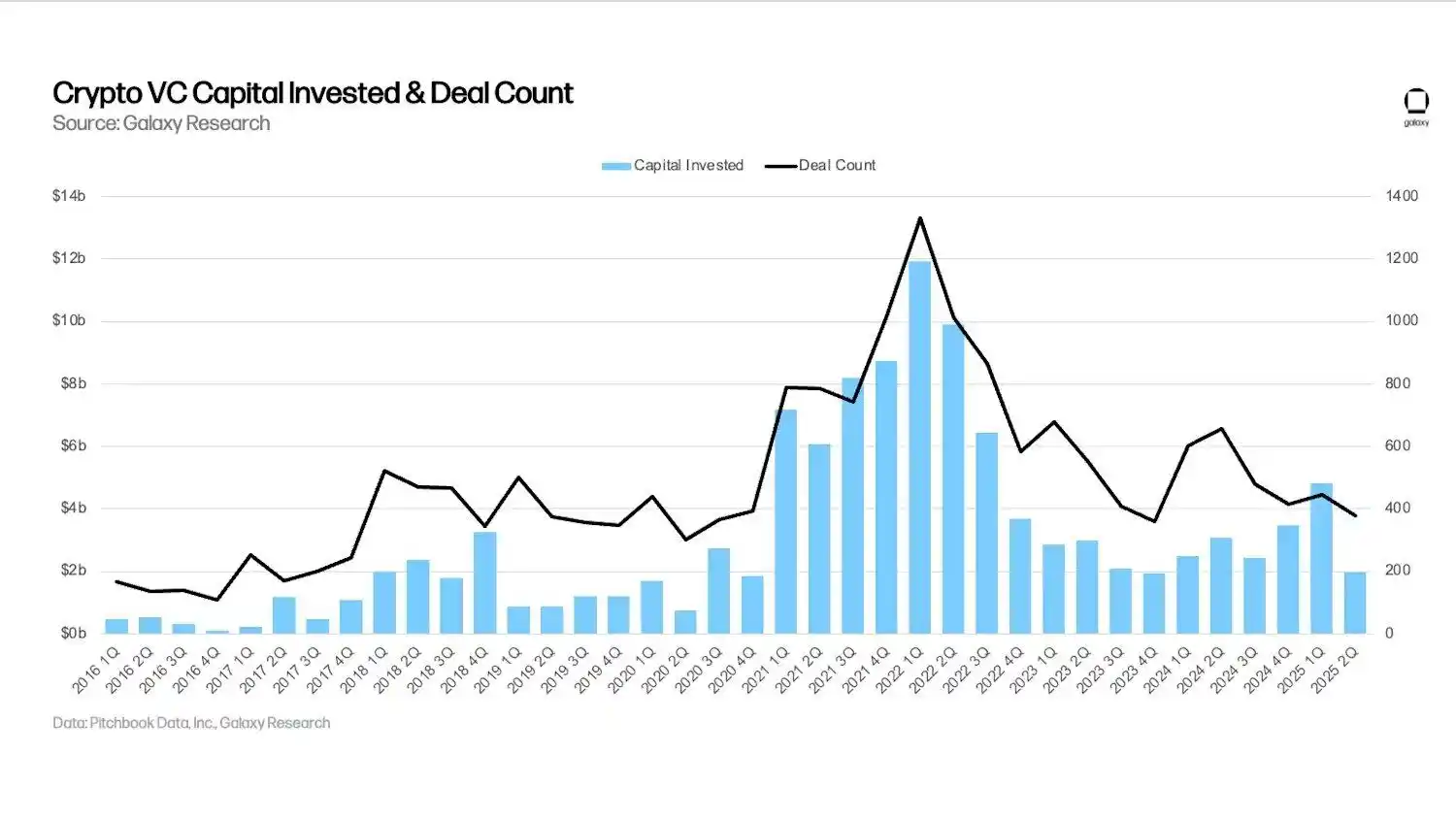
It's nearly impossible to build anything meaningful in 18 months; true infrastructure takes at least 3-5 years, and achieving product-market fit truly takes years, not quarters of iteration.
But if crypto founders stick to last year's narrative, they are wasting money, investors will leave, users will churn. Some investors will even force crypto founders to chase the current trend, and their team will start evaluating investments in projects that secured funding based on this quarter's hot narrative.
Sunk Cost Fallacy as a Survival Mechanism
The traditional business advice is not to fall into the sunk cost fallacy. If a project isn't working, pivot immediately. But the crypto space is deeply entrenched in it, using the sunk cost fallacy as a survival mechanism. Now, no one sticks around long enough to validate if what they're doing actually works — facing resistance, pivoting; slow user growth, pivoting; fundraising challenges, pivoting.
Every crypto founder faces this tradeoff:
· Keep building the existing product, maybe achieving success 2-3 years down the line. If lucky, you might secure another round of funding.
· Embrace the hot narrative: raise funds immediately, show superficial progress, and exit before anyone realizes it's not working.
In most cases, the second option wins out.
Projects Forever About to Be Completed
Few crypto projects ever truly complete what they set out to do in their roadmap. Most projects are always in a state of being "about to be completed." Always one feature away from achieving product-market fit. They never get there because halfway through, the winds shift, and overnight, finishing your DeFi protocol becomes irrelevant because everyone is talking about AI agents.
The market punishes completed projects. Because a finished product has its known limitations, while an "about to be completed" product still has infinite narrative potential.
Capital Chases Attention, Not Completion
In crypto, if you have a new narrative, you can raise $50 million even without a product; if the narrative is established, the product is live, you might struggle to raise even $5 million; if it's an old narrative, with a product and real users, then funding might not be possible at all.
Venture capitalists don’t invest in products; they invest in attention. Attention flows to new narratives, not established ones. Most teams now are solely focused on "narrative maximization," optimizing entirely for which story attracts funds, not caring about what they are actually doing. Completing a project boxes you in, while abandoning one keeps your options open.
Team Retention
If you're a crypto founder, when the new narrative arrives, your best engineers might get poached, receiving double the pay to join the latest hot project; your marketing director might be lured by a company that just raised a billion dollars. You can't compete because you abandoned the hot narrative six months ago to truly finish what you started.
No one wants to be part of a boring stable project. They want chaos, excess capital, projects that may fail but could also bring tenfold returns.
User Attention Span
Crypto users sometimes engage with a product simply because it's new, because everyone is talking about it, or because there might be an airdrop. Once the narrative shifts, they move on, and whether the product has improved, or if the requested features have been added, no one cares anymore.
In fact, we cannot build sustainable products for unsustainable users. Some crypto founders pivot so many times that even they forget the original mission.
Decentralized social network -> NFT marketplace -> DeFi aggregator -> Gaming infrastructure -> AI agent -> Prediction market... Transformation is no longer a strategic issue but has become the core of the entire business model.

Infrastructure Paradox
In the crypto space, the things that endure are mostly those that were established before cryptocurrency gained attention. Bitcoin emerged when no one cared, without VCs, and without an ICO. Ethereum was born before the ICO frenzy, before people could envision the future of smart contracts.
Most things born during hype cycles will fade with the end of the cycle, while those born before the cycle are more likely to succeed. Yet few will build before a narrative begins due to lack of funding, attention, and exit liquidity.
Why is This Hard to Change?
Token-based incentive structures create liquidity exit opportunities. As long as founders and investors can exit before the product matures, they will.
The speed of information and emotion spreading far exceeds the speed of construction. By the time a project is done, everyone knows how it turned out. The entire value proposition of the crypto industry is evolving rapidly, demanding slow evolution in a rapidly evolving sector is like expecting it to turn into something it was not meant to be.
This means that if you spend three years building a product, someone else can copy your idea and launch a product with worse code and better marketing strategy in three months. And then they win.
Cryptocurrencies struggle to build any long-term products because structurally they are at odds with long-term thinking.
You can be a principled founder, refuse to pivot, stay true to the original vision, take years instead of months to develop. But you are likely to go bankrupt, be forgotten, and eventually be replaced by those who pivoted three times while you were launching your first version.
The market does not reward completion, but it rewards constantly creating new things. Perhaps the true innovation in the crypto industry lies not in the technology itself, but in how to achieve the maximum value with the minimum input.
You may also like

How to Earn Up to 40% Rebates on Crypto Futures Trading (WEEX Trade to Earn IV Guide)
WEEX Trade to Earn IV lets traders earn up to 40% fee rebates in real time through a tiered miner system tied to trading activity. With additional boosts from referrals, it offers a more reliable alternative to airdrops as the crypto market gains momentum.

NVIDIA Plays Trillion-Dollar Chess Game | Rewire News Morning Edition

Real-time Update | NVIDIA GTC 2026 Conference Highlights Galore

People Behind Pokémon Go: Started with CIA's Money, Now Mapping the World for the Military AI

Huang Renxun GTC Speech Full Text: By 2027, Market Demand Will Exceed $1 Trillion; Everyone Should Develop an OpenClaw Strategy

Stratechery Debunks the AI Bubble Myth: What Should We Do with AI?
Three Charts to Watch at NVIDIA's GTC: Cheaper Compute, Spend More
BTC Eight Green Candles Reach $76K, What Is the Logic Behind Outperforming Gold in the Midst of Battle?

Morning Report | Strategy invested $1.57 billion last week to increase its holdings by 22,337 bitcoins; Abra plans to go public through a SPAC merger; Metaplanet aims to raise approximately $765 million to increase its bitcoin holdings
CB Insights: Nine Predictions for the Fintech Sector in 2026, with Asset Tokenization Already Becoming a Trend

Huang Renxun's full GTC speech: The era of inference has arrived, with revenue expected to reach at least one trillion dollars by 2027, and lobster is the new operating system

Trade Gold, Silver & Oil on WEEX: $300K Rewards and 0% Fees
WEEX has launched a large-scale Gold, Silver, and Oil trading campaign featuring 0% fees, a $300K reward pool, and Trade-to-Earn opportunities, allowing traders to deposit, trade tokenized commodities like PAXG and XAUT, and compete on leaderboards — all at WEEX.

WEEX P2P now supports KZT, UZS, AMD, GEL & MDL—Merchant Recruitment Now Open
To make crypto deposits easier, WEEX has officially launched its P2P trading platform and continues to expand fiat support. We're excited to announce that the Kazakhstani Tenge (KZT), Uzbekistani Som (UZS), Armenian Dram (AMD), Georgian Lari (GEL) and Moldovan Leu (MDL) are now available on WEEX P2P!

21Shares Enhances Crypto ETP Pricing with FTSE Partnership
Key Takeaways: 21Shares AG updates the pricing methodology for its Bitcoin and Ethereum-linked ETPs on the London Stock…

Alibaba AI Projects Crypto Value Surge for XRP, Bitcoin, and Ethereum by 2026
Key Takeaways: Alibaba’s AI predicts significant price increases for XRP, Bitcoin, and Ethereum by 2026’s end, driven by…

Ethereum USD Reclaims $2,200 Amidst Crypto Market Surge
Key Takeaways: Ethereum USD rebounds from $1,840 lows, reclaiming the $2,200 mark with a +19% recovery as of…

TRUMP Memecoin Investors Granted Exclusive Mar-a-Lago Invite
Key Takeaways: $TRUMP memecoin holders gain exclusive access to a Mar-a-Lago event featuring Donald Trump and other key…

Why Is Crypto Up: BTC USD Decoupling From Gold Amid Heated Israel-Iran Conflict
Key Takeaways: Bitcoin’s price recently hit $74,000, marking its highest close since February 2026 before slightly retracting to…
How to Earn Up to 40% Rebates on Crypto Futures Trading (WEEX Trade to Earn IV Guide)
WEEX Trade to Earn IV lets traders earn up to 40% fee rebates in real time through a tiered miner system tied to trading activity. With additional boosts from referrals, it offers a more reliable alternative to airdrops as the crypto market gains momentum.


 App
App