
- Buy Crypto
- Markets
 Futures
- Spot
- Copy Trade
- Earn
- More
Who Will Be the Biggest Winner of the x402 Trillion Race?

Original Title: Who Will Accrue the Most Value in the x402 Race?
Original Author: Yash
Original Translation: AididiaoJP, Foresight News
The x402 is now approaching its shining moment, referred to by a16z as a $30 trillion market.
As someone who has been following x402 since its inception, I began to ponder: if this market is truly massive, who will emerge as the biggest winner?
This article will not explain what x402 is, but will instead analyze its value accumulation and adoption from a practical standpoint.
The core value of x402 is to enable every API call to act as a payment transaction. Simply put, every button click can turn into a microtransaction.
x402 is not a technological innovation; it can be fully achieved through blockchain transactions. All the constraints of blockchain transactions, such as Gas fees, wallets, etc., equally apply to x402.
However, as a payment standard, it is powerful because it is compatible with the HTTPS protocol, enabling the entire Internet to support payment functionality.
Like all payment systems, x402 has four main stakeholders:
· API Sellers (Suppliers)
· API Buyers (Demanders)
· Intermediaries
· Underlying Chain and Tokens
1. Sellers (Suppliers)
Primarily divided into two categories:
· First-party / Second-party sellers (such as @switchboardxyz selling proprietary pricing data)
· Third-party sellers (such as selling @heliuslabs' RPC service through an API proxy)
For the first category of sellers, once the demand is significant, they have every reason to support x402, as it can help them tap into new markets.
For example, The New York Times could make its website x402-enabled, requiring web scraping bots to pay for access, thereby creating a new revenue stream.
Or when a platform like Airbnb supports x402, @perplexity_ai's AI agent can directly pay with USDC and automatically receive a commission in the same transaction.
The second type of seller often becomes an "API marketplace," integrating various APIs to provide users with convenient payment methods. Their profit model is arbitrage, such as paying a $20 fixed fee per month and then charging $0.0001 per call.
In the short term, intermediaries are motivated to build API marketplaces to solve the cold start problem (like @corbits_dev).
For sellers, the immediate opportunity is to upgrade existing APIs or websites to support x402, gaining additional revenue and traffic from network effects.
2. Buyer (Demand Side)
API consumers, especially "AI agents." Any user or agent with a wallet can pay API fees through x402.
This is the most challenging part of the entire chain to kickstart. It can be said that the current real demand is almost zero (most are spam transactions).
Stimulating demand has two avenues:
· Sellers exclusively provide data through x402 (e.g., a news website only allows paid crawling through x402)
· Provide enough APIs supporting x402 for agents and applications to easily use
I believe the key driver could be @Cloudflare (a member of the x402 Foundation, particularly focused on pay-per-request crawling). As the world's largest edge network/CDN service provider, Cloudflare deeply controls the distribution of network traffic (including APIs, content, and services).
They only need to flip a switch to enable x402 for specific content, allowing developers to earn additional revenue. (I guess it will initially be exclusive to Coinbase/Base, supporting NET USD payments).
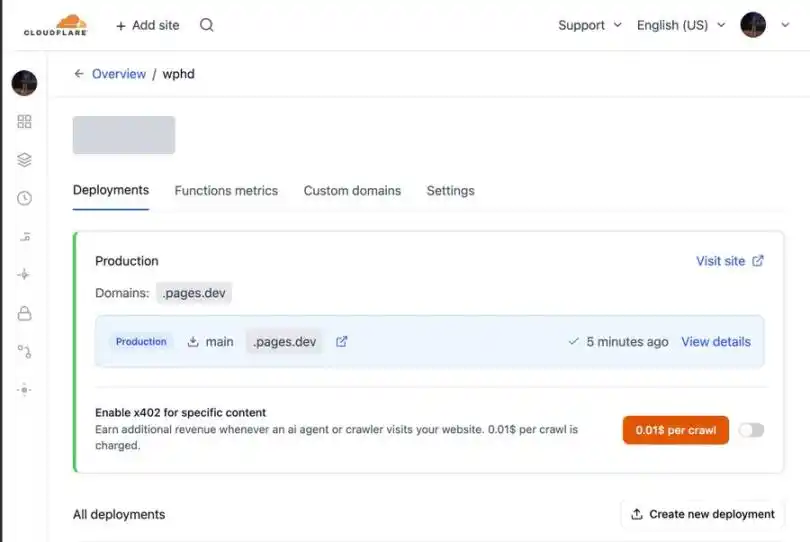
I have even conceptualized the interface design for Cloudflare to implement this functionality.
Business agents (such as ChatGPT, Shopify, etc.) will become the primary demand drivers for x402.
Important Note: Many people mistakenly believe that x402 can be transacted without a wallet, but x402 is not magic. It still fundamentally requires a wallet and blockchain transaction (including Gas fees), it's just that these elements are abstracted or can be batched off-chain through API calls.
3. Intermediaries
Similar to Visa and Mastercard, they route payments between API buyers and sellers. They usually charge a fee of 0-25 basis points (currently mostly free), but this is bound to be a price war as the barrier to entry for setting up intermediaries is low.
While Visa/Mastercard have strong moats, x402 intermediaries have almost no moat at all because the real network effects are all accumulated at the base layer blockchain. Large companies like Cloudflare or Google could easily launch their own intermediaries on chains like Solana or Base within a day, given they control the user interface.
Giants like Coinbase may even open-source and offer intermediary services for free to further squeeze profit margins in order to promote ecosystem growth.
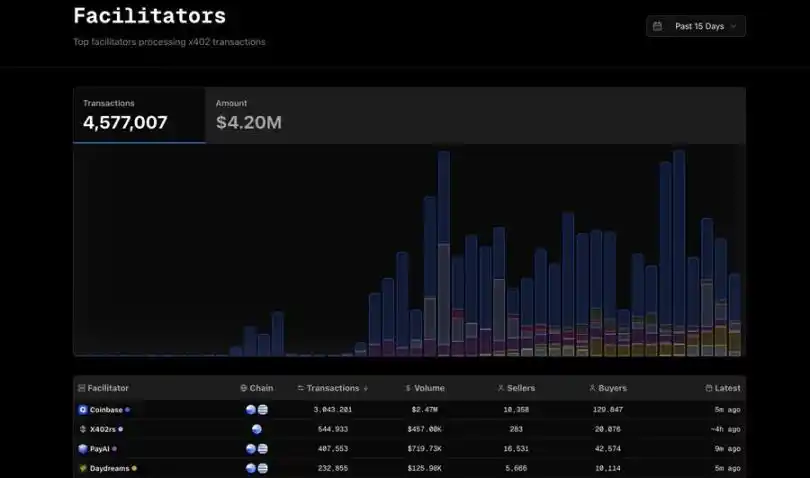
Some of the major x402 intermediaries currently include: @CoinbaseDev, @x402rs, and @PayAINetwork.
4. Public Chains and Tokens
As a key project of @coinbase, @base (and USDC) is naturally the most prominent chain. However, other public chains like @SolanaFndn (host of the x402 hackathon) are also making a strong push.
All stablecoins and public chains will strive for dominance in x402 since this directly boosts on-chain TVL (by increasing stablecoin lock-up and transaction volume).
It will be interesting to see how stablecoin chains like @tempo and @arc integrate x402 into enterprise development toolkits.
In my view, public chains, tokens, and wallets will capture the most value in the x402 ecosystem.
Coinbase and @brian_armstrong's vigorous promotion of x402 is for a reason. Coinbase controls the entire tech stack:
· Custodial Data Provider (CDP)
· Mainnet (Base)
· Stablecoin (USDC)
· Wallet (Base App and Coinbase Embedded Wallet)
They can directly provide end-to-end solutions to enterprise clients (such as Cloudflare, Vercel) while keeping the core protocol open-source.
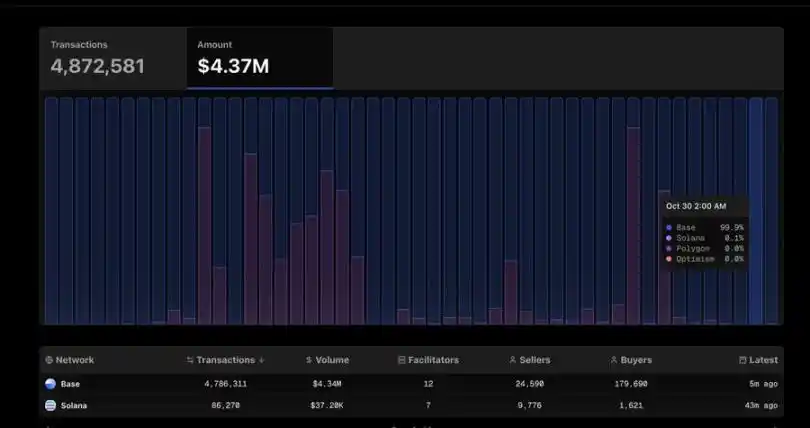
Base is currently far ahead, but it's just the beginning.
Large companies like Stripe are likely to launch their own x402-like protocols or run x402 payments on their private chains (such as @tempo). Additionally, on chains like @solana or @base, large-scale micropayments are currently not economical.
For example, on Solana, due to base fee + priority fee, any payment below $0.1 is not cost-effective, and payment transactions need to compete for resources with speculative transactions (such as Memecoin exchanges). I admire Tempo's design, which provides a dedicated channel for payment transactions.
It is foreseeable that with the widespread adoption of x402, there will definitely be sidechains / appchains / Rollup solutions specifically for handling x402 payments.
Capture of Value by Interfaces and Wallets
It goes without saying that the party that controls traffic entry and user interfaces will capture the most value, whether it is a platform / marketplace, AI chat application, AI browser, and so on.
In the internet domain, browsers occupy most user attention and are naturally suitable for integrating x402 and controlling the wallet layer.
Imagine a Chrome browser with a native built-in wallet, where every click could trigger x402 payments. Any API only needs to pass through a secure whitelist review to complete payments directly when needed.
Browsers can easily collect a 0.05% transaction fee, and users are willing to pay for convenience.
However, Stripe is x402's biggest competitor!
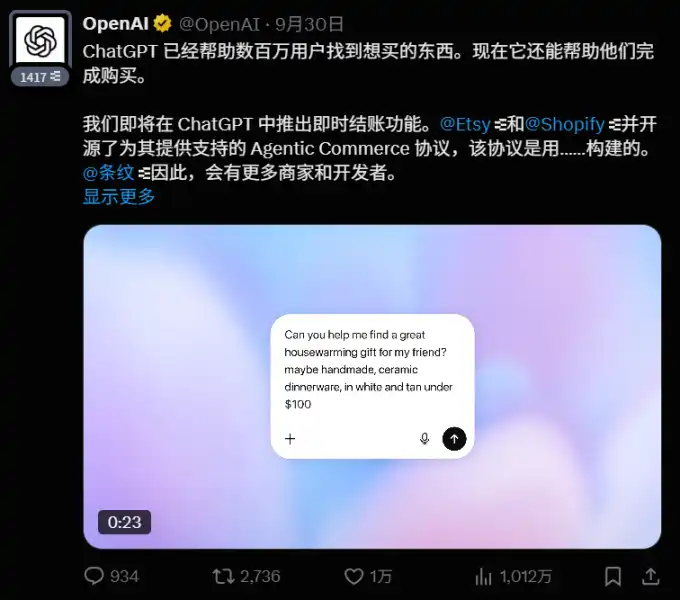
For example, the largest consumer AI application ChatGPT announced the implementation of its business functions through @Stripe. Stripe has its own Agent Commerce Protocol (ACP) and processes payments on existing credit card networks through shared payment tokens.
x402 and Dynamic Resource Pricing
x402 excels at handling fixed pricing (such as "0.001 USD per API call"), but it has failed to fully realize the true potential of blockchain: creating a market for everything.
I believe x402's uniqueness lies in achieving a "resource market." These resources can be:
· Data or results (such as price, news)
· Computing power or specific operational reasoning (such as booking a flight)
· Complex workflows (such as a custom chair)
· Priority services (such as time slots or reserved bandwidth)
Historically, market mechanisms have solved the information coordination problem, with prices naturally reflecting supply and demand.
Now, imagine a future where you tell an AI agent, "Customize a chair for me based on these specifications for $500."
This agent autonomously coordinates multiple resources: procuring wood, hiring a carpenter, arranging delivery—all automated, completely solving the resource coordination problem.
Thanks to large language models and AI agents, we now have machines capable of reasoning and negotiating throughout the entire supply chain. This will drive hyper-monetization, dynamic market formation, real-time pricing for every resource and action, with AI agents seamlessly transacting and paying behind the scenes.
Although x402 itself does not support dynamic pricing, blockchains like Solana can through permissionless market creation mechanisms.
Imagine if every Airbnb host had a dynamic market, where prices are no longer fixed by hosts but entirely determined by market demand. This is the world we are moving towards.
x402 Development Prospects
I look forward to x402 and the endless possibilities it brings.
However, it has indeed been overhyped, and if you're looking to invest in x402 tokens, 99% of them are just vaporware.
Despite my short-term skepticism, I am extremely optimistic in the long run: x402 will undoubtedly become the foundational technology of the agent-based internet and be deeply integrated into the crypto network.
x402 reminds me of Solana Blinks, where every click could trigger a Solana transaction, although Blinks failed to take off back then.
But this time is different. We have the giant @coinbase leading the way, and if successful, we will forever change the way payments work on the internet!
Summary
The party controlling the flow of traffic onboarding and the user interface (as well as the asset/mainchain) stands to gain the most value in the x402 ecosystem. This is why Coinbase is going all-in, as it owns the end-to-end full tech stack.)
The SendAI team (especially @_0xaryan) has been closely following x402 developments since May 2025 and has actively collaborated with @vercel to contribute to the x402-mcp project (which added @solana support for a specific use case).
In the future, we will integrate the entire x402 tech stack into broader infrastructure and applications.
You may also like

How to Earn Up to 40% Rebates on Crypto Futures Trading (WEEX Trade to Earn IV Guide)
WEEX Trade to Earn IV lets traders earn up to 40% fee rebates in real time through a tiered miner system tied to trading activity. With additional boosts from referrals, it offers a more reliable alternative to airdrops as the crypto market gains momentum.

NVIDIA Plays Trillion-Dollar Chess Game | Rewire News Morning Edition

Real-time Update | NVIDIA GTC 2026 Conference Highlights Galore

People Behind Pokémon Go: Started with CIA's Money, Now Mapping the World for the Military AI

Huang Renxun GTC Speech Full Text: By 2027, Market Demand Will Exceed $1 Trillion; Everyone Should Develop an OpenClaw Strategy

Stratechery Debunks the AI Bubble Myth: What Should We Do with AI?
Three Charts to Watch at NVIDIA's GTC: Cheaper Compute, Spend More
BTC Eight Green Candles Reach $76K, What Is the Logic Behind Outperforming Gold in the Midst of Battle?

Morning Report | Strategy invested $1.57 billion last week to increase its holdings by 22,337 bitcoins; Abra plans to go public through a SPAC merger; Metaplanet aims to raise approximately $765 million to increase its bitcoin holdings
CB Insights: Nine Predictions for the Fintech Sector in 2026, with Asset Tokenization Already Becoming a Trend

Huang Renxun's full GTC speech: The era of inference has arrived, with revenue expected to reach at least one trillion dollars by 2027, and lobster is the new operating system

Trade Gold, Silver & Oil on WEEX: $300K Rewards and 0% Fees
WEEX has launched a large-scale Gold, Silver, and Oil trading campaign featuring 0% fees, a $300K reward pool, and Trade-to-Earn opportunities, allowing traders to deposit, trade tokenized commodities like PAXG and XAUT, and compete on leaderboards — all at WEEX.

WEEX P2P now supports KZT, UZS, AMD, GEL & MDL—Merchant Recruitment Now Open
To make crypto deposits easier, WEEX has officially launched its P2P trading platform and continues to expand fiat support. We're excited to announce that the Kazakhstani Tenge (KZT), Uzbekistani Som (UZS), Armenian Dram (AMD), Georgian Lari (GEL) and Moldovan Leu (MDL) are now available on WEEX P2P!

21Shares Enhances Crypto ETP Pricing with FTSE Partnership
Key Takeaways: 21Shares AG updates the pricing methodology for its Bitcoin and Ethereum-linked ETPs on the London Stock…

Alibaba AI Projects Crypto Value Surge for XRP, Bitcoin, and Ethereum by 2026
Key Takeaways: Alibaba’s AI predicts significant price increases for XRP, Bitcoin, and Ethereum by 2026’s end, driven by…

Ethereum USD Reclaims $2,200 Amidst Crypto Market Surge
Key Takeaways: Ethereum USD rebounds from $1,840 lows, reclaiming the $2,200 mark with a +19% recovery as of…

TRUMP Memecoin Investors Granted Exclusive Mar-a-Lago Invite
Key Takeaways: $TRUMP memecoin holders gain exclusive access to a Mar-a-Lago event featuring Donald Trump and other key…

Why Is Crypto Up: BTC USD Decoupling From Gold Amid Heated Israel-Iran Conflict
Key Takeaways: Bitcoin’s price recently hit $74,000, marking its highest close since February 2026 before slightly retracting to…
How to Earn Up to 40% Rebates on Crypto Futures Trading (WEEX Trade to Earn IV Guide)
WEEX Trade to Earn IV lets traders earn up to 40% fee rebates in real time through a tiered miner system tied to trading activity. With additional boosts from referrals, it offers a more reliable alternative to airdrops as the crypto market gains momentum.


 App
App