Which Crypto Exchanges Offer Verifiable Protection Funds? What to Check, With WEEX as an Example

 Prefer us on Google
TL;DR
- Verifiable means checkable. A public wallet address, a balance you can look up on a block explorer, written eligibility terms and a stated claim process.
- A protection fund is not Proof of Reserves. Proof of Reserves shows the assets an exchange holds against customer balances. A protection fund is a separate pool for specific losses, subject to terms.
- It is not insurance either. A protection fund is the exchange's own money, paid out under its own rules, with no legal guarantee and no regulator enforcing it.
- WEEX's 1,000 BTC Protection Fund. Its wallet address is published, its covered and excluded cases are listed, and claims must be reported within 30 days.
- Read dates and terms. Balances change, and eligibility decides what is actually covered.
What Is a Protection Fund, and How Does It Differ From Proof of Reserves?
Safeguard | What it is | What it can tell you |
Protection fund | A pool the exchange sets aside for specified losses | How much is set aside and under which terms |
Proof of Reserves | A snapshot of reserves against customer balances | Whether reserves cover user holdings on a date |
Derivatives insurance fund | A pool that absorbs shortfalls in liquidated leveraged positions | How trading losses beyond margin are handled |
Government deposit insurance | A statutory scheme for eligible bank deposits | Usually does not apply to exchange balances |
What Makes a Protection Fund “Verifiable”?
- A public wallet address. The exchange publishes the address, not just a headline amount.
- An on-chain balance. You can look the address up on a block explorer and see the holdings yourself.
- Matching addresses across pages. The address on the fund page, the transparency hub and any announcements is the same.
- Written eligibility and exclusions. The terms say which losses qualify and which do not.
- A claim process with a deadline. The exchange names a channel and a time limit.
- Dates and disclosure. Balances, reserve data and updates carry a date, so you can see when they were last checked.
Which Crypto Exchanges Publish a Protection Fund?
| Exchange | Fund | Disclosed size | How it can be verified | Note |
| Binance | SAFU | 15,000 BTC as of February 2026, according to Binance's site | Binance publishes the SAFU wallet addresses, so the balance can be watched on-chain | Company-funded and not commercial insurance |
| Bitget | Protection Fund | A committed minimum of $300 million; about $351 million on average in July 2026 | Reported alongside monthly Proof of Reserves updates | An exchange-established reserve, not equivalent to a statutory guarantee |
| WEEX | WEEX 1,000 BTC Protection Fund | 1,000 BTC | Public wallet address on the Trust Center and Protection Fund page | Covered and excluded cases listed; claims within 30 days |
How Does WEEX's 1,000 BTC Protection Fund Measure Against the Checklist?
Check | WEEX documentation | Where to see it |
Public wallet address | Published | |
On-chain balance | Look up the address on a block explorer | |
Matching addresses | The same address appears on the Trust Center and the fund page | |
Eligibility | Losses that occur through no fault of the user | |
Exclusions | Trading losses, fraud or abuse, cases where a user is tricked into or mistakenly authorizes a transaction, and apparent unauthorized transactions with no external transfer | |
Claim process | Contact support@weex.com within 30 days of the incident | |
Funding and separation | Held separately from operational funds and backed by the platform rather than an external insurer | |
Dates | Balance and reserve snapshots carry dates |
bc1qeg5xn5plttr7w045apm92yx08c2swc6yw2vtj7. Always reach it from WEEX's official Trust Center rather than from a message, and confirm that the address you open matches.How Do You Check WEEX's Protection Fund Yourself?
- Open the WEEX Trust Center and select BTC Protection Fund.
- Follow the Verify or Wallet link to check the fund’s balance on-chain. You can also access the wallet from the WEEX Protection Fund page.
- Read the address and the balance on the block explorer, and note the date.
- Read the terms: who qualifies, what is excluded, and how to claim within 30 days.
- Check Proof of Reserves separately. Confirm the snapshot date and the asset you hold.
- Verify any contact before acting on a message, using the Contact Verifier.
What Does a Protection Fund Not Do?
- It does not cover trading losses. Market movement and leverage losses are outside it. WEEX's own page excludes them.
- It does not guarantee reimbursement. Eligibility is assessed against the terms.
- It is not insurance. There is no external underwriter or regulator behind it.
- It does not replace Proof of Reserves, or security practices of your own, such as passkeys, two-factor authentication and withdrawal whitelists.
- Its size is not a measure of sufficiency. A larger or smaller fund says little about whether it would be enough for a given incident. Balances and terms can change.
What Should You Ask Any Exchange About Its Protection Fund?
- Is the wallet address published, and does it match across the exchange's pages?
- What is the balance today, and how often is it updated?
- Which losses are covered, and which are excluded?
- How do I make a claim, and by when?
- Who funds it, and is it held separately from operating funds?
- Is it insurance, or the exchange's own discretionary reserve?
FAQ
Which crypto exchanges offer a protection fund?
Does WEEX have a protection fund?
Can I verify WEEX's Protection Fund on-chain?
What does the WEEX Protection Fund cover?
How do I make a claim?
Is the WEEX Protection Fund insurance?
Is Proof of Reserves the same as a protection fund?
Does the protection fund cover liquidations or trading losses?
Is WEEX safe?
About WEEX
Follow WEEX on social media
This content is provided for general informational purposes only and doesn't constitute financial, investment, legal, or tax advice. Any events, rewards, online promotions, or related information mentioned herein should not be considered a recommendation, solicitation, or invitation to purchase, sell, trade, or otherwise deal in any crypto assets. Crypto assets are highly volatile and may result in loss. The availability of WEEX services, products, and related events may vary by region. You are responsible for ensuring that your participation is in accordance with applicable local laws and regulations.
You may also like
WEEX WWFC 2026: Schedule, 5M USDT Prize Pool & How to Join

Did My Order Go Through? How to Check After a WEEX API or AI Trading Tool Timeout
A timeout tells you the tool didn't receive confirmation in time. It doesn't tell you whether the exchange accepted the order or how much was filled. If the first order is still open, a second one could leave you buying or selling more than you intended.

Fidelity Files for a Spot Chainlink ETF (FLNK): What Does It Mean for LINK's Price?
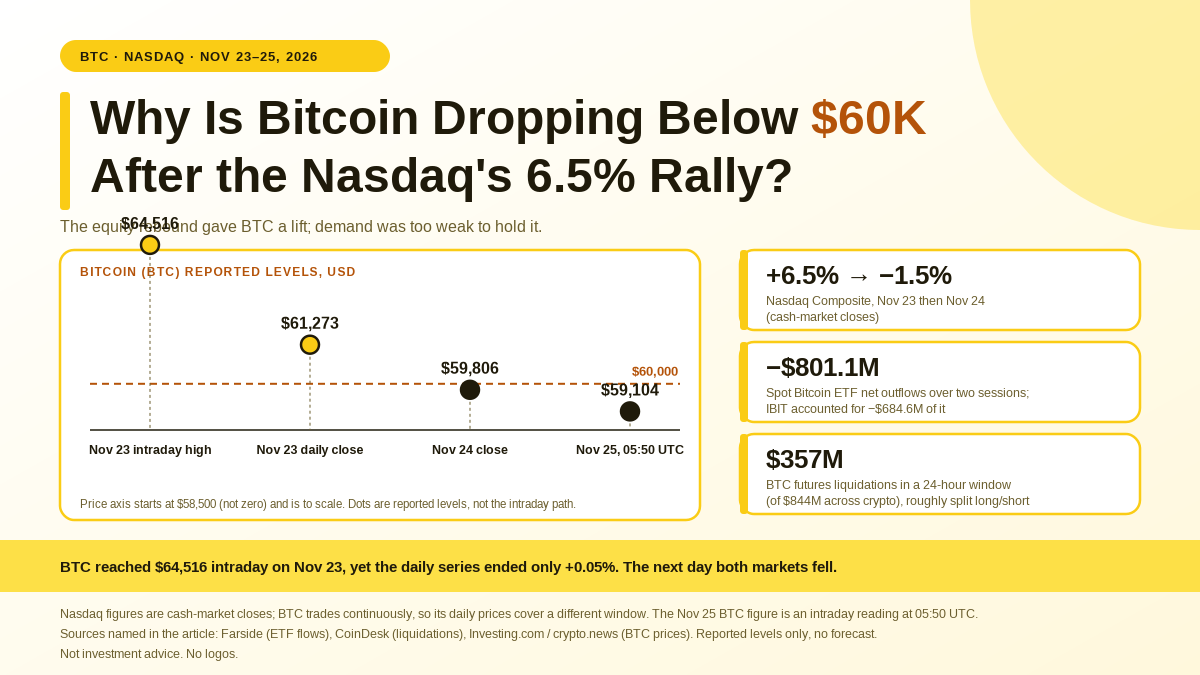
Why Is Bitcoin Dropping Below $60K After the Nasdaq’s 6.5% Rally?
Why is Bitcoin dropping below $60,000 after the Nasdaq rallied 6.5%? See what $801.1 million in ETF outflows, exchange flows, and liquidations reveal.

Fidelity Lists AAVE, LINK and UNI: How Do Crypto Trading Fees Compare?

PCE Inflation (Nov 25) Preview: What to Watch for the Fed, Stocks, Bitcoin and Gold

CFTC Allows Bitcoin and Ethereum as Operating Reserves: Will It Boost Crypto Markets?

Why Did Nvidia Stock Skyrocket 31% After Jensen Huang Was Reinstated? Can the Rally Last?
Rivian Q3 Revenue Rises 38% as R2 Leads Deliveries, but Shares Hit a 52-Week Low

Baidu Q3 2026: AI Cloud Growth Fails to Offset Ad Decline as Shares Hit a 52-Week Low
McDonald’s (MCD) Outlook: Earnings Beat and Value-Menu Strategy

WEEX Futures Liquidations Explained: Mark Price, Margin Tiers and Chart Wicks
Does WEEX really have a 1,000 BTC Protection Fund?

Anthropic IPO Hits Record $81.34B: Will ANT Stock Follow SpaceX’s Post-IPO Path?

Before Trading Futures on WEEX: What to Check About Security and KYC
Before you deposit, there is another question worth asking. WEEX may need to verify who you are. What can you verify about WEEX? A reserve snapshot, a public fund address and a futures eligibility rule each answer a different part of that question.

Bitcoin Near $63K Amid Extreme Fear: Why Is Solana Still Attracting Traders With $1.5B in DEX Volume?
Starbucks (SBUX) Near Its Highs: Comparable-Sales Rebound and Turnaround Progress

Airbnb (ABNB) Earnings: Faster Growth, Buybacks, and an AI Travel Assistant

Amex (AXP) Outlook: Stable Credit, AI Cost Savings, and Premium Growth
BlackRock (BLK): ETIF Innovation, AUM Growth, and Valuation
Quantinuum (QNT): Revenue Growth, Quantum Partnerships, and Valuation Risks

Anthropic IPO: What Could It Mean for Stocks and Bitcoin?
Does an AI Trading Tool Need Permission to Place Orders on WEEX?

Why Is Bitcoin Falling? BTC Near $64K as Anthropic IPO Looms

Coherent (COHR) Stock Volatility: AI Optics Growth and Cash-Flow Pressure
Applied Materials (AMAT) Earnings Hit Records, but Shares Remain Under Pressure
BitMine (BMNR) Stock Under Pressure: Ethereum Holdings, Accounting Losses, and Treasury Discount

PayPal (PYPL) Stock Rebound: Earnings Guidance, Buybacks, and Business Transformation

MVLL ETF Sell-Off: MRVL Weakness and 2x Leverage Decay
Fluence Energy (FLNC) Stock Under Pressure: Leadership Changes, Factory Delays, and Backlog Execution
WEEX WWFC 2026: Schedule, 5M USDT Prize Pool & How to Join
Did My Order Go Through? How to Check After a WEEX API or AI Trading Tool Timeout
A timeout tells you the tool didn't receive confirmation in time. It doesn't tell you whether the exchange accepted the order or how much was filled. If the first order is still open, a second one could leave you buying or selling more than you intended.
Fidelity Files for a Spot Chainlink ETF (FLNK): What Does It Mean for LINK's Price?
Why Is Bitcoin Dropping Below $60K After the Nasdaq’s 6.5% Rally?
Why is Bitcoin dropping below $60,000 after the Nasdaq rallied 6.5%? See what $801.1 million in ETF outflows, exchange flows, and liquidations reveal.
Fidelity Lists AAVE, LINK and UNI: How Do Crypto Trading Fees Compare?
PCE Inflation (Nov 25) Preview: What to Watch for the Fed, Stocks, Bitcoin and Gold
Latest articles




Latest coin listings on WEEX



