
- Buy Crypto
- Markets
 Futures
- Spot
- Copy Trade
- Earn
- More
USDe issuance plummets by $6.5 billion, but Ethena faces an even bigger issue

Original Title: "USDe Issuance Shrinks by $6.5 Billion, but Ethena Faces Bigger Challenges"
Original Author: Azuma, Odaily
Ethena is undergoing its largest funding outflow since its inception.
On-chain data shows that Ethena's primary stablecoin product, USDe's circulating supply, has dropped to 8.395 billion tokens, a reduction of approximately 6.5 billion tokens from its peak of nearly 14.8 billion tokens in early October. Although not quite a "halving," the decrease is still significant.
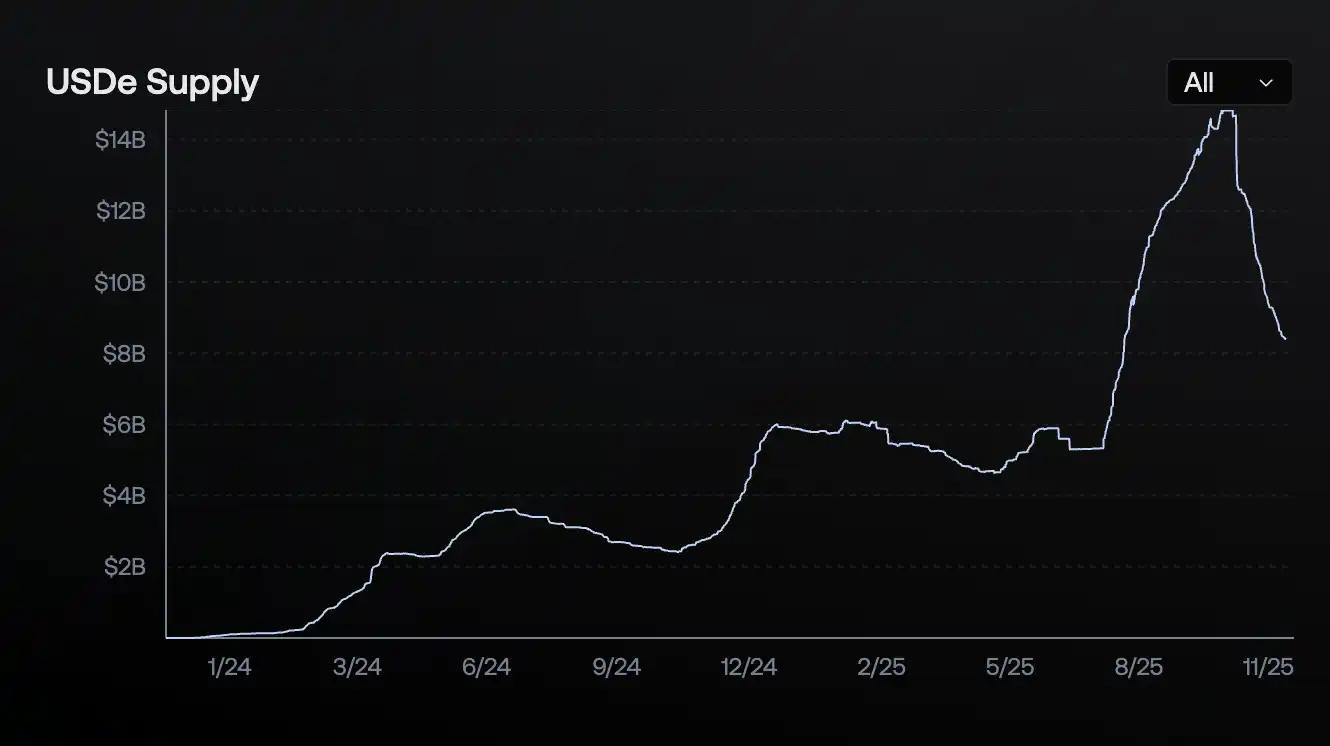
Coinciding with recent DeFi security incidents, especially two yield-bearing stablecoins, Stream Finance (xUSD) and Stable Labs (USDX), which claim to use a similar Delta neutral model as Ethena, collapsing in succession. Rumors suggest that the trigger for these collapses was the neutral balance breaking on October 11 due to CEX's ADL during the market crash, coupled with USDe's vivid memory of briefly deviating from its peg on Binance. Currently, there is a widespread FUD surrounding Ethena.
Is USDe Still Safe?
Given Ethena's current market size, if any unexpected event were to occur, it could potentially brew a black swan event comparable to Terra's back in the day... So, is Ethena in trouble? Is the fund outflow merely driven by risk aversion? Can you still confidently deploy funds into USDe and its derivative strategies?
Jumping to a conclusion, I personally tend to believe: Ethena's current strategy is still operating normally; while risk aversion in DeFi has exacerbated Ethena's outflow to some extent, it is not the main reason; USDe's current security situation remains relatively stable, but it is advisable to avoid leveraging too much.
The reason for acknowledging Ethena's current operational status mainly lies in two points.
Firstly, unlike most yield-bearing stablecoins that do not provide clear disclosures on position structure, leverage multiples, hedging exchanges, and liquidation risk parameters, Ethena can be said to be an industry benchmark in transparency. You can directly see reserve information and proofs, position distribution and percentages, implementation yield status, and other elements clearly on the Ethena website.
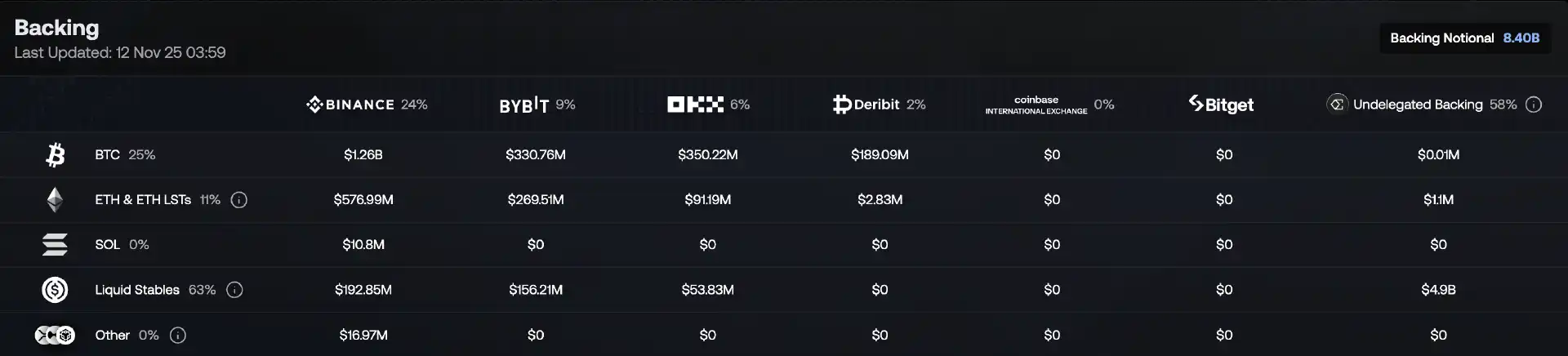
The second point is the issue of ADL mentioned earlier that causes imbalance in neutral strategy. There are rumors that Ethena has signed ADL exemption agreements with some exchanges, but this has never been confirmed, so let's not dwell on it for now. Even without exemption clauses, Ethena is essentially less susceptible to ADL impact. This is because from its public strategy, it can be seen that Ethena basically only selected BTC, ETH, and SOL as hedge assets (BNB, HYPE, XRP have a very small proportion), and these three major assets had relatively small fluctuations during the major crash on October 11. The counterparty's capacity to bear risks is also greater. ADL is actually more likely to occur in the highly volatile altcoin market where the counterparty's capacity to bear risks is smaller. Therefore, the ones that are most likely to suffer major losses at present are those protocols that are not transparent enough (possibly their strategy is too aggressive compared to the plan, or even not neutral at all).
As for the main reasons for the outflow of funds from Ethena, it can also be attributed to two points. First, as market sentiment has cooled down (especially after October 11), the basis arbitrage space between the futures and spot markets has narrowed, causing the protocol's yield and sUSDe annualized yield (as of the time of writing, it has dropped to 4.64%) to decrease simultaneously, making it less advantageous compared to mainstream lending markets such as Aave and Compound. As a result, some funds have chosen other paths for interest generation. Second, the price volatility of USDe on Binance on October 11 has raised market awareness of the risks associated with flash loans. In addition, the decrease in yields on both the off-chain (CEX subsidy reduction) and on-chain ends has led to a large amount of funds unwinding flash loans and withdrawing funds.
Based on the above logic, we believe that Ethena and USDe still maintain a relatively stable operational state. Although this round of fund outflows has exceeded expectations to some extent due to extreme market conditions and security incidents, the main reason can still be attributed to the decrease in attractiveness caused by the narrowing of arbitrage opportunities in a subdued market sentiment. This is precisely determined by Ethena's design logic—affected by market environment fluctuations, the protocol's yield and fund attractiveness will also fluctuate in sync.
A More Severe Test: Scalability
Compared to the phased outflow of funds, the even more severe issue facing Ethena is that its Delta-neutral model relying on the perpetual contract market seems to have reached a bottleneck in terms of scalability.
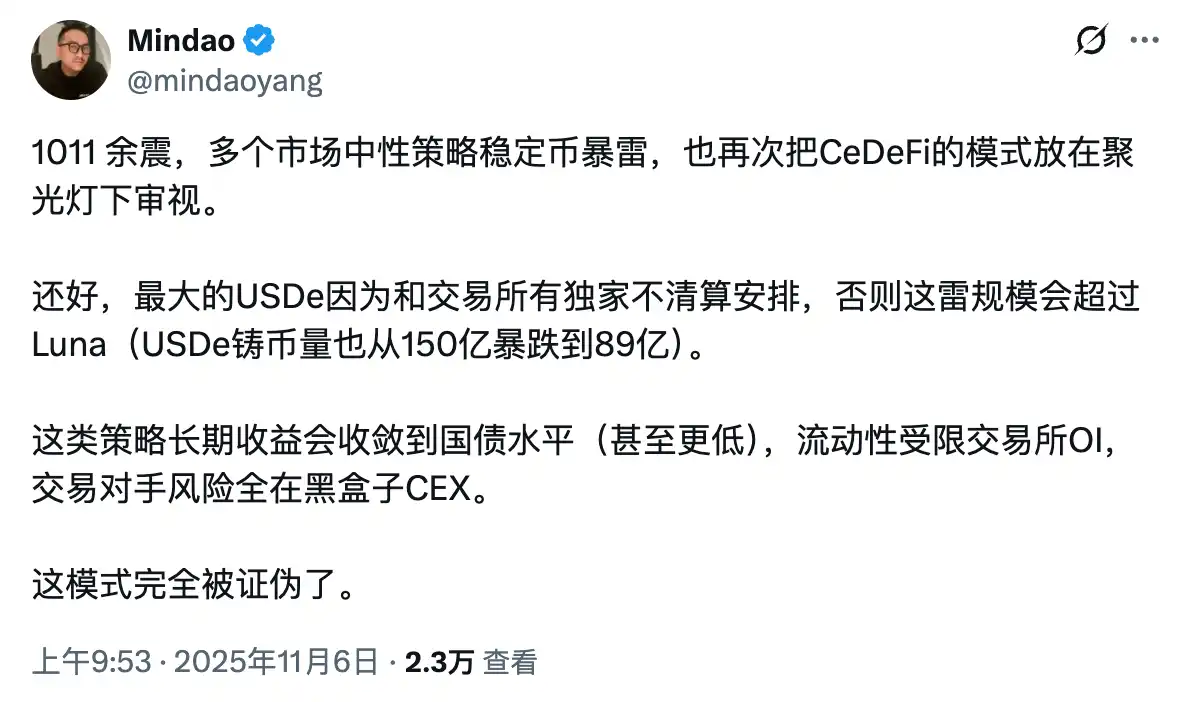
On November 6, DeFi expert Mindao commented on the recent stablecoin liquidity crisis related to the neutral strategy, stating: "The long-term returns of such strategies will converge to the level of government bonds (or even lower), with liquidity constrained exchanges' Open Interest (OI), and counterparty risks all concentrated in the black box CEX. This model has been completely falsified... They cannot scale and will ultimately only be niche financial products, unable to compete with fiat-backed stablecoins."
This is akin to "The Truman Show," where Ethena once thrived in a small, limited-scale world but was confined by factors such as perpetual contract market size, exchange liquidity, infrastructure, etc., while the targets Ethena aspired to challenge, USDT, existed in the unrestricted larger world outside. Perhaps this inherent environmental growth difference is the greatest challenge that Ethena faces.
You may also like

The Rise of Crypto Passive Income: How Auto Earn Unlocks the Hidden Value of Idle Crypto
Discover how Auto Earn helps investors turn idle crypto into crypto passive income. Learn why Auto Earn is becoming a popular strategy in the evolving Web3 economy.

Tron Industry Weekly Report: Risk aversion intensifies but Strategy increases BTC holdings, detailed explanation of the Agent payment protocol PAN Network based on x402 and ERC-8004

March 16 Key Market Intel - A Must-See! | Alpha Morning Report

Google's biggest acquisition ever, why Wiz?
「1011 Insider Whale」 Agent Garrett Jin: After the Houthi blockade, who will run out of steam first?

Vitalik Revisits Ethereum Beacon Chain Architecture, Claude's Off-Peak Transaction Limit Doubled, What Are English-Speaking Communities Discussing Today?

$90 Million Black Hole: War, Power, and the Crypto-Tragedy of the Middle East

The price difference exceeds 50%, and the pre-market arbitrage market for cryptocurrency stocks will become a new business in the crypto bear market

How to Trade Crude Oil: Market Volatility Creates New Opportunities for Crypto Traders
Oil prices are back in focus as geopolitical tensions and supply shifts reshape global markets. Learn how crude oil trading works and explore a $30,000 trading campaign on WEEX.

OpenClaw and AI Bots: From AI Trading to BTC Liquidations in the Crypto Gold Rush
AI crypto trading bots like OpenClaw and AI trading apps are reshaping digital markets. From BTC liquidations to crypto bubble charts, automated trading is expanding alongside free crypto airdrops, affiliate programs, LALIGA partnerships, and tokenized gold markets.

Michael Saylor's advice to young people: read more history and science fiction, and use AI to accelerate personal growth

Morning Report | USDC issuance increased by approximately 1.7 billion in one week; Aave will launch the Aave Shield feature; total circulation of Ethereum is approximately 121.53 million

Circle CEO's latest interview: Stablecoins are not crypto assets

Crypto ETF Weekly | Last week, the net inflow for Bitcoin spot ETFs in the U.S. was $763 million; the net inflow for Ethereum spot ETFs in the U.S. was $160 million
This Week's Key News Preview | The Federal Reserve Announces New Interest Rate Decision; The U.S. Releases February PPI Data

From Human Strategy to AI Trading Bot: How Shadow Trading AI Won 2nd Place in the WEEX Hackathon
Ivan’s Shadow Trading AI secured second place in the WEEX AI Trading Hackathon, demonstrating how AI trading systems built on real market expertise can perform under live market conditions.
Circle CEO’s Insight: The Future of Stablecoins and Digital Financial Platforms
Key Takeaways: Circle completed a noteworthy IPO in 2025, signifying a major milestone in the crypto space. The…

NVIDIA GTC 2026 Set to Gather Global Tech Enthusiasts
Key Takeaways: NVIDIA GTC 2026 will occur in San Jose from March 16-19, bringing together over 30,000 participants.…
The Rise of Crypto Passive Income: How Auto Earn Unlocks the Hidden Value of Idle Crypto
Discover how Auto Earn helps investors turn idle crypto into crypto passive income. Learn why Auto Earn is becoming a popular strategy in the evolving Web3 economy.


 App
App