
Timeline | Bybit Loses Over 500K ETH in Hack, $1.5 Billion Loss





On the early morning of February 22, on-chain detective Zachxbt detected a suspicious fund outflow incident on Bybit. Subsequent on-chain records showed that a multisig address controlled by Bybit transferred out $1.5 billion worth of ETH and used a DEX to convert LSD assets into native ETH. Possibly due to FUD sentiment, Ethereum briefly dropped below $2,700; Bybit's native platform token MNT briefly fell below $0.9, with a 24-hour decrease of 7.71%.
Bybit CEO Ben Zhou quickly responded, stating that indeed a hacker had control of a specific ETH cold wallet, but the rest of the cold wallets are secure and withdrawals are functioning normally. Ben Zhou also emphasized that Bybit has the ability to make payment and can bear this loss. BlockBeats will continue to monitor and provide real-time updates, as outlined in the timeline below:
Bybit CEO: Will Soon Host a Livestream to Address All Questions
On February 22, Bybit CEO Ben Zhou posted an update on Platform X stating, "I will soon start a livestream to answer all questions!! Please stay tuned."
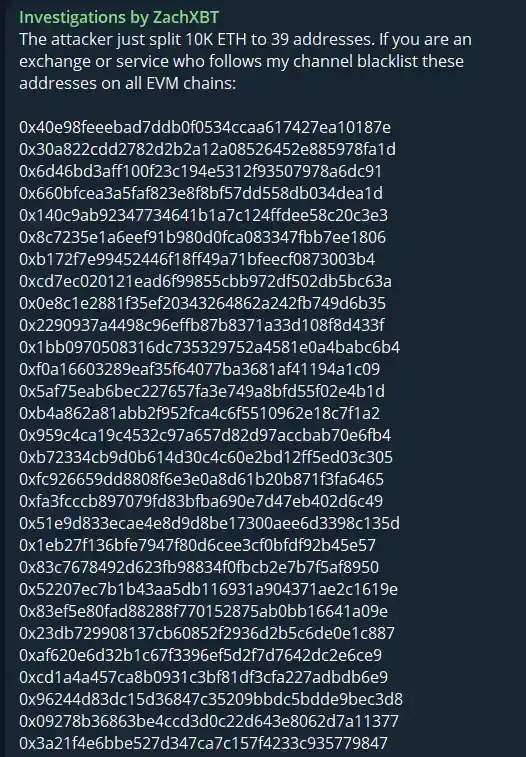
ZachXBT: Bybit Hacker Has Distributed 10,000 ETH to 39 New Addresses, Urging All Parties to Blacklist Promptly
On February 22, ZachXBT stated that the Bybit hacker had just distributed 10,000 ETH to 39 new addresses. "If you are an exchange platform or service provider, please blacklist these addresses on all EVM chains."
SlowMist Founder: Bybit Hacker's Attack Method Similar to North Korean Hackers
On February 22, SlowMist founder COSMOS published a post saying, "Although there is no direct evidence at the moment, based on the Safe multisig approach and the current laundering method, it resembles North Korean hackers."
Bybit CEO: Platform Withdrawals Operating Normally, Other Cold and Hot Wallets Not Affected; Bybit has Payment Ability and Can Bear This Loss
On February 22, Bybit CEO Ben Zhou posted an update saying that Bybit's hot wallets, warm wallets, and all other cold wallets were not affected. The only wallet compromised was the ETH cold wallet. All withdrawals are operating normally. Additionally, it was emphasized, "Bybit still has the ability to make payments. Even if the loss from this hacker attack cannot be recovered, all client assets remain 1:1 backed, and we can bear this loss."
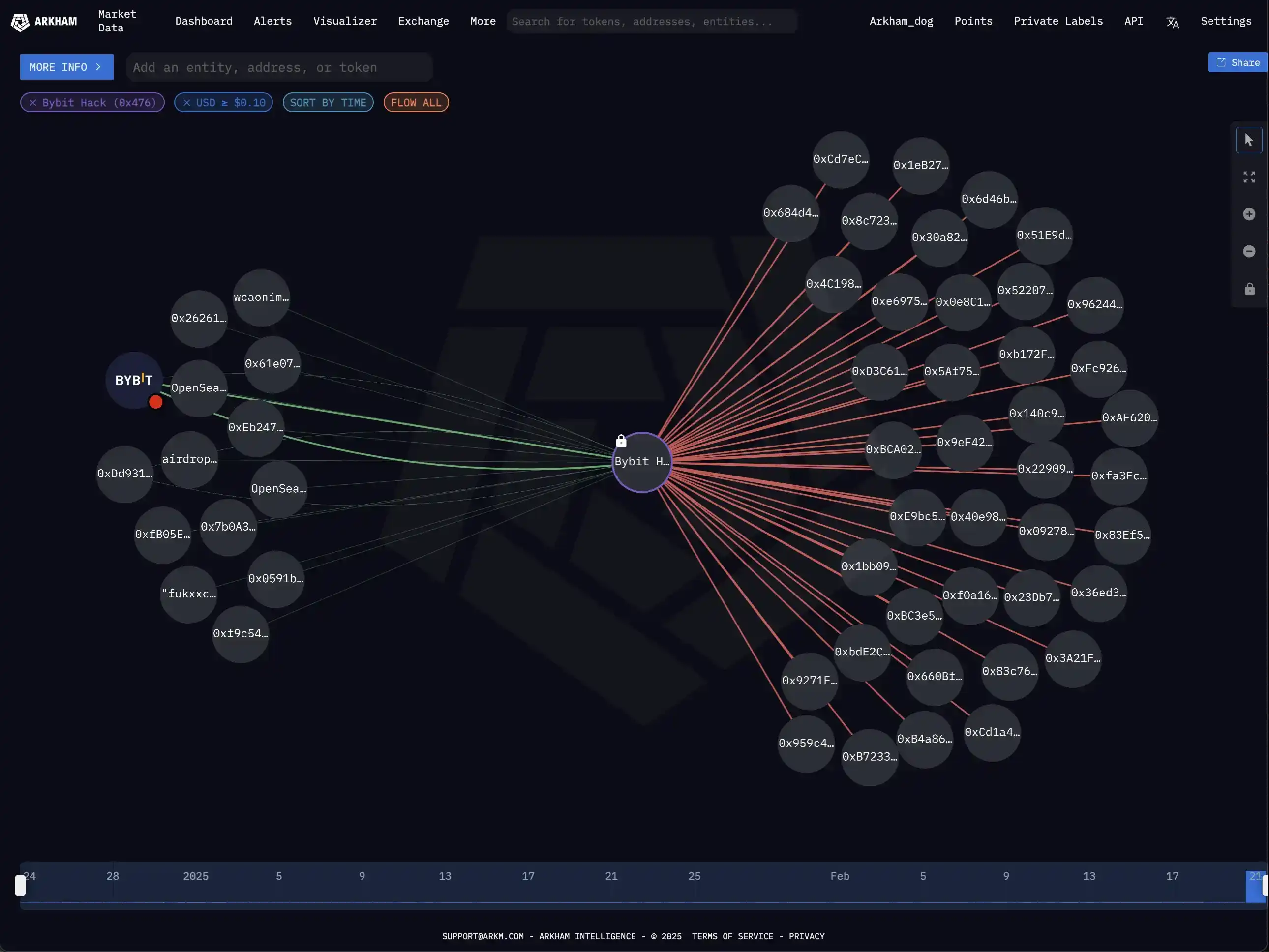
Bybit Hacker Starts to Disperse Funds to Multiple Addresses
On February 21, according to Arkham Monitoring, the Bybit hacker has started to disperse funds to multiple addresses.
Bybit Platform Total Assets Reach $15.727 Billion, with $5.18 Billion in Ethereum Assets
On February 21, according to Defillama data, the Bybit platform's total assets amount to $15.727 billion, including:
· $6.263 billion in Bitcoin;
· $5.18 billion in Ethereum;
· $1.35 billion in SOL;
· $1.143 billion in TRON.
Bybit CEO: Hacker Controls Specific ETH Cold Wallet, Other Cold Wallets Secure and Withdrawals Operating Normally
On February 21, Bybit Co-Founder and CEO Ben Zhou stated in a post, "Bybit's ETH multisig cold wallet made a transfer to our hot wallet approximately 1 hour ago. It appears the transaction was spoofed, with all signers seeing a spoofed interface displaying the correct address and URL coming from Safe.
However, the signature information was to alter the smart contract logic of our ETH cold wallet. This resulted in the hacker controlling our signed specific ETH cold wallet and moving all ETH in the wallet to this unconfirmed address.
Rest assured, all other cold wallets are secure. All withdrawals are functioning normally. I will continue to update as more unfolds. If there are teams that can assist us in tracking the stolen funds, it would be greatly appreciated."
Bybit Multi-Sig Address Transfers $1.5 Billion Worth of ETH and Swaps LSD Assets for Native ETH Using DEX
On February 21, crypto KOL Finish posted that, according to on-chain data, a Bybit multi-signature address transferred $1.5 billion worth of ETH to a new address. The funds reached the new address 0x47666fab8bd0ac7003bce3f5c3585383f09486e2, then were moved to 0xa4b2fd68593b6f34e51cb9edb66e71c1b4ab449e, where 0xa4 is currently selling stETH and mETH in exchange for ETH.
「Currently, this address is using 4 different DEXs. If they were to simply swap the LSD for native ETH, the transaction execution would be very inefficient (high slippage). This scale of operation is typically done off-chain, so this is very unusual.」
Zachxbt Monitors Bybit for Suspected Fund Outflow
On February 21, the Zachxbt monitoring channel reported that they are currently monitoring a suspicious fund outflow from Bybit, totaling over $1.46 billion.
You may also like

New York Proposes Stricter Stablecoin Issuer Rules Aligned With Federal GENIUS Act
NYDFS proposed stricter stablecoin issuer rules aligned with the GENIUS Act, covering reserves, custody, redemption timelines, audits, and capital buffers.

Every exchange is a "Universal Exchange."

The counterattack of traditional finance: Alliance chains are quietly reviving

CryptoQuant Says Bitcoin Profitable Supply Is Near 45% Pressure Zone as On-Chain Data Points to Market Repricing
CryptoQuant said Bitcoin’s profitable supply is nearing the 45% pressure zone, signaling rising market stress, unrealized losses, and a possible on-chain repricing phase.

Bitcoin Falls Below 200-Week Moving Average as On-Chain Data Shows Over Half of Supply in Loss
Bitcoin dropped below its 200-week moving average as on-chain data showed over 50% of circulating supply is now in loss, signaling rising market stress.

CFTC Reportedly Plans New Prediction Market Rules Focused on Manipulation Risk and Public Interest Review
The CFTC is reportedly preparing new prediction market rules focused on manipulation risk, public interest review, and retail trader protections.

Meet the new WEEX trial fund—your gateway to greater profits

WEEX Labs Lands at Dutch Blockchain Week: A Disruptive Crypto × AI Conversation Sets Sail in Amsterdam

SK Hynix Reportedly Plans U.S. ADR Listing as Early as August, With SEC Approval Possible in Late June
SK Hynix may pursue a U.S. ADR listing as early as August, with SEC approval reportedly possible in late June amid strong AI chip supply chain demand.

SpaceX vs Tesla vs xAI: Which Elon Musk Trade Has the Biggest Upside in 2026?
OpenAI Reveals It Has Confidentially Submitted an S-1 to the SEC, Keeping the Door Open for a Future IPO
On June 9, according to an OpenAI announcement, the company recently confidentially submitted a draft S-1 registration statement to the U.S. Securities and Exchange Commission (SEC), beginning the preliminary compliance process for a potential initial public offering. OpenAI said it chose to disclose this proactively because it expected the news might leak; however, the company has not yet set a specific listing timeline, and related arrangements may still take some time.

Latest research from 13 top universities including Cornell University: The current state, challenges, and misconceptions of the fusion of Crypto and AI
Deconstructing Anthropic: The Best AI Company, Possibly Also a Type of Organizational Invention
Apollo and Blackstone Reportedly Back $35 Billion Anthropic Chip Financing as Deal Details Remain Unclear
On June 9, according to currently available news alerts, Apollo and Blackstone Group participated in a $35 billion financing for an Anthropic “chip project.” Based on the original wording of the report, the funding has already been raised, but public information remains limited. The financing structure, use of proceeds, project entity, and whether Apollo and Blackstone participated through equity, debt, or project financing have not yet been disclosed.

Humanity Protocol Security Incident Escalates: More Than $31 Million Stolen From Related Addresses as Attacker Continues Selling H for ETH
On June 9, according to monitoring by Onchain Lens, more than $31 million has been stolen from addresses linked to Humanity Protocol, and the attack is still ongoing, with the hacker continuously swapping H tokens for ETH. Project founder Terence Kwok later confirmed the security incident on X, saying the issue involved a private key leak.

Bloomberg: As Bitcoin Weakens, Stablecoins and RWA Continue to Drive Expansion in Crypto Businesses
In June, Bloomberg reported that despite Bitcoin falling below $60,000 last week, wiping out about $235 billion in market value within seven days, and dropping close to 50% from last year’s peak, some core businesses in the crypto industry are still expanding, mainly in stablecoins, real-world asset tokenization (RWA), payments, and infrastructure. The report also noted that overall altcoin activity has contracted significantly: altcoin market capitalization has fallen from a peak of about $431 billion in November 2021 to around $170 billion, and among the tens of millions of tokens issued in recent years, fewer than 1,700 still maintain meaningful trading activity.

Galaxy Deep Research Report: How Hyperliquid's HIP-4 Upgrade Changes the Landscape of Prediction Markets?
Binance Research: RWA Market Expected to Expand Nearly 6x from Early 2025, with Public Equities and Onchain Payments Heating Up Together
In June, Binance Research said in its monthly market report that the real-world asset (RWA) market is expected to grow by about 589% from the beginning of 2025. Bond- and money market fund-related RWA expanded by about $6.5 billion, up 83% year over year, while publicly traded equity RWAs grew by about 422%. The report also noted that monthly crypto debit card transaction volume exceeded $747 million in May, up 48.6% year to date.
New York Proposes Stricter Stablecoin Issuer Rules Aligned With Federal GENIUS Act
NYDFS proposed stricter stablecoin issuer rules aligned with the GENIUS Act, covering reserves, custody, redemption timelines, audits, and capital buffers.
Every exchange is a "Universal Exchange."
The counterattack of traditional finance: Alliance chains are quietly reviving
CryptoQuant Says Bitcoin Profitable Supply Is Near 45% Pressure Zone as On-Chain Data Points to Market Repricing
CryptoQuant said Bitcoin’s profitable supply is nearing the 45% pressure zone, signaling rising market stress, unrealized losses, and a possible on-chain repricing phase.
Bitcoin Falls Below 200-Week Moving Average as On-Chain Data Shows Over Half of Supply in Loss
Bitcoin dropped below its 200-week moving average as on-chain data showed over 50% of circulating supply is now in loss, signaling rising market stress.
CFTC Reportedly Plans New Prediction Market Rules Focused on Manipulation Risk and Public Interest Review
The CFTC is reportedly preparing new prediction market rules focused on manipulation risk, public interest review, and retail trader protections.


