
Stop Looking for the Sword in the Same Place: The Current Bitcoin Market Is Not a Replay of the 2022 Bear Market


Original Article Title: Why Comparing Today's BTC to 2022 Is Absolutely Unprofessional
Original Article Author: Garrett, Crypto Analyst
Original Article Translation: Yuliya, PANews
Lately, some analysts have started comparing the current Bitcoin price trend to that of 2022. Although the short-term price patterns may appear somewhat similar, the comparison is entirely absurd from a long-term perspective. Whether looking at long-term price patterns, the macroeconomic backdrop, or investor composition and holding structures, the underlying logic has fundamentally shifted.
One of the biggest mistakes in analyzing and trading financial markets is focusing solely on short-term, surface-level statistical similarities while overlooking the long-term, macro, and fundamental driving factors.
A Starkly Different Macro Backdrop
In March 2022, the United States was clearly in a high inflation and rate-hike cycle primarily driven by:
· Excess liquidity unleashed during the COVID-19 pandemic.
· The outbreak of the Ukraine conflict, which significantly exacerbated inflation.
In that environment, risk-free rates kept rising, liquidity was systematically drained, and financial conditions continued to tighten. Therefore, capital's primary objective was risk aversion. What we saw in the Bitcoin market was a distribution structure at a high level typical of a tightening cycle.
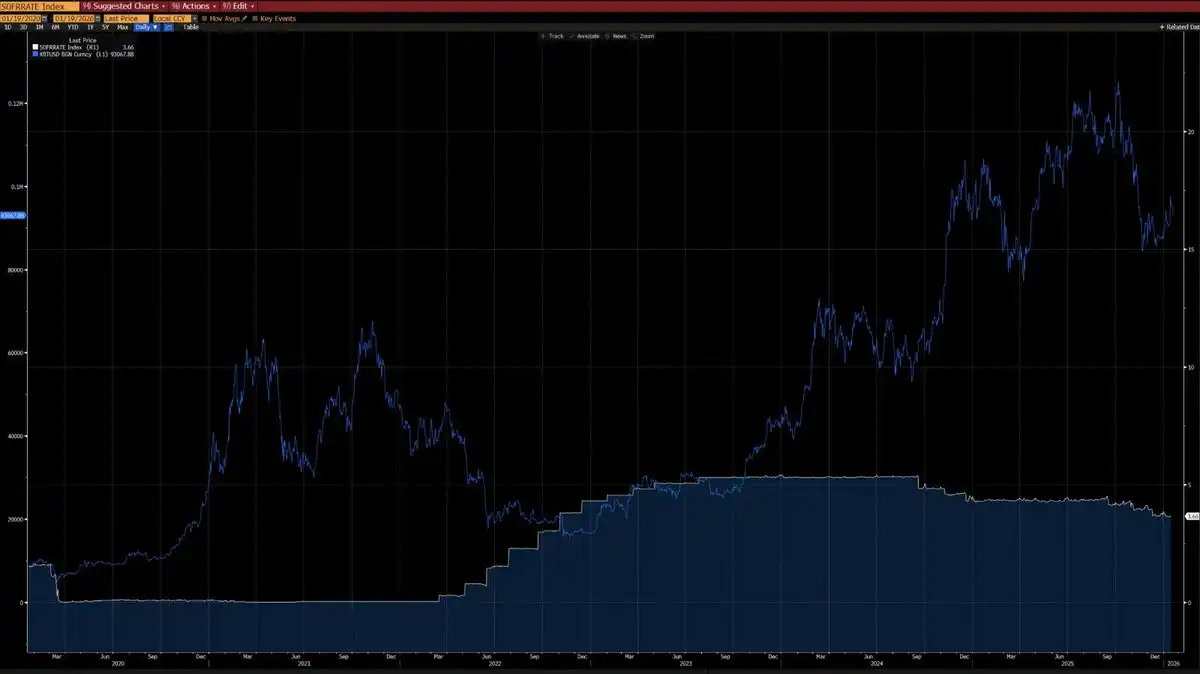
While the current macro environment is exactly the opposite:
· The Ukraine conflict is easing (partly due to U.S. efforts to lower inflation and rates).
· The Consumer Price Index (CPI) and U.S. risk-free rates are decreasing.
· More importantly, the AI technology revolution has significantly increased the likelihood of the economy entering a long-term inflation decline period. Therefore, in a larger cycle, rates have already entered a cutting phase.
· Central bank liquidity is being reinjected into the financial system.
All of this defines capital behavior as "risk preference."
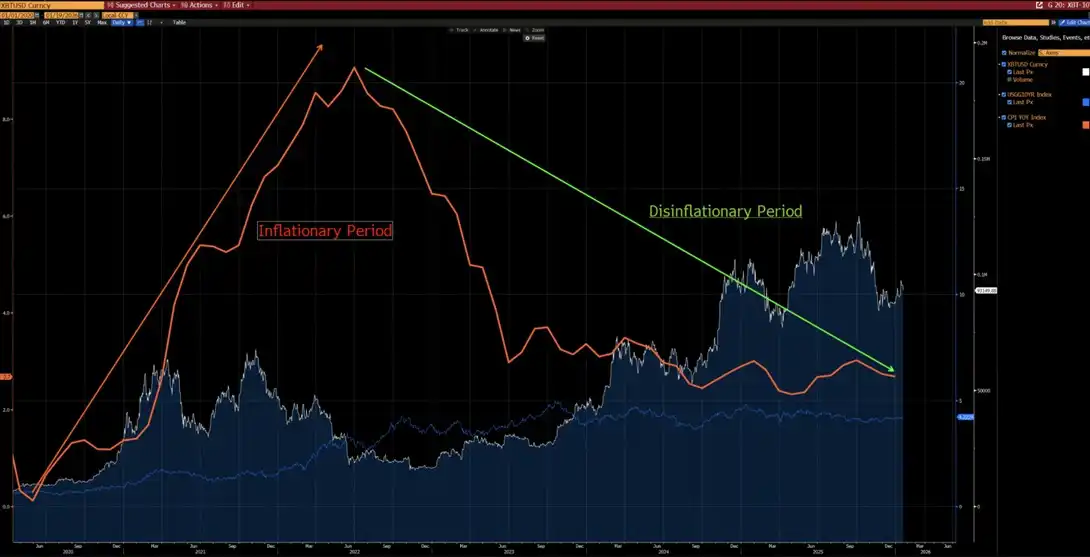
Chart analysis shows that since 2020, there has been a clear negative correlation between the Bitcoin price and CPI's year-on-year change — Bitcoin tends to fall during inflationary periods and rise during inflation declines. In the AI-driven technological revolution, a long-term inflation decline is a high-probability event, a view echoed by Elon Musk, thus reinforcing this point.
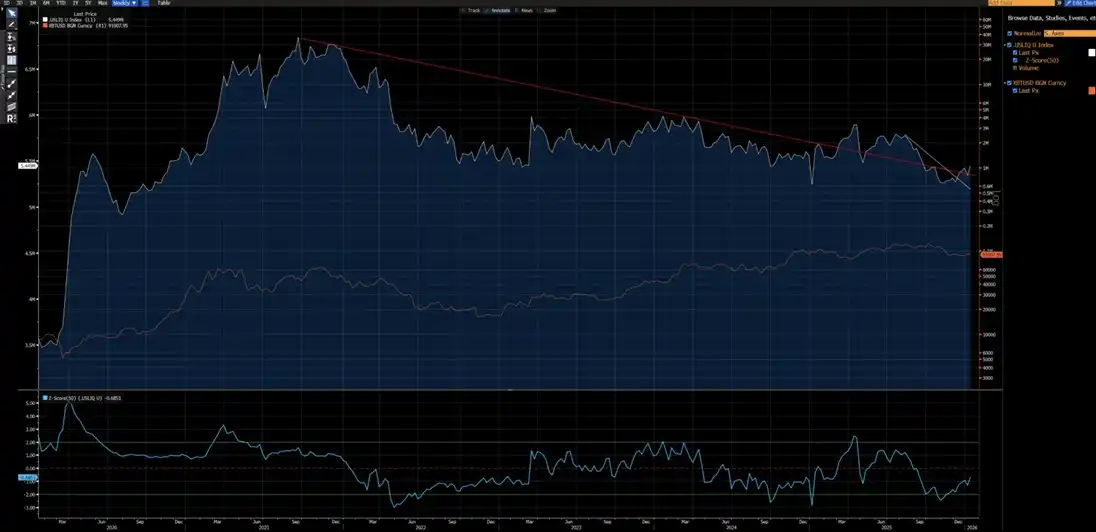
Furthermore, since 2020, Bitcoin has shown a strong correlation with the US Liquidity Index (except for a short-term distortion in 2024 due to ETF inflows). Currently, the US Liquidity Index has broken above both its short-term (white line) and long-term (red line) downtrend lines, signaling a new uptrend ahead.
Different Technical Structures
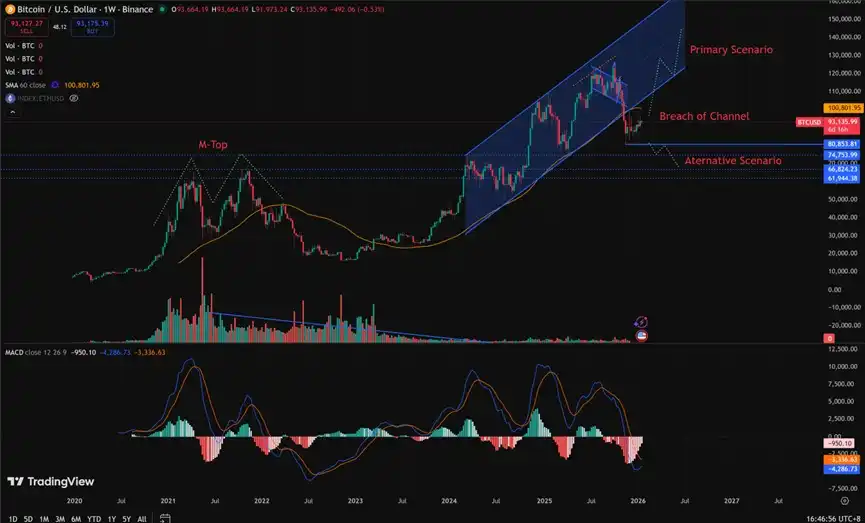
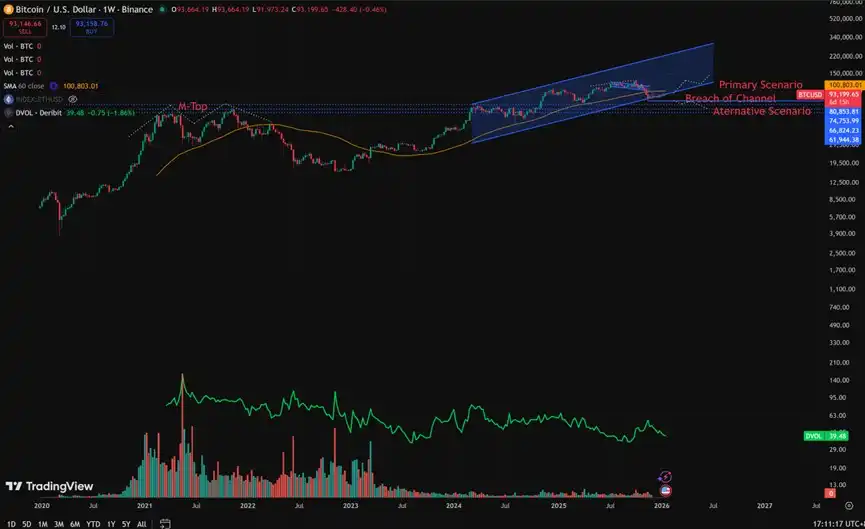
· 2021–2022: The market exhibited a weekly chart M-top structure, usually associated with a long-term market top that can suppress prices for a considerable amount of time.
· 2025: The current market is displaying a weekly chart breakdown from an ascending channel. From a probabilistic standpoint, this is more likely a "bear trap," with prices expected to rebound back into the channel.
Of course, the possibility of the market evolving into a bear market similar to 2022 cannot be entirely ruled out. However, the $80,850 to $62,000 range has seen extensive consolidation and turnover. The previous significant accumulation phase has provided a much superior risk-to-reward ratio for establishing bullish positions now: the upside potential significantly outweighs the downside risk.
What Conditions Are Needed to Replicate a 2022-style Bear Market?
To replicate a bear market of a similar magnitude to that of 2022, the following indispensable conditions must be met:
A new round of inflationary shock or a significant geopolitical crisis comparable to that of 2022.
· Central banks around the world resume interest rate hikes or quantitative tightening (QT).
· Price decisively and sustainably falls below $80,850.
· Any claims of a structural bear market arriving before these conditions are met would be premature and subjective speculation rather than objective analysis.
Different Investor Structures
· 2020–2022: This was a market dominated by retail investors, with limited institutional participation, especially lacking long-term allocators.
· 2023–Present: The introduction of a Bitcoin spot ETF brought in structurally long-term holders. These institutions have effectively locked up the supply, sharply reduced token velocity, and significantly dampened market volatility.
Whether from a macroeconomic or quantitative perspective, 2023 marks a structural inflection point for Bitcoin as an asset. Bitcoin's volatility pattern has shifted from a historical range of 80%–150% to 30%–60%, reflecting a fundamental change in its asset behavior.
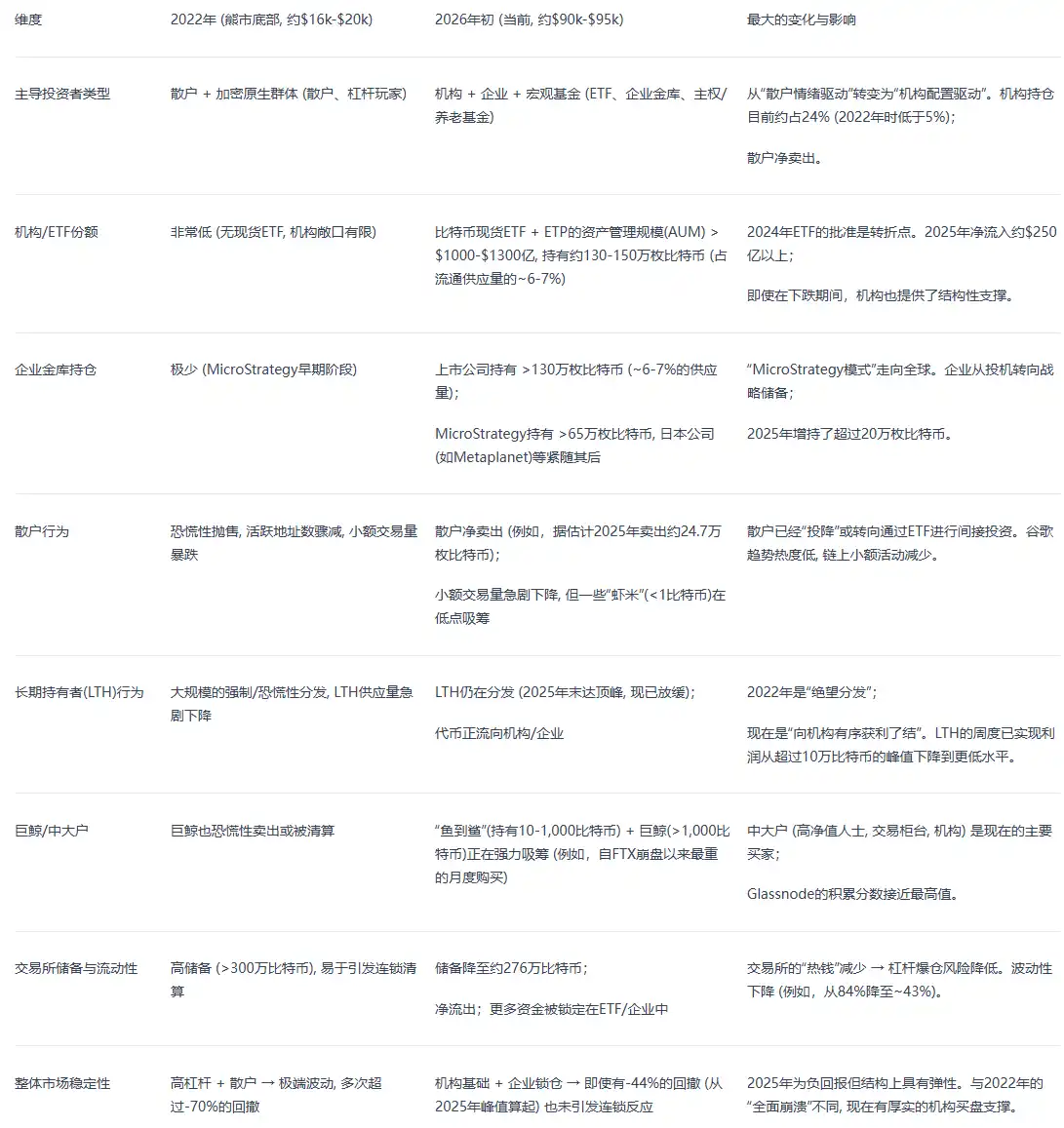
Core Structural Differences (Current vs. 2022)
The biggest difference in Bitcoin investor structure between the present (early 2026) and 2022 is that the market has transitioned from being "retail-driven, high-leverage speculation" to "institutionally driven, structurally long-term holding."
In 2022, Bitcoin witnessed a classic "crypto-native bear market," driven by retail panic selling and cascading liquidations of leveraged positions. Today, however, Bitcoin's operating environment has entered a more mature institutional era characterized by:
· Stable underlying demand.
· Locked-in supply.
· Institutional-grade volatility.
The following is a core comparison based on on-chain data (e.g., Glassnode, Chainalysis) and institutional reports (e.g., Grayscale, Bitwise, State Street) as of mid-January 2026 (when Bitcoin's price was in the $90k–$95k range).
You may also like

What is the connection between Huang Zheng of Pinduoduo and blockchain?

The other side of Musk's trillion-dollar fortune: 85% cannot be sold

The U.S. government prohibits foreigners from using Fable 5, Anthropic issues a rebuttal

Citibank releases "2030 Asset Tokenization Market Outlook": 6 major trends may create a $8.2 trillion market

The trillion-dollar valuation test: Are the three major super IPOs a celebration for tech stocks or a nightmare for the crypto market?

Morning Report | Digital Asset completes $355 million financing led by a16z Crypto; Meta completes operational separation from Manus

a16z Crypto Partner: Cash flow is the moat

Cryptocurrency market makers collectively seek change as it becomes increasingly difficult to make money

How TradeXYZ, xStocks, and Alpaca break down the SpaceX IPO into three different strategies
$75 billion in risk asset redistribution: How will SpaceX's IPO affect U.S. stocks and Bitcoin?

Why Is BlackRock Investing $5 Billion in the SpaceX IPO?
Morning News | CME Group launches Nasdaq Cryptocurrency Index futures; Asset management giant Janus Henderson strategically invests in Ethena

Bitcoin Layer 2 Network Botanix: Why Did We Choose to Dissolve?

Why did Oracle deliver the strongest financial report in history, yet its stock price fell?
When the P2P illicit funds from ten years ago turned into 60,000 bitcoins
Dialogue with OmenX Founder: Why does the prediction market need an evolution from "spot" to "derivatives"?
Galaxy in-depth report: Is Solana still worth paying attention to?
Young people in South Korea make a "final effort" in the epic bull market
What is the connection between Huang Zheng of Pinduoduo and blockchain?
The other side of Musk's trillion-dollar fortune: 85% cannot be sold
The U.S. government prohibits foreigners from using Fable 5, Anthropic issues a rebuttal
Citibank releases "2030 Asset Tokenization Market Outlook": 6 major trends may create a $8.2 trillion market
The trillion-dollar valuation test: Are the three major super IPOs a celebration for tech stocks or a nightmare for the crypto market?
Morning Report | Digital Asset completes $355 million financing led by a16z Crypto; Meta completes operational separation from Manus


