
- Buy Crypto
- Markets
 Futures
- Spot
- Copy Trade
- Earn
- More
Soon to come "Santa Rally," which is more promising, Bitcoin or Gold?

Original Title: "Santa Claus Rally": Bitcoin vs. Gold
Original Author: Ashrith Rao, Blockhead
Original Translation: Chopper, Foresight News
The so-called "Santa Claus Rally" refers to the phenomenon where the cryptocurrency market typically experiences a price surge in the last few weeks of December to early January. This trend is driven by multiple factors, including annual portfolio rebalancing by institutions and traders, as well as a seasonal boost in investor confidence.
During the holiday period, market liquidity decreases, which can amplify price fluctuations, further fueling the upward momentum. There is a noticeable difference in the market behavior of crypto assets between the full year and the Christmas period. While this trend originated in the traditional stock market, it has begun to manifest in the gold market and more recently in the Bitcoin market.
Whenever global markets slow down due to holidays, market participants reassess the possibility of a Santa Claus Rally. During periods of low liquidity or shifts in market sentiment, the reactions of gold and Bitcoin may vary significantly.
Now investors are discussing: in the anticipated seasonal uptrend in December, which asset, gold or Bitcoin, will benefit more?
To protect wealth from the impact of inflation, people have been buying gold for generations. Central banks around the world also hold significant amounts of gold in reserve as a crucial part of their foreign exchange reserve management and monetary policy.
At the end of each year, the seasonal demand for gold tends to rise, driven by various factors:
· During festivals and wedding seasons in India and China, jewelry purchases typically increase;
· Central banks continue to adjust their reserve structures, leaning towards increasing their gold holdings;
· Institutions engage in year-end risk management and portfolio adjustments.
Gold's Holiday Performance
December is not typically a month of surging gold prices but rather a gradual uptrend. During economic downturns or geopolitical unrest, gold often exhibits more safe-haven characteristics than other assets.
Although the price of gold may fluctuate with overall economic conditions, it rarely delivers the staggering returns seen in cryptocurrencies.
Nevertheless, this year, the price of gold has been soaring, reaching historic highs multiple times, with a peak of $4380 per ounce, followed by an unprecedented pullback.
Over the past few weeks, gold has rebounded from a steep decline, with the current trading price surpassing $4,100 per ounce, showing a strong performance. In this highly active trading market, long positions have seen significant profits.
With the end of the U.S. government shutdown and the national debt expected to reach a historical high of $40 trillion, this precious metal has bounced back from a deep decline.
Currently, the price of gold is only 7% away from its all-time high, and investors are well aware that after the government shutdown, deficit spending will only increase further.
Bitcoin: A New Choice for Value Storage
Since Bitcoin's price touched around $16,000 in November 2022, the view that "Bitcoin is digital gold" has been widely recognized, and its price has continued to rise.
On December 5, 2024, Bitcoin first broke through the $100,000 mark, and has since repeatedly reached that level. During the peak period in October of this year, Bitcoin's price surpassed $125,000, but like gold, it then experienced a sharp pullback.
Nevertheless, Bitcoin has generally held above the key psychological level of $100,000, only briefly dipping below this level on a few occasions.
Bitcoin's decentralized structure and fixed supply of 21 million coins make it a potential choice to hedge against currency inflation.
However, overall, Bitcoin is considered a riskier investment compared to gold: when investor confidence is high, its price may skyrocket; when confidence is low, it could also see a sharp drop.
From historical data, Bitcoin's performance in the fourth quarter of each year has often been noteworthy.
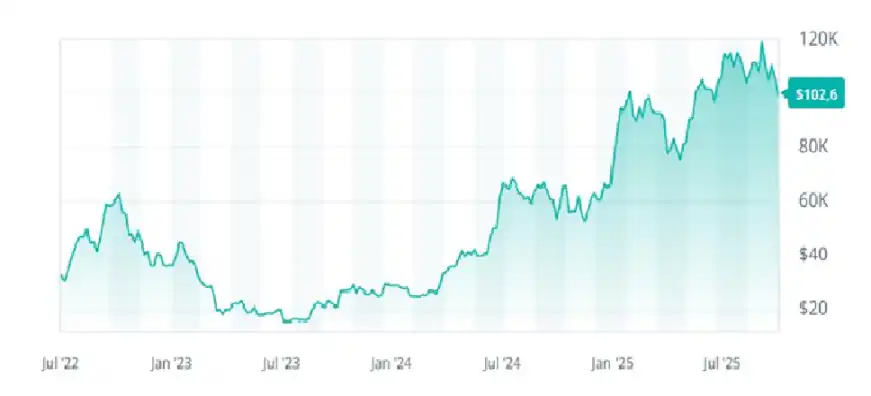
Data Source: TradingView
Macroeconomic Factors Drive This Year's Core Momentum
This year, the economic situation has become the most critical factor determining whether the Christmas rebound will occur as expected.
Market liquidity, inflation metrics, and central bank policies around the world (especially the Fed's policy) are all key driving factors.
At the October 2025 Fed interest rate meeting, the central bank cut the federal funds rate by 25 basis points, setting the new target range at 3.75%-4.00%. This rate cut was in line with market expectations and was another move after the September cut, bringing borrowing costs to the lowest level since the end of 2022.
A decrease in interest rates usually leads to a depreciation of the U.S. dollar, which may in turn increase investors' interest in alternative assets such as Bitcoin.
A report shows that in September 2025, the official inflation rate in the United States was 3.0%, higher than August's 2.9%; however, the core inflation rate saw a slight decrease from 3.1% to 3.0%. During times of high inflation, the market's focus on alternative assets like Bitcoin and the safe-haven asset gold tends to significantly increase.
Unlike traditional assets, Bitcoin's liquidity exhibits higher volatility.
Institutional buying behavior of Bitcoin Exchange-Traded Funds (ETFs) and small fund inflows can both have a significant impact on short-term price fluctuations.
The core difference between the two assets lies in their buyer base: gold's main buyers are jewelry manufacturers, sovereign wealth funds, and central banks, while Bitcoin's core supporters are young digital currency enthusiasts, tech pioneers, and retail investors.
Comparison of Gold and Bitcoin Performance
Over the past few years, both assets have experienced synchronous rallies, especially notable in 2025. However, there have also been instances of "one asset rallying first, followed by the other asset entering an uptrend."
In 2020, in response to the economic downturn caused by the pandemic, various governments implemented large-scale stimulus plans. With fiat currency depreciation, investors seeking asset preservation flocked to assets with stability guarantees.
At the beginning of the year, gold prices surged; in the latter half of the year, Bitcoin gained momentum. In December 2020, gold closed at $1900, a slight increase, while Bitcoin approached its interim high and closed at around $29,000.
This case illustrates that during periods of ample market liquidity and low interest rates, Bitcoin's performance tends to outshine traditional assets like gold. In
From 2021 to 2022, as inflation soared, central banks worldwide hiked interest rates significantly.
During this market crash period, speculative assets like Bitcoin suffered heavy losses. Market participants turned to gold, a traditional safe-haven asset, and its price experienced multiple rallies, demonstrating exceptional resilience.
This indicates that during times of monetary tightening and market pressure, gold's ability to preserve value usually surpasses that of Bitcoin.
With the government shutdown causing data freeze, now that the Washington fiscal standoff has ended, the release of inflation data will to a large extent determine which of the two asset classes will win the Christmas rally.
You may also like

Circle CEO’s Insight: The Future of Stablecoins and Digital Financial Platforms
Key Takeaways: Circle completed a noteworthy IPO in 2025, signifying a major milestone in the crypto space. The…

NVIDIA GTC 2026 Set to Gather Global Tech Enthusiasts
Key Takeaways: NVIDIA GTC 2026 will occur in San Jose from March 16-19, bringing together over 30,000 participants.…

What Competitive Edges Still Remain in the AI era?
Key Takeaways: AI’s ability to write code and automate tasks is reshaping traditional job structures, pushing for new…

Aave’s New Protective Layer: Introducing Aave Shield
Key Takeaways: Aave has introduced the Aave Shield feature, designed to block swaps with a price impact exceeding…
U.S.-Iran Conflict Intensifies Amid Diplomatic Stalemate
Key Takeaways: Middle Eastern efforts to mediate U.S.-Iran tension have been declined by both nations, indicating a readiness…

AI “Brainwashing” Scandal: Spotlight on GEO and Data Poisoning in Large Models
Key Takeaways: The GEO business has emerged, capitalizing on AI manipulation by making products appear as standard answers…

Bitwise CIO: Bitcoin’s Potential to Reach $1 Million if it Captures Gold and Sovereign Debt Market Share
Key Takeaways: Matt Hougan of Bitwise suggests that Bitcoin could reach a $1 million price if it captures…

Argentinian President Milae Accused of $5 Million Scheme with LIBRA Token
Key Takeaways: President Milae is alleged to have facilitated a $5 million scam involving LIBRA tokens. The scheme…

Aave Post-Mortem: Liquidity Shortfall Causes $50 Million Loss
Key Takeaways: On March 12, 2026, a significant token swap on Aave led to a $50.43 million discrepancy…

Bitcoin’s HODL Strategy Faces a 5.96% Unrealized Loss
Key Takeaways: Bitcoin holds a current unrealized loss of 5.96%, translating to an estimated $3.34 billion. Bitcoin has…
Polymarket’s Predictions on Bitcoin’s 2026 Trajectory
Key Takeaways: Polymarket assigns a 40% probability for Bitcoin hitting $100,000 this year, emphasizing market uncertainty. The chances…
Michael Saylor’s Recent Moves and the Implications for Bitcoin Accumulation
Key Takeaways: As of March 8, 2026, Strategy, led by Michael Saylor, accumulated a total of 738,731 BTC…

Bitcoin Weekly Return Hits 8.55%, Largest Surge Since 2025
Key Takeaways: Bitcoin’s weekly return rate has surged to 8.55%, marking its most significant weekly gain since September…
Tom Lee: Oil Price Hike and U.S. Stock Market Dynamics
Key Takeaways: Tom Lee suggests that rising oil prices might bolster rather than hinder the U.S. stock market…

「Wood Sister」: Market Bravery Amidst Fear
Key Takeaways: Cathie Wood sees the current market climate as an opportunity to buy volatile stocks due to…
China Internet Finance Association Issues Warning on OpenClaw Security Risks
Key Takeaways: OpenClaw smart agent, while boosting efficiency, is highly susceptible to exploitation due to weak security and…
Oil Price Soars Amid US-Iran Tensions: Strategic Moves for Investors
Key Takeaways: The US-Iran conflict has led to a 45% surge in oil prices since February 27th, importantly…

CEX Observes a Net Inflow of 4300.25 BTC Over the Past Week
Key Takeaways: Significant BTC inflows were recorded on major crypto exchanges, totaling 4300.25 BTC over the last seven…
Circle CEO’s Insight: The Future of Stablecoins and Digital Financial Platforms
Key Takeaways: Circle completed a noteworthy IPO in 2025, signifying a major milestone in the crypto space. The…
NVIDIA GTC 2026 Set to Gather Global Tech Enthusiasts
Key Takeaways: NVIDIA GTC 2026 will occur in San Jose from March 16-19, bringing together over 30,000 participants.…
What Competitive Edges Still Remain in the AI era?
Key Takeaways: AI’s ability to write code and automate tasks is reshaping traditional job structures, pushing for new…
Aave’s New Protective Layer: Introducing Aave Shield
Key Takeaways: Aave has introduced the Aave Shield feature, designed to block swaps with a price impact exceeding…
U.S.-Iran Conflict Intensifies Amid Diplomatic Stalemate
Key Takeaways: Middle Eastern efforts to mediate U.S.-Iran tension have been declined by both nations, indicating a readiness…
AI “Brainwashing” Scandal: Spotlight on GEO and Data Poisoning in Large Models
Key Takeaways: The GEO business has emerged, capitalizing on AI manipulation by making products appear as standard answers…


 App
App