
 Buy Crypto
- Markets
 Futures
- Spot
- Copy Trade
- Earn
- More
SBF's bro turned 225 million into 5.5 billion in one year


Original Title: "SBF's Protégé Turned 2.25 Billion into 55 Billion in One Year"
Original Author: Azuma, Odaily Planet Daily
Have you heard of Leopold Aschenbrenner?
He is currently one of the hottest names in the AI investment circle — at 24, the Situational Awareness LP fund he founded had a public AUM of "only" 2.25 billion USD in Q4 2024, a number that has skyrocketed to 55 billion USD in the holdings disclosure for Q4 2025 released last month.
What few know is that Leopold Aschenbrenner was once part of the crypto world — having worked at FTX's FTX Future Fund team under FTX until the exchange's bankruptcy.
AI Prodigy from a Family of Doctors
Leopold Aschenbrenner, born in Germany, comes from a family of doctors.
In 2021, Leopold Aschenbrenner graduated from Columbia University at the age of 19 at the top of his class, with dual degrees in Economics and Mathematical Statistics. During his time at Columbia, he co-founded the university's Effective Altruism (EA) chapter.
Effective Altruism was a mantra often voiced by FTX founder SBF. Whether it was shared ideology, Leopold Aschenbrenner joined the FTX Future Fund team in February 2022, a philanthropic initiative created by the FTX Foundation to advance effective altruism, and remained with the team until just before FTX's collapse in November 2022.
In 2023, after leaving FTX, Leopold Aschenbrenner joined what is now a leading AI powerhouse, OpenAI, and became part of the Superalignment team led by luminaries Ilya Sutskever and Jan Leike, dedicated to breakthrough research to guide and control AI systems smarter than humans.
In April 2023, OpenAI's internal communication system was hacked, but the company did not publicly disclose the incident. Leopold Aschenbrenner then submitted a memo to the OpenAI board, expressing concerns about OpenAI's security practices. Subsequently, Leopold Aschenbrenner stated that this memo sparked disagreement between the board and the management regarding security issues, and he himself received a warning from the HR department.
In April 2024, OpenAI fired Leopold Aschenbrenner on grounds of alleged information leak, but Leopold Aschenbrenner argued that the so-called "leak" was actually sharing a "brainstorm" document with three external researchers for feedback purposes. OpenAI claimed that the dismissal was unrelated to the security memo previously submitted by Leopold Aschenbrenner, while Leopold Aschenbrenner mentioned that he was explicitly told at the time that the memo was the main reason for his dismissal. Just 1 month later, the Superalignment team disbanded, and other prominent AI researchers, including Ilya Sutskever, also left OpenAI.
Interestingly, the conflict between Leopold Aschenbrenner and OpenAI is not the only one. His fiancée Avital Balwit is now the Chief of Staff at Anthropic, OpenAI's biggest competitor... And back in the day, FTX was also one of Anthropic's major early backers.

Farewell to Tech Frontlines, Entering the Investment Circle
In June 2024, merely two months after leaving OpenAI, Leopold Aschenbrenner authored a 165-page magnum opus titled "Situational Awareness: The Decade Ahead." The paper consisted of multiple sections, predicting the emergence of Artificial General Intelligence (AGI), envisioning the pathway from AGI to superintelligence, outlining four major risks to humanity, summarizing approaches for humans to deal with superintelligence, and elaborating on the principles of "AGI realism."
"Situational Awareness: The Decade Ahead" triggered significant debate in Silicon Valley, propelling Leopold Aschenbrenner to fame. Subsequently, in September 2024, Leopold Aschenbrenner founded the eponymous Situational Awareness LP fund based on the paper and assumed the role of Chief Investment Officer, focusing on investment opportunities across the AI industry chain.
The initial fund size of Situational Awareness LP is not publicly available, but according to reports from mainstream media such as WSJ and Fortune in mid-2025, the fund's total assets under management at that time were approximately $1.5 billion. The LP includes Stripe's co-founders Patrick Collison and John Collison, former GitHub CEO Nat Friedman, and prominent investor Daniel Gross.
According to the 13F filing disclosed by Situational Awareness LP (a quarterly filing required by the SEC for funds with AUM exceeding $100 million), as of Q4 2024, Situational Awareness LP's publicly disclosed holdings were still "only" $255 million. However, in the Q4 2025 holdings disclosure just released on February 16th of this year, that number had surged to a staggering $5.5 billion.
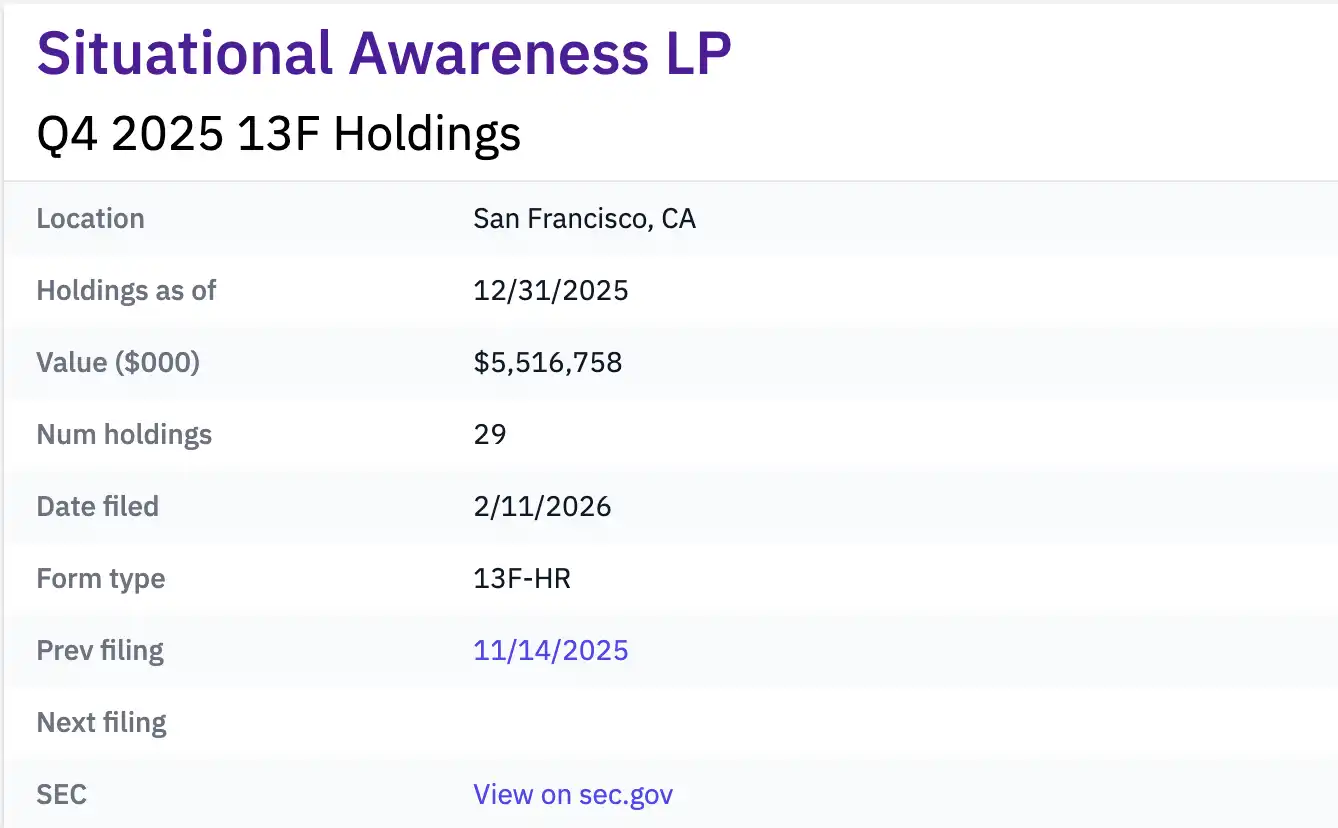
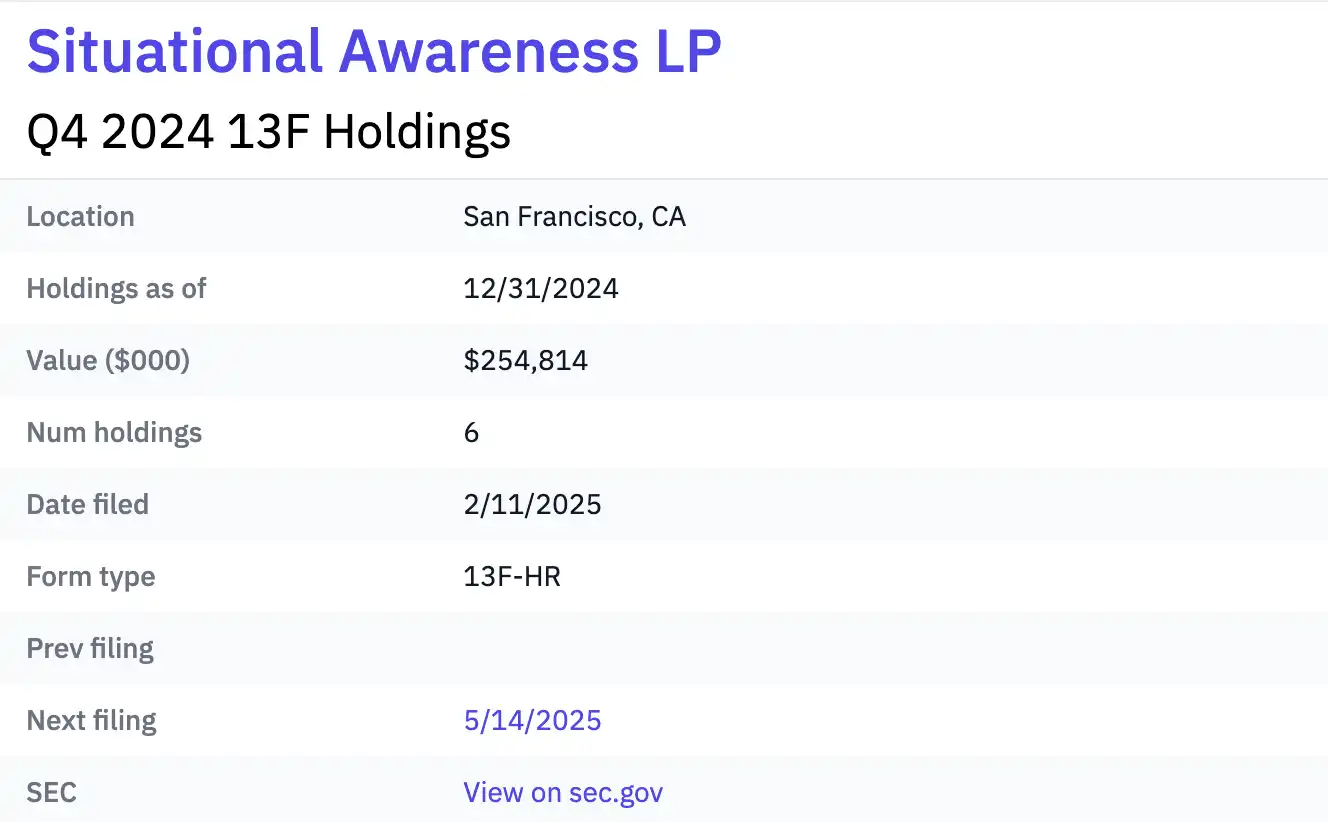
Considering that Situational Awareness LP was relatively new at the end of Q4 2024, the fund likely had a significant reserve beyond the $255 million disclosed holdings. But even starting from an AUM of around $1.5 billion in mid-2025, the disclosed holdings by Q4 of the same year had already grown to $5.5 billion, showcasing a remarkable pace.
Position Analysis: Still Showing Crypto Influence
Situational Awareness LP disclosed the top 29 holdings of the fund in the 13F filing, as shown in the chart below.
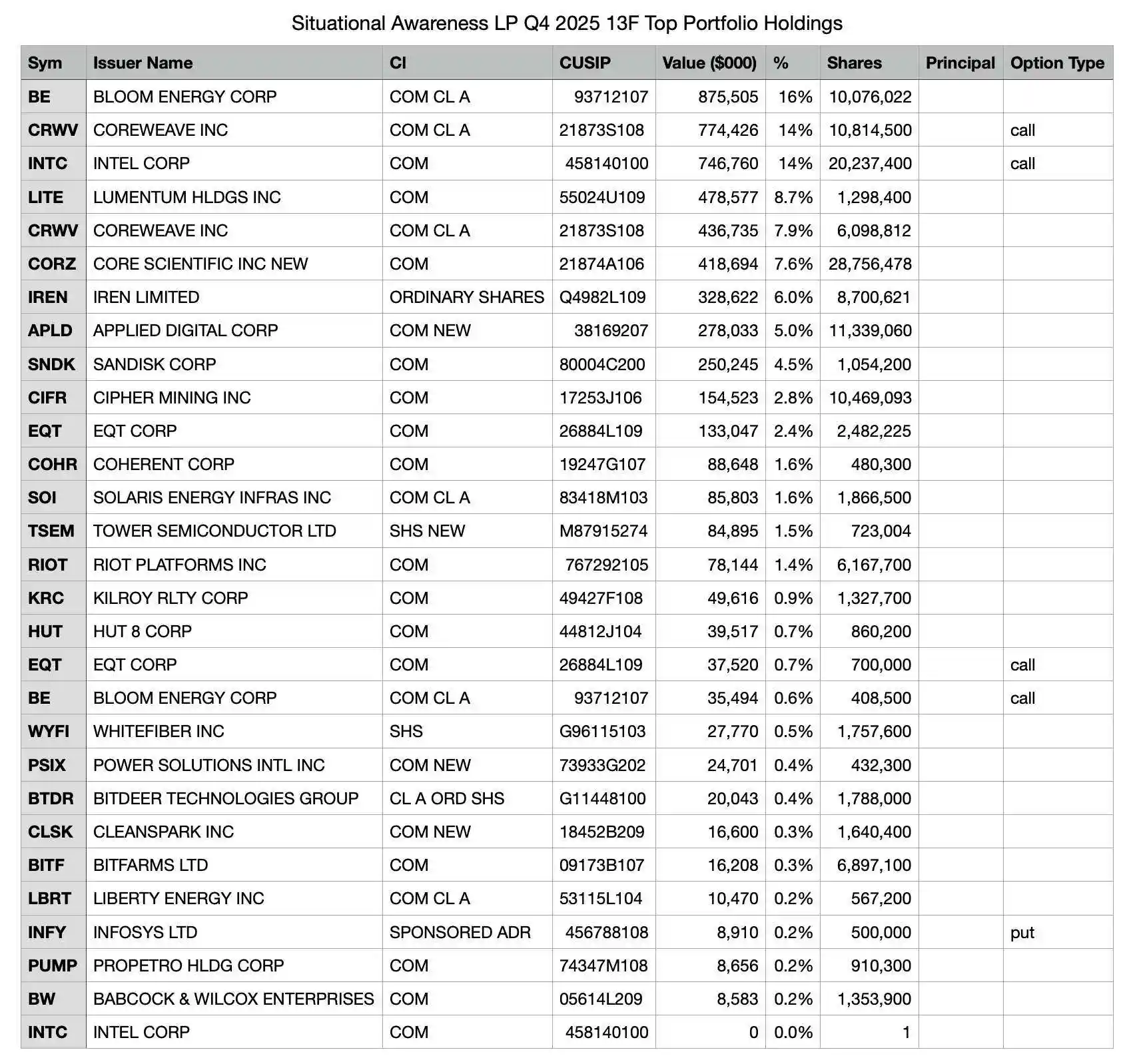
As shown in the chart, Situational Awareness LP's bet on AI is not focused on the more hyped application side but rather on the upstream infrastructure industry chain.
· The top ten holdings of Situational Awareness LP account for a whopping 86% of the portfolio, showing a highly concentrated strategy, mainly focusing on energy, computing power, optical communication, and storage sectors.
· The largest position, Bloom Energy, is dedicated to solid oxide fuel cell (SOFC) and solid oxide electrolyzer cell (SOEC) technology development. Benefiting from the growth in AI data center demand, the company has consistently outperformed expectations, with its stock price rising over 10x since the end of 2024.
· Big-name targets such as Nvidia, Microsoft, Amazon, and Google were not present in the holdings, indicating that Situational Awareness LP prefers relatively more "under-the-radar" targets.
· The only disclosed short position of Situational Awareness LP was a put option to short India-based IT service exporter Infosys, suggesting a bet that the development of Claude Code and Codex will replace traditional IT outsourcing.
Another clue somewhat related to the crypto world is that Situational Awareness LP's holdings show shadows of several Bitcoin mining companies, such as Core Scientific, Cipher Mining, Iren (formerly Iris Energy), and Wu Jihan's Bitdeer.
Unfortunately, it seems that what Situational Awareness LP is interested in is not these companies' direct involvement in the cryptocurrency business, but rather a bet on mining companies' transition to AI hashpower centers—amid the flourishing AI trend and the cryptocurrency market downturn, an increasing number of mining companies are proactively adapting by leveraging their existing resources such as land, hashpower, and electricity. Stay tuned for an upcoming article on this trend.
A Fork in Destiny, a Reconstruction of Belief
Looking back at Leopold Aschenbrenner's career, it's hard not to be reminded of another shining young prodigy, SBF, both of whom have worked at FTX, both have believed in effective altruism, and both have delivered remarkable results in investments. However, after a misstep, SBF is now a fallen star, facing a long prison sentence ahead; on the other hand, Leopold Aschenbrenner's life has taken a different path following FTX's overnight collapse, but fortunately, this seems to be a path more suitable for him.
Time does not turn back, and fate never offers a chance to replay. Some are forever trapped in the ruins of the old era, while others are forced off their original path but unveil a brand-new story.
As a part of the Crypto industry, the phrase that comes to mind right now is— the industry is currently experiencing its most tumultuous moment of confidence since its inception, with some leaving in disappointment, some hesitating on the sidelines, but others actively embracing the new technological wave and narrative shift. History often unfolds this way; as the old story crumbles, it is often the moment of birth of a new story. The reconstruction of belief may well be another opportunity.
You may also like

a16z: 5 Ways Blockchain Helps AI Agent Infrastructure

Morning News | The Hong Kong Securities and Futures Commission announced the regulatory framework for secondary market trading of tokenized investment products; Strategy increased its holdings by 34,164 bitcoins last week; KAIO completed a strategic fi...

What Is an XRP Wallet? The Best Wallets to Store XRP (2026 Updated)
An XRP wallet lets you safely store, send, and receive XRP on the XRP Ledger. Learn what wallets support XRP and discover the best XRP wallets for beginners and long-term holders in 2026.

What are the Top AI Crypto Coins? Render vs. Akash: 5 Gems Solving the 2026 GPU Crisis
What are the best AI crypto coins for the 2026 cycle? Beyond the hype, we analyze top tokens like RNDR, AKT, and FET that provide real-world solutions to the global GPU shortage and the rise of autonomous agents.

What Is a Token in AI? What Is an AI Token + 3 Gems You Can't Miss in 2026
The era of AI hype has transitioned into an era of utility. As we move through Q2 2026, the market is no longer rewarding "narrative-only" projects. At WEEX Research, we are seeing a massive capital rotation into Decentralized Compute (DePIN) and Autonomous Agent coordination layers. This guide analyzes which AI tokens are capturing institutional liquidity and how to spot high-conviction setups in a maturing market.

Consumer-grade Crypto Global Survey: Users, Revenue, and Track Distribution

Prediction Markets Under Bias

Stolen: $290 million, Three Parties Refusing to Acknowledge, Who Should Foot the Bill for the KelpDAO Incident Resolution?

ASTEROID Pumped 10,000x in Three Days, Is Meme Season Back on Ethereum?

ChainCatcher Hong Kong Themed Forum Highlights: Decoding the Growth Engine Under the Integration of Crypto Assets and Smart Economy

Why can this institution still grow by 150% when the scale of leading crypto VCs has shrunk significantly?

Anthropic's $1 trillion, compared to DeepSeek's $100 billion

Geopolitical Risk Persists, Is Bitcoin Becoming a Key Barometer?
Annualized 11.5%, Wall Street Buzzing: Is MicroStrategy's STRC Bitcoin's Savior or Destroyer?
An Obscure Open Source AI Tool Alerted on Kelp DAO's $292 million Bug 12 Days Ago

Mixin has launched USTD-margined perpetual contracts, bringing derivative trading into the chat scene.
The privacy-focused crypto wallet Mixin announced today the launch of its U-based perpetual contract (a derivative priced in USDT). Unlike traditional exchanges, Mixin has taken a new approach by "liberating" derivative trading from isolated matching engines and embedding it into the instant messaging environment.
Users can directly open positions within the app with leverage of up to 200x, while sharing positions, discussing strategies, and copy trading within private communities. Trading, social interaction, and asset management are integrated into the same interface.
Based on its non-custodial architecture, Mixin has eliminated friction from the traditional onboarding process, allowing users to participate in perpetual contract trading without identity verification.
The trading process has been streamlined into five steps:
· Choose the trading asset
· Select long or short
· Input position size and leverage
· Confirm order details
· Confirm and open the position
The interface provides real-time visualization of price, position, and profit and loss (PnL), allowing users to complete trades without switching between multiple modules.
Mixin has directly integrated social features into the derivative trading environment. Users can create private trading communities and interact around real-time positions:
· End-to-end encrypted private groups supporting up to 1024 members
· End-to-end encrypted voice communication
· One-click position sharing
· One-click trade copying
On the execution side, Mixin aggregates liquidity from multiple sources and accesses decentralized protocol and external market liquidity through a unified trading interface.
By combining social interaction with trade execution, Mixin enables users to collaborate, share, and execute trading strategies instantly within the same environment.
Mixin has also introduced a referral incentive system based on trading behavior:
· Users can join with an invite code
· Up to 60% of trading fees as referral rewards
· Incentive mechanism designed for long-term, sustainable earnings
This model aims to drive user-driven network expansion and organic growth.
Mixin's derivative transactions are built on top of its existing self-custody wallet infrastructure, with core features including:
· Separation of transaction account and asset storage
· User full control over assets
· Platform does not custody user funds
· Built-in privacy mechanisms to reduce data exposure
The system aims to strike a balance between transaction efficiency, asset security, and privacy protection.
Against the background of perpetual contracts becoming a mainstream trading tool, Mixin is exploring a different development direction by lowering barriers, enhancing social and privacy attributes.
The platform does not only view transactions as execution actions but positions them as a networked activity: transactions have social attributes, strategies can be shared, and relationships between individuals also become part of the financial system.
Mixin's design is based on a user-initiated, user-controlled model. The platform neither custodies assets nor executes transactions on behalf of users.
This model aligns with a statement issued by the U.S. Securities and Exchange Commission (SEC) on April 13, 2026, titled "Staff Statement on Whether Partial User Interface Used in Preparing Cryptocurrency Securities Transactions May Require Broker-Dealer Registration."
The statement indicates that, under the premise where transactions are entirely initiated and controlled by users, non-custodial service providers that offer neutral interfaces may not need to register as broker-dealers or exchanges.
Mixin is a decentralized, self-custodial privacy wallet designed to provide secure and efficient digital asset management services.
Its core capabilities include:
· Aggregation: integrating multi-chain assets and routing between different transaction paths to simplify user operations
· High liquidity access: connecting to various liquidity sources, including decentralized protocols and external markets
· Decentralization: achieving full user control over assets without relying on custodial intermediaries
· Privacy protection: safeguarding assets and data through MPC, CryptoNote, and end-to-end encrypted communication
Mixin has been in operation for over 8 years, supporting over 40 blockchains and more than 10,000 assets, with a global user base exceeding 10 million and an on-chain self-custodied asset scale of over $1 billion.

$600 million stolen in 20 days, ushering in the era of AI hackers in the crypto world
Vitalik's 2026 Hong Kong Web3 Summit Speech: Ethereum's Ultimate Vision as the "World Computer" and Future Roadmap
a16z: 5 Ways Blockchain Helps AI Agent Infrastructure
Morning News | The Hong Kong Securities and Futures Commission announced the regulatory framework for secondary market trading of tokenized investment products; Strategy increased its holdings by 34,164 bitcoins last week; KAIO completed a strategic fi...
What Is an XRP Wallet? The Best Wallets to Store XRP (2026 Updated)
An XRP wallet lets you safely store, send, and receive XRP on the XRP Ledger. Learn what wallets support XRP and discover the best XRP wallets for beginners and long-term holders in 2026.
What are the Top AI Crypto Coins? Render vs. Akash: 5 Gems Solving the 2026 GPU Crisis
What are the best AI crypto coins for the 2026 cycle? Beyond the hype, we analyze top tokens like RNDR, AKT, and FET that provide real-world solutions to the global GPU shortage and the rise of autonomous agents.
What Is a Token in AI? What Is an AI Token + 3 Gems You Can't Miss in 2026
The era of AI hype has transitioned into an era of utility. As we move through Q2 2026, the market is no longer rewarding "narrative-only" projects. At WEEX Research, we are seeing a massive capital rotation into Decentralized Compute (DePIN) and Autonomous Agent coordination layers. This guide analyzes which AI tokens are capturing institutional liquidity and how to spot high-conviction setups in a maturing market.



 App
App