
RWA, TVL Hit All-Time Highs: A Huge Opportunity for the Next Decade of Traditional Finance?


Original Article Title: RWA TVL Hit a New ATH—Don't Get Left Behind
Original Article Author: Moomsxxx
Original Article Translation: Plain Talk on Blockchain
The RWA sector is growing at an astounding pace. Just a few days ago, the total value of RWA hit a new all-time high, and today it has once again surpassed this new record.
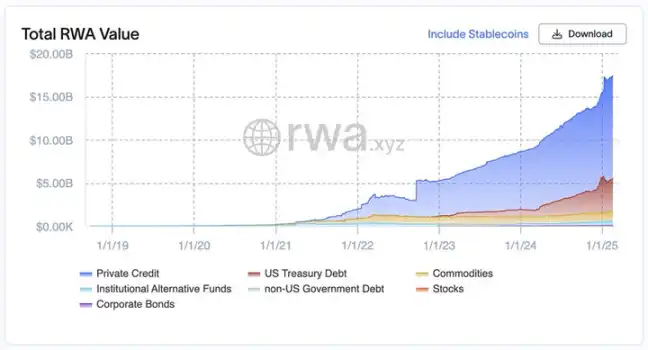
1. RWA TVL
Despite many ongoing operational frictions related to privacy solutions, digital identity solutions, interoperability, and being a bottleneck for faster adoption, the on-chain funds raised of 20-30 billion USD and around 200 billion USD in stablecoins demonstrate the increasing interest and adoption in this area of the Web3 industry.
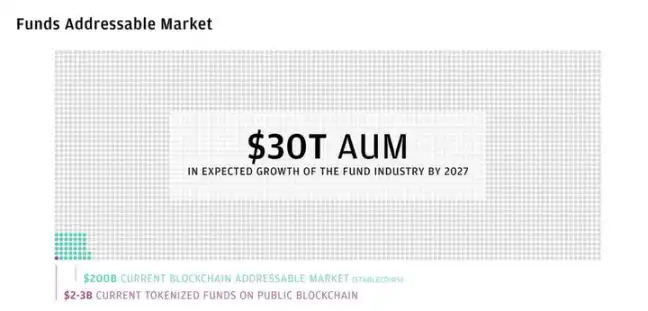
The current tokenized funds represent only a small portion of the expected growth in the fund industry in the coming years.
Likewise, the growth in private credit also reflects market participants' growing interest in opportunities beyond Bitcoin, DeFi native yields, alternative coins, and meme coins.
According to @Preqin, the global private credit market's investment size is close to $17 trillion, while according to @RWA_xyz, the size of tokenized private credit is only about $11.9 billion.
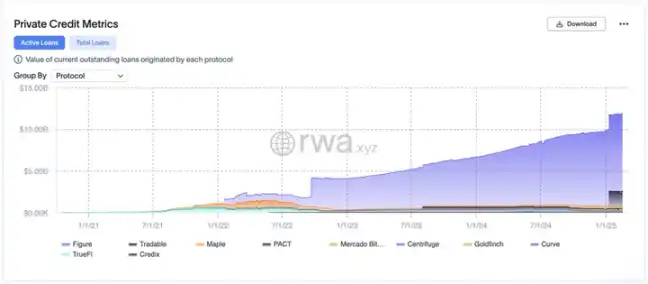
Active Loan Value - Private Credit Market (Source: RWA.xyz)
A deeper analysis of this area, I believe it is necessary to mention that since the market crash of 2022, the reliability of these loans has undergone a significant change, with teams of different platforms becoming more cautious and investing more resources to ensure higher credit quality issuance.
From July 2021 to the end of 2022, borrowing was mainly dominated by crypto trading and market-making companies. Therefore, the borrowing sector in this area collapsed in the 2022 bear market.
Subsequently, the growth mainly came from funds pool of various RWA transactions, such as consumer asset-backed securities (such as auto loans, credit card debt, student loans, small business loans, etc.), real estate bridge loans, trade finance, and other less volatile asset classes.
The proof of this point is resilient protocols like @maplefinance, as demonstrated in the liquidation event on February 3, 2025—a historic event in crypto. For more details, please see the following link: https://x.com/maplefinance/status/1886332880411832514 Additionally, over the past three years, the industry has matured significantly, with continuous emergence of technical solutions aimed at addressing regulatory and privacy obligations, further enhancing this critical area.
2. Opportunity Scale
According to @BCG data, tokenizing all global mutual funds could unlock an additional $100 billion in annual returns for investors. At the same time, "sophisticated investors" (sorry, not referring to you) could earn $400 billion by "capturing intraday value changes" (basically, day trading). Based on the historical adoption pattern of ETFs, it is reasonable to estimate that tokenized funds will represent 1% of global mutual fund and ETF assets under management in the next seven years.
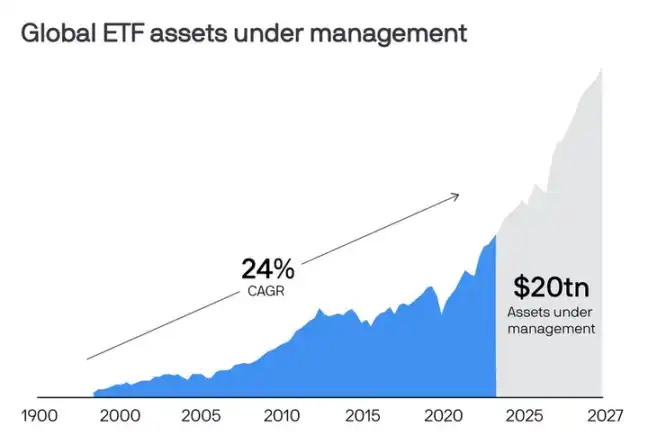
Global ETF Assets Under Management (Source - J.P. Morgan Asset Management)
This implies that by 2030, tokenized assets will exceed $600 billion.
Furthermore, if regulators allow existing mutual funds and ETFs to convert into tokenized funds (which is simpler than launching a new tokenized fund), we might see trillions of dollars in asset under management.
Given the similar growth expectations prior to the introduction of BTC ETFs, I believe we cannot dismiss the possibility that these figures may be overly conservative, and the actual growth might be astonishingly high.
However, even based on these expectations, we are still talking about at least a 200x growth.
Let me say that again, at least a 200x growth from now.
Are you still sitting there lamenting over not making money temporarily?
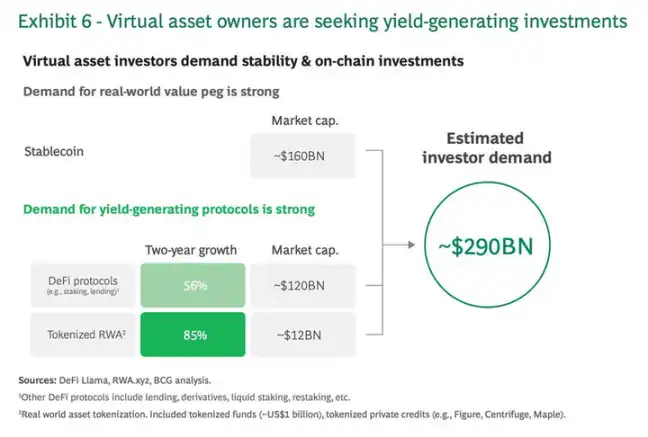
Give me that yield, please!
According to this @BCG study, our industry's investment demand for tokenized funds is approximately $290 billion. This figure includes stablecoin holders, tokenized RWAs, and DeFi protocol demand.
I believe this number may be high because it takes into account the growth of the DeFi protocol market cap, and this growth comes from a user base with a higher risk appetite, whose investment preferences may differ from those willing to invest in tokenized assets.
A more reasonable approach would be to consider the growth of DeFi Total Value Locked (TVL) over the past two years; nonetheless, it would still be a significant number: $580.6 billion (Source - @DefiLlama).
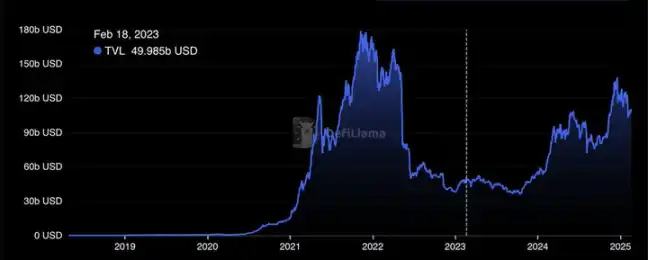
DeFi Total Value Locked (TVL)
Nevertheless, the value propositions of tokenized funds and RWAs are undeniable. They provide a channel to access real-world investment opportunities, allowing investors to better diversify their portfolios amidst market dynamics.
Imagine if, in the past few months, through @Rabby_io, you could have converted your on-chain tokens into stocks, commodities, and real estate without needing to cash out—wouldn't that be convenient?
But why must all this happen? What are the benefits for traditional finance? Lately, on Crypto Twitter (CT), I haven't seen much discussion on this topic, especially amidst the memecoin craze and controversy. We always talk about how Traditional Finance (TradFi) is stepping into the Web3 industry and adopting the technology we are building. But why are they doing this? While I plan to write an article specifically addressing this topic, below are some key points explaining why traditional finance needs and must embrace the crypto rails:
Instant settlement as shown in the following figure could potentially add around $500 billion annually to investors' portfolios. Lowering commissions saves another $330 billion, which will ultimately flow into investors' portfolios. Composability tokenized funds will be easier to lend out. Accessible trading tokenization will make it easier for investors to trade assets.
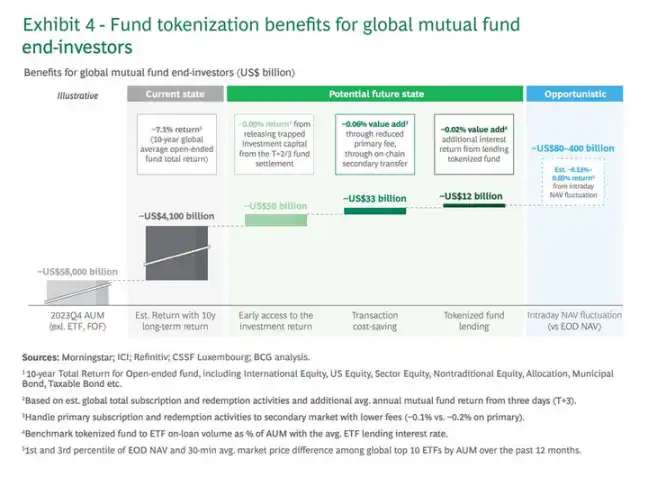
How Tokenization Enhances Returns (Source: Boston Consulting Group)
3. Sentiment Comes Second, Momentum Comes First
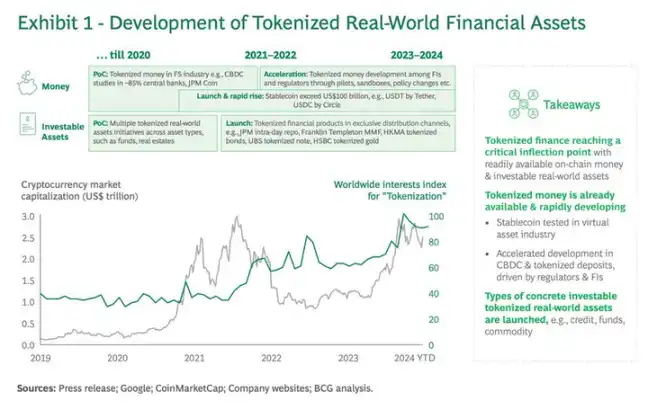
Traditional finance bids farewell, while Crypto Twitter (CT) gets rug pulled.
The chart above shows that regardless of the market conditions, especially Crypto Twitter (CT) sentiment (
You may also like

WEEX Labs Lands at Dutch Blockchain Week: A Disruptive Crypto × AI Conversation Sets Sail in Amsterdam

SK Hynix Reportedly Plans U.S. ADR Listing as Early as August, With SEC Approval Possible in Late June
SK Hynix may pursue a U.S. ADR listing as early as August, with SEC approval reportedly possible in late June amid strong AI chip supply chain demand.

SpaceX vs Tesla vs xAI: Which Elon Musk Trade Has the Biggest Upside in 2026?

OpenAI Reveals It Has Confidentially Submitted an S-1 to the SEC, Keeping the Door Open for a Future IPO
On June 9, according to an OpenAI announcement, the company recently confidentially submitted a draft S-1 registration statement to the U.S. Securities and Exchange Commission (SEC), beginning the preliminary compliance process for a potential initial public offering. OpenAI said it chose to disclose this proactively because it expected the news might leak; however, the company has not yet set a specific listing timeline, and related arrangements may still take some time.

Latest research from 13 top universities including Cornell University: The current state, challenges, and misconceptions of the fusion of Crypto and AI
Deconstructing Anthropic: The Best AI Company, Possibly Also a Type of Organizational Invention
Apollo and Blackstone Reportedly Back $35 Billion Anthropic Chip Financing as Deal Details Remain Unclear
On June 9, according to currently available news alerts, Apollo and Blackstone Group participated in a $35 billion financing for an Anthropic “chip project.” Based on the original wording of the report, the funding has already been raised, but public information remains limited. The financing structure, use of proceeds, project entity, and whether Apollo and Blackstone participated through equity, debt, or project financing have not yet been disclosed.

Humanity Protocol Security Incident Escalates: More Than $31 Million Stolen From Related Addresses as Attacker Continues Selling H for ETH
On June 9, according to monitoring by Onchain Lens, more than $31 million has been stolen from addresses linked to Humanity Protocol, and the attack is still ongoing, with the hacker continuously swapping H tokens for ETH. Project founder Terence Kwok later confirmed the security incident on X, saying the issue involved a private key leak.

Bloomberg: As Bitcoin Weakens, Stablecoins and RWA Continue to Drive Expansion in Crypto Businesses
In June, Bloomberg reported that despite Bitcoin falling below $60,000 last week, wiping out about $235 billion in market value within seven days, and dropping close to 50% from last year’s peak, some core businesses in the crypto industry are still expanding, mainly in stablecoins, real-world asset tokenization (RWA), payments, and infrastructure. The report also noted that overall altcoin activity has contracted significantly: altcoin market capitalization has fallen from a peak of about $431 billion in November 2021 to around $170 billion, and among the tens of millions of tokens issued in recent years, fewer than 1,700 still maintain meaningful trading activity.

Galaxy Deep Research Report: How Hyperliquid's HIP-4 Upgrade Changes the Landscape of Prediction Markets?
Binance Research: RWA Market Expected to Expand Nearly 6x from Early 2025, with Public Equities and Onchain Payments Heating Up Together
In June, Binance Research said in its monthly market report that the real-world asset (RWA) market is expected to grow by about 589% from the beginning of 2025. Bond- and money market fund-related RWA expanded by about $6.5 billion, up 83% year over year, while publicly traded equity RWAs grew by about 422%. The report also noted that monthly crypto debit card transaction volume exceeded $747 million in May, up 48.6% year to date.

Japan to Assess a Framework for Yen Stablecoins and Crypto ETFs as Asia’s Compliant Payments Narrative Heats Up
Recently, according to the original report, Japan is considering the launch of yen stablecoins and cryptocurrency ETFs. Public information remains limited at this stage, and there is still no complete policy text, regulatory draft, or clear implementation timeline, so this is better characterized as a “policy discussion” rather than formal implementation. The original wording also noted that advancing stablecoin regulation in Asia is driving XRP usage and supporting growth in the XRPL ecosystem. However, based on currently available public information, there is not enough evidence to directly establish a clear causal relationship between this round of discussion in Japan and XRP or XRPL.

ZachXBT: Humanity private key leak and abnormal surge in H token should be viewed separately
On June 9, according to related disclosures, on-chain investigator ZachXBT posted an update on Humanity’s roughly $31 million security incident, saying that after further analyzing fund flows, he currently tends to believe the project team was not involved in an “inside job” or a self-staged attack. According to him, the official explanation about the private key leak was broadly accurate, but before the token unlock, the price of H had been artificially pushed higher, and the hacker later took advantage of that market environment; therefore, the private key leak and the earlier abnormal price pumping should be regarded as two separate and independent events. This reframing has shifted the market’s understanding of the nature of the incident. Earlier discussion around Humanity had focused on whether the team directly participated in the attack or used the security incident to cover up internal operations. ZachXBT’s latest remarks shift the focus from “whether it was self-theft” to “whether there were pre-unlock market structure issues.” He also questioned whether the team may have.

Morning Report | OpenAI has submitted an S-1 registration statement draft to the U.S. SEC; Morpho completes $175 million financing

Morning Report | BitMine increased its holdings by 126,971 ETH last week; trader Eugene announced his exit from the crypto market

Wang Chuan: How can one not feel anxious after the neighbor Old Wang made thirty times profit by investing in storage stocks? (Seven) - A quarter-century cycle
Cryptocurrency CEXs are flocking to sell US stocks, and traditional brokerages are facing an "uninvited guest."
$75 billion in foreign capital has fled, and South Korean retail investors have absorbed it all using leverage
WEEX Labs Lands at Dutch Blockchain Week: A Disruptive Crypto × AI Conversation Sets Sail in Amsterdam
SK Hynix Reportedly Plans U.S. ADR Listing as Early as August, With SEC Approval Possible in Late June
SK Hynix may pursue a U.S. ADR listing as early as August, with SEC approval reportedly possible in late June amid strong AI chip supply chain demand.
SpaceX vs Tesla vs xAI: Which Elon Musk Trade Has the Biggest Upside in 2026?
OpenAI Reveals It Has Confidentially Submitted an S-1 to the SEC, Keeping the Door Open for a Future IPO
On June 9, according to an OpenAI announcement, the company recently confidentially submitted a draft S-1 registration statement to the U.S. Securities and Exchange Commission (SEC), beginning the preliminary compliance process for a potential initial public offering. OpenAI said it chose to disclose this proactively because it expected the news might leak; however, the company has not yet set a specific listing timeline, and related arrangements may still take some time.
Latest research from 13 top universities including Cornell University: The current state, challenges, and misconceptions of the fusion of Crypto and AI
Deconstructing Anthropic: The Best AI Company, Possibly Also a Type of Organizational Invention


