
- Buy Crypto
- Markets
 Futures
- Spot
- Copy Trade
- Earn
- More
Robinhood's Rare Bet, Lighter with Its Brilliant Founder

Original Article Title: "Robinhood Makes Rare Bet, Lighter with Its Ingenious Founder"
Original Article Author: Eric, Foresight News
Perp DEX has undoubtedly been one of the hottest topics in recent months, with top projects showcasing their abilities following HyperLiquid's breakout. HyperLiquid shone brightly through the team's operational prowess without any funding, while Aster hitched a ride on Binance's coattails, leveraging the "big brother's" influence to quickly capture market share. Meanwhile, Lighter chose to embrace capital.
《Fortune》 magazine reported on Lighter's latest $68 million funding round on November 11, with a formidable lineup of investors including Founders Fund, Ribbit Capital, and Haun Ventures, as well as the almost non-investing social media-famous brokerage Robinhood couldn't resist voting with its feet.
In addition to the funding, the report also showed us the unknown story behind Lighter.
From Trading to AI and Back to Trading
Lighter founder Vladimir Novakovski showed us a profound truth, that even geniuses need to focus on their familiar field. Unlike many entrepreneurs who transitioned from the Web3 industry to AI, Vlad chose to go the other way.
Having immigrated from Russia to the US at a young age, Vlad was selected for the US national team to participate in the International Olympiads in Informatics and Physics when many were still memorizing quadratic formula solutions. At 16, Vlad entered Harvard University and graduated early three years later, at the age of 18, he was personally invited by Ken Griffin, CEO of one of the world's largest hedge funds and market makers, Citadel.
After nearly 15 years of experience as an engineer and trader, in 2017, Vlad co-founded the AI social networking platform Lunchclub with Scott Wu, who had worked at the investment firm Addepar.
Lunchclub raised about $30 million in funding, and at the beginning of the pandemic, its product attracted a large number of users eager to meet new friends. However, by 2022, growth began to stagnate. "We had three options at the time: one was to work hard to make it profitable but on a small scale; the second was to find a way to develop it from its current state into a platform similar to TikTok or Snapchat, but it seemed impractical," Vald said, "The third option: pivot to do what we are truly interested in."
This year, the two founders went their separate ways, with Wu leaving Lunchclub to found the AI coding company Cognition, which is now valued at over a billion dollars. Vlad, who stayed at Lunchclub, decided to lead the company through a transformation, leveraging his expertise in trading. After the transformation, Lunchclub became Lighter, with Vlad retaining 80% of the original team. In 2024, Lighter completed a $21 million funding round, led by Haun Ventures and Craft Ventures, with participation from Dragonfly and Robot Ventures, although this funding round was not public at the time.
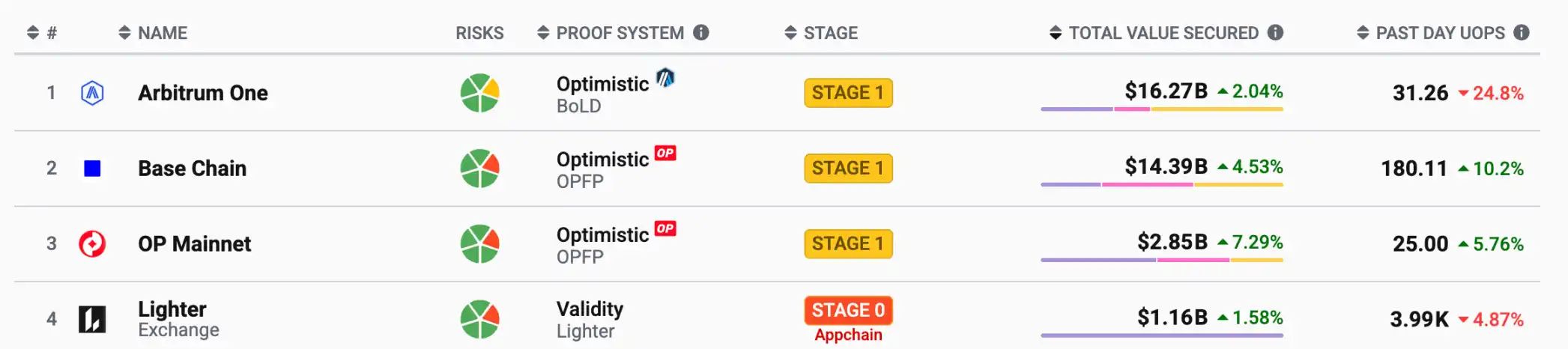
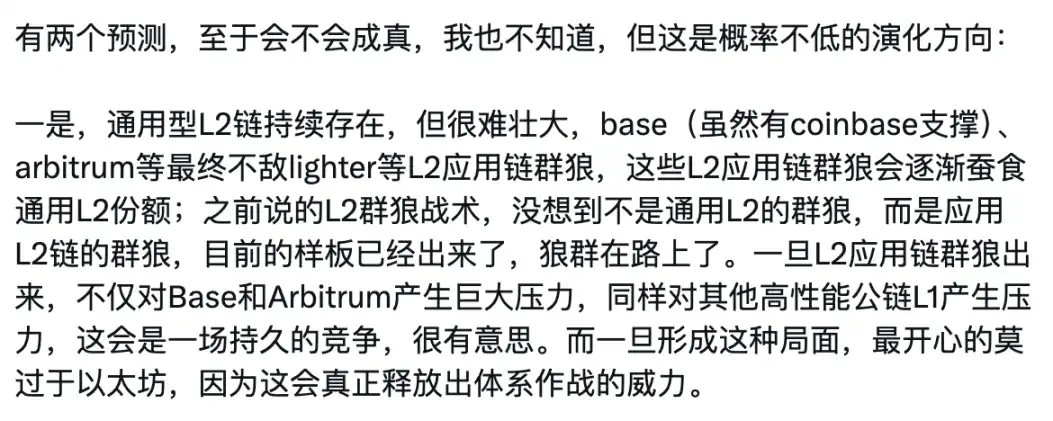
In fact, Lighter did not initially target the perp DEX direction. Lighter, launched on Arbitrum at the end of 2022, started its transformation to a perp DEX in 2023 and began developing its own ZK Rollup, with the mainnet officially launching just this October. However, within just over a month of its launch, Lighter has become the fourth largest L2 in terms of TVL, behind only Arbitrum One, Base, and OP Mainnet. Even the OG Blue Fox marveled at the fact that a customized L2 came out ahead of a general-purpose L2.
What kind of ZK L2 is Lighter?
At a time when OP Rollup had the upper hand, many visionary industry insiders pointed out that "ZK is the End Game." Today, from Brevis to ZKsync Airbender, we finally understand the meaning of this phrase, and obviously, Vald had already seen through everything.
As a founder with both engineering and trading experience, Vald's launched L2 is almost tailor-made for DEX.
In simple terms, Lighter has integrated all core logic such as matching, clearing, and risk control into a custom SNARK circuit and batch anchors the final state to the Ethereum L1. In other words, the design of Lighter's L2 incorporates the "exchange logic" into a ZKP circuit, and all the design revolves around how to execute transactions faster and validate them. Even Lighter's sequencer only has "ordering rights," with the matching logic hardcoded into the circuit, making it impossible for the sequencer to front-run or sandwich orders.
Lighter has named this architecture the "Lighter Core," which is described in the documentation as follows: "The scalability of Lighter Core benefits from its newly developed proof engine, which is specifically designed from scratch for exchange-specific workloads. It leverages new algorithms and optimized data structures to efficiently generate exchange operation proofs. All exchange operations are deterministically executed through user-signed transactions. A batch of such transactions will produce a new post-execution state and a concise cryptographic proof."
In the article "ZKsync Praised by Vitalik, Might Really Be Underestimated," the author explains the advantages of ZK in terms of verification. In theory, when transactions are ZKP verified, finality is achieved, and submitting to the Ethereum L1 chain becomes a "process" issue. Lighter has increased the complexity of the proof process itself in order to generate simple proofs but has optimized transaction speed.
Additionally, Lighter's zero-fee transactions for retail users have also been a widely discussed point in the market. Lighter did not specifically explain why no fees are charged, but from its mechanism design and Robinhood's investment, we can roughly infer the reasons behind it.
According to the Lighter documentation, the protocol does not charge fees to retail traders, but the latency for market orders and limit orders is 300 milliseconds and 200 milliseconds, respectively. For advanced accounts targeting market makers and high-frequency traders, a fee of 0.002% for limit orders and 0.02% for market orders is charged, with latencies of 0 milliseconds and 150 milliseconds, respectively. The author speculates that implementing a fee-free but high-latency design for retail traders with lower price sensitivity may be akin to Robinhood's Payment for Order Flow (PFOF) mechanism, while the fees charged to advanced accounts are equivalent to the commission Robinhood extracts from market makers.
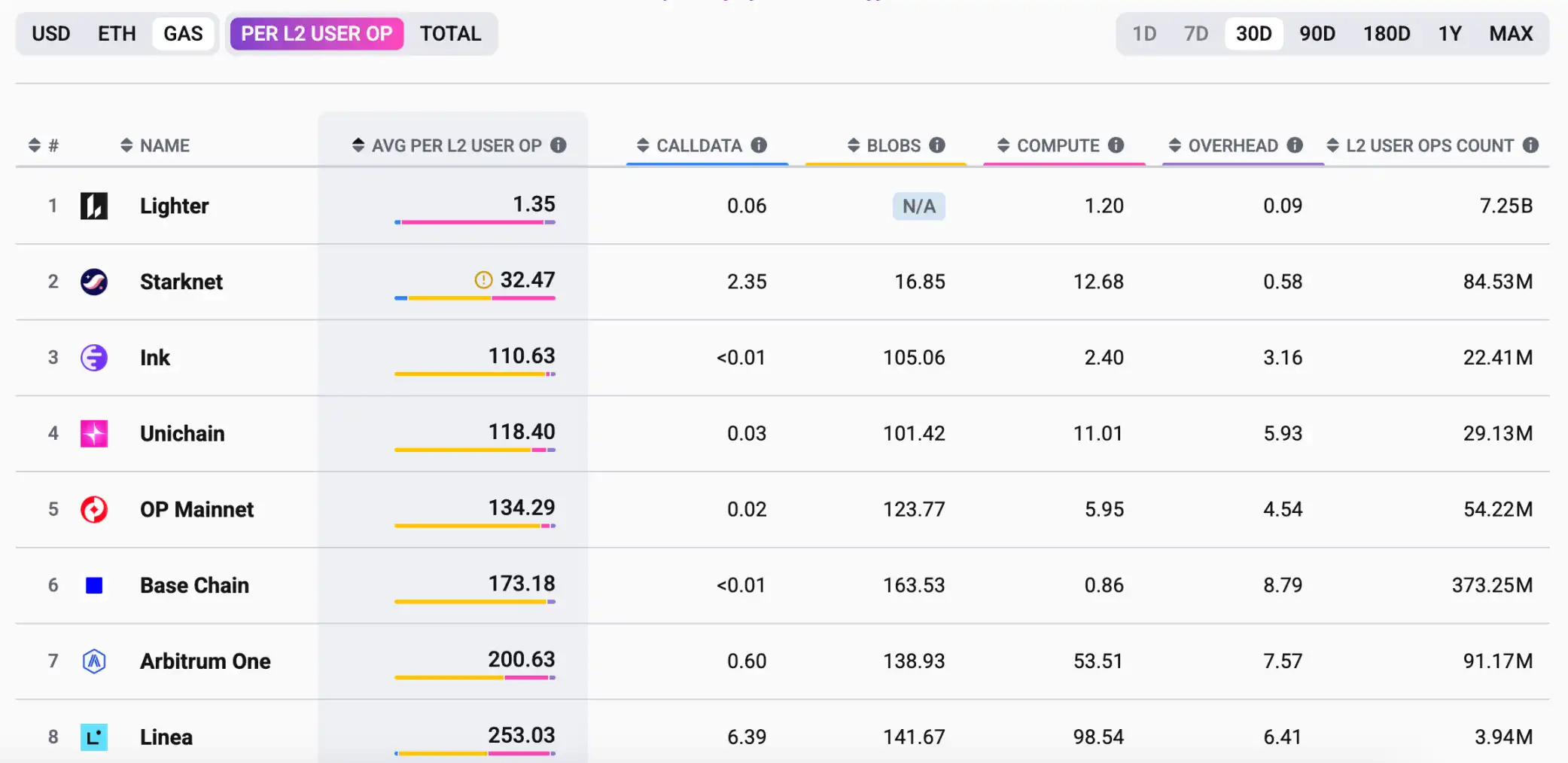
Therefore, with retail traders showing high enthusiasm for trading and high-frequency trading by advanced accounts proving profitable, Lighter only needs to charge fees to advanced accounts. This approach allows Lighter to provide a better user experience and also collect substantial fees from market makers. This mutually beneficial model, as transaction volumes continue to grow, has significantly reduced gas fees.
As a side note, it is currently the second season of the Lighter rewards program, where both retail traders and market makers have corresponding point distribution policies. For retail traders, there are a total of 200,000 points per week, which will be distributed every Friday based on users' trading volume, open positions, earnings, and other factors. Considering that Fortune's report also mentioned tokenized equity funding, Lighter's points are very likely to be a significant consideration for future airdrops.
Even Geniuses Can't Do Everything
Entering Harvard at 16, completing all courses in 3 years, personally recruited by Citadel CEO—these are the kinds of experiences that not even a sensationalist writer would dare to fabricate, yet they actually happened to Lighter founder Vladimir Novakovski. However, even someone as formidable as Vlad faced defeat in the realm of AI social entrepreneurship.
With his engineering and trading talents, Vlad steered Lighter into Web3, attracting a lineup of profit-seeking capital. Founders Fund partner Joey Krug stated that Vlad and his assembled team held 85% to 90% of the decision-making power in investments.
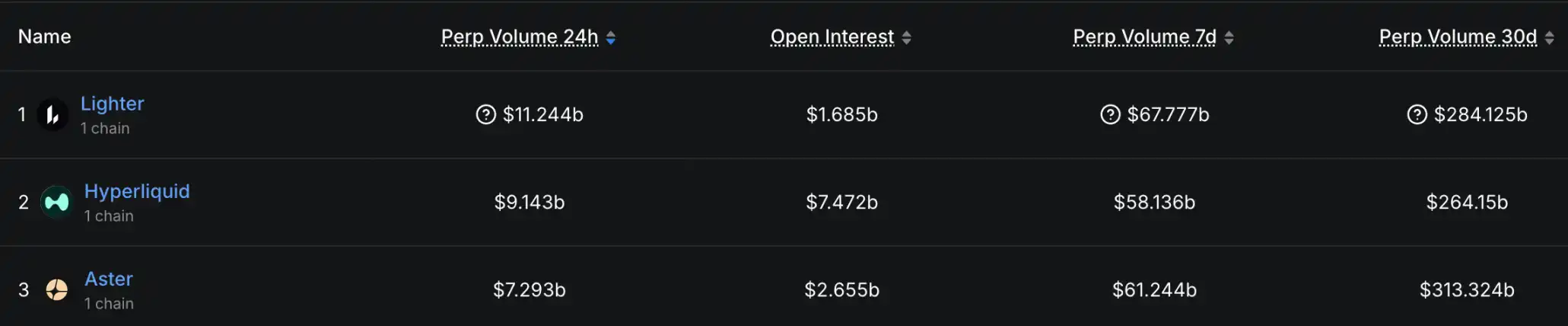
According to DefiLlama data, Lighter's recent trading volume has surged to the top position, although due to zero fees, we cannot rule out visits from airdrop hunters. However, what's intriguing is that the final showdown of the perp DEX, which was believed to have been concluded by HyperLiquid, may just be getting started.
You may also like

March 16 Key Market Intel - A Must-See! | Alpha Morning Report

Google's biggest acquisition ever, why Wiz?

「1011 Insider Whale」 Agent Garrett Jin: After the Houthi blockade, who will run out of steam first?

Vitalik Revisits Ethereum Beacon Chain Architecture, Claude's Off-Peak Transaction Limit Doubled, What Are English-Speaking Communities Discussing Today?

$90 Million Black Hole: War, Power, and the Crypto-Tragedy of the Middle East

The price difference exceeds 50%, and the pre-market arbitrage market for cryptocurrency stocks will become a new business in the crypto bear market

How to Trade Crude Oil: Market Volatility Creates New Opportunities for Crypto Traders
Oil prices are back in focus as geopolitical tensions and supply shifts reshape global markets. Learn how crude oil trading works and explore a $30,000 trading campaign on WEEX.

OpenClaw and AI Bots: From AI Trading to BTC Liquidations in the Crypto Gold Rush
AI crypto trading bots like OpenClaw and AI trading apps are reshaping digital markets. From BTC liquidations to crypto bubble charts, automated trading is expanding alongside free crypto airdrops, affiliate programs, LALIGA partnerships, and tokenized gold markets.

Michael Saylor's advice to young people: read more history and science fiction, and use AI to accelerate personal growth

Morning Report | USDC issuance increased by approximately 1.7 billion in one week; Aave will launch the Aave Shield feature; total circulation of Ethereum is approximately 121.53 million

Circle CEO's latest interview: Stablecoins are not crypto assets

Crypto ETF Weekly | Last week, the net inflow for Bitcoin spot ETFs in the U.S. was $763 million; the net inflow for Ethereum spot ETFs in the U.S. was $160 million
This Week's Key News Preview | The Federal Reserve Announces New Interest Rate Decision; The U.S. Releases February PPI Data

From Human Strategy to AI Trading Bot: How Shadow Trading AI Won 2nd Place in the WEEX Hackathon
Ivan’s Shadow Trading AI secured second place in the WEEX AI Trading Hackathon, demonstrating how AI trading systems built on real market expertise can perform under live market conditions.
Circle CEO’s Insight: The Future of Stablecoins and Digital Financial Platforms
Key Takeaways: Circle completed a noteworthy IPO in 2025, signifying a major milestone in the crypto space. The…

NVIDIA GTC 2026 Set to Gather Global Tech Enthusiasts
Key Takeaways: NVIDIA GTC 2026 will occur in San Jose from March 16-19, bringing together over 30,000 participants.…

What Competitive Edges Still Remain in the AI era?
Key Takeaways: AI’s ability to write code and automate tasks is reshaping traditional job structures, pushing for new…

Aave’s New Protective Layer: Introducing Aave Shield
Key Takeaways: Aave has introduced the Aave Shield feature, designed to block swaps with a price impact exceeding…


 App
App