
Recent Revenue Overview of the Top Seven Mainstream DEXs: Who is Surging Against the Odds?





Original Article Title: "A Close Look at the Recent Performance of Seven Mainstream DEXs"
Original Article Author: Scof, ChainCatcher
Over the past week, the survival status of decentralized exchange platforms has sparked widespread discussions.
Hyperliquid caused a market upheaval with a 50x leverage whale "self-destructive arbitrage," resulting in a loss of nearly $4 million to its HLP insurance pool after absorbing liquidation orders.
On the other hand, during the Pump era, the once shining GMGN also faced a significant challenge. According to Dune's data, the platform's revenue has plummeted from $2.34 million on January 19 to $74,000 on March 11, a drop of nearly 97%. Meanwhile, community feedback on high KOL marketing expenses, user attrition, and increased competition from CEX entries has raised further concerns about GMGN's future among users.
In light of this, ChainCatcher has compiled a rundown of the revenue performance of seven mainstream DEXs in this article for readers' reference.
Quick Takeaways (Cutting to the Chase, Just Look at the Conclusion)
Jupiter and PancakeSwap continue to maintain high daily earnings, with consistent long-term performance. Hyperliquid leads in recent 24-hour earnings but has seen a significant drop from its historical high. Raydium and Shadow Exchange have experienced a sharp decline in earnings, with a noticeable decrease in market activity. Aerodrome, THENA, and others have suffered severe declines but still demonstrate some profitability.
Below is a comparison of the recent 24-hour earnings and historical highest single-day earnings of several mainstream DEXs:
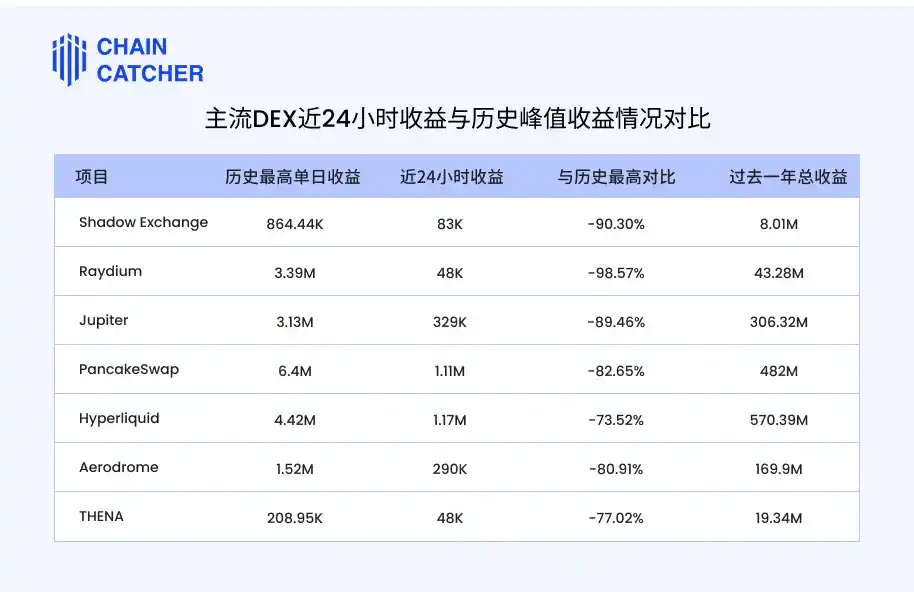
Note: All data in this article is sourced from Defillama and is current as of March 12.
Breaking It Down: A Look into the Current Situation and Trends of Mainstream DEXs
1. Shadow Exchange
· Background and Positioning: Built on a native liquidity layer and exchange platform on Sonic. Supported by the x(3,3) incentive model, it aims to provide an efficient, low-cost trading experience.
· Yield Data: All-time high of 864.44K, 83K in the past 24 hours, a 90.30% decrease.
· Market Performance: Ranked in the top ten cryptocurrency revenue in the past 30 days, with stable user activity. The x(3,3) mechanism improves capital utilization efficiency, the MEV protection mechanism optimizes the trading experience, and both liquidity providers and traders earn significant rewards. The Gems reward system attracts deep involvement in the Sonic ecosystem, driving protocol ecosystem expansion and demonstrating sustained growth potential.
2. Raydium
· Background and Positioning: The leading AMM DEX in the Solana ecosystem, which has attracted a large number of users in the past due to low fees and efficient trading.
· Yield Data: All-time high of 3.39M, only 48K in the past 24 hours, a 98.57% decrease, with a significant drop in market activity. Its native token.
· Market Performance: In 2024 Q4, it once accounted for 61% of the SolanaDEX trading volume but had a TVL of only 39% of Uniswap, indicating active trading but relatively insufficient liquidity. Additionally, since Raydium's trading volume heavily relies on Pump.fun's support, it must seek to expand into new non-meme areas for future growth.
3. Jupiter
· Background and Positioning: The leading DEX aggregator in the Solana ecosystem, providing optimal trade path optimization and serving as a core pillar of Solana DeFi trading volume.
· Yield Data: All-time high of 3.13M, 329K in the past 24 hours, an 89.46% decrease, but still maintaining relatively high activity compared to other DEXs.
· Market Performance: Being the largest DEX in the Solana ecosystem, Jupiter has deep liquidity and high cross-platform integration, with low user trading costs. However, it was recently questioned for insider trading due to the Libra incident, and there are currently no further investigation results.
4. PancakeSwap
· Background and Positioning: As the leading DEX in the BSC ecosystem, PancakeSwap maintains its competitiveness through low Gas fees, fast transactions, and multi-chain scalability (Ethereum, Arbitrum, Polygon, etc.).
· Revenue Data: All-time high of 6.4M, 1.11M in the last 24 hours, a decrease of 82.65%, but still retains high profitability in the DeFi space.
· Market Performance: Thanks to the vibrancy of the BSC ecosystem, PancakeSwap has a wide DeFi user base and continues to expand its product offerings (such as NFTs, staking, etc.).
5. Hyperliquid
· Background and Positioning: A decentralized derivatives trading platform in the Arbitrum ecosystem, Hyperliquid employs an active market-making mechanism, differentiating itself from GMX.
· Revenue Data: All-time high of 4.42M, 1.17M in the last 24 hours, a decrease of 73.52%, but still dominates the DeFi derivatives market.
· Market Performance: Due to the attraction of high-leverage trading, Hyperliquid maintains its lead in trading volume and profitability. However, recently, due to a whale arbitrage event, users have become skeptical of its liquidity management mechanism, leading to a partial run-off of funds.
6. Aerodrome
· Background and Positioning: The core DEX in the Base ecosystem, Aerodrome adopts the ve(3,3) economic model to incentivize liquidity providers and optimize the trading experience.
· Revenue Data: All-time high of 1.52M, 290K in the last 24 hours, a decrease of 80.91%. Market liquidity has declined but still maintains some level of activity.
· Market Performance: Holding a dominant position in the Base ecosystem, Aerodrome benefits from the recent recovery of the Base chain's Gold Dog. With a strong market performance, increasing trading volume, and market capitalization, community engagement remains high.
7. THENA
· Background and Positioning: One of the DEXs in the BNB ecosystem, adopting the ve(3,3) economic model, aimed at improving the sustainability of liquidity incentives.
· Yield Data: All-time high of 208.95K, 48K in the last 24 hours, a 77.02% decrease. Despite the decline, it still maintains some competitiveness within the BSC ecosystem.
· Market Performance: Classified as a second-tier DEX in the BSC ecosystem, facing strong competition from PancakeSwap. However, its ve(3,3) model can still attract some liquidity. According to the website, THENA is currently planning to migrate to the V3 version. This upgrade will introduce a "Hooks" feature, allowing the deployment of smart contracts on specific liquidity pools to execute specific logic upon user interaction. This will provide support for advanced order types, complex applications, and customized needs, further enhancing the protocol's flexibility and functionality.
Currently, decentralized exchanges overall are experiencing a trend of declining yields, intensified competition, and structural differentiation. The revenues of mainstream platforms have generally fallen by 70%-98% from their historical highs, significantly impacting market activity.
Jupiter and PancakeSwap still lead the pack, with high daily yields and relatively stable long-term performance, maintaining their competitiveness through ecosystem development and user base. Hyperliquid still holds a place in the derivatives market but faced liquidity issues due to a whale arbitrage event raising concerns over its risk management capabilities. Raydium and Shadow Exchange saw significant drops in yield, with the former being affected by the decline in Pump.fun's trading volume, and the latter due to overall market activity weakening. Aerodrome and THENA still have some profit potential but face pressure from stronger competitors within their respective ecosystems.
Looking ahead, DEXs still need to address three core issues:
· How to Maintain Trading Activity—As the market cools down and user trading willingness decreases, how can DEXs enhance user stickiness?
· How to Optimize Liquidity Management—With whale arbitrage and increased CEX competition, how can platforms build a more robust liquidity system in the DeFi space?
· How to Achieve Sustainable Revenue—During a bear market cycle, a high fee model is difficult to sustain long-term. Do DEXs need a new revenue model?
Facing industry challenges, the future survival path of DEXs may no longer be just about trading volume, but about liquidity, risk control mechanisms, and ecosystem development.
You may also like

Morning News | CME Group launches Nasdaq Cryptocurrency Index futures; Asset management giant Janus Henderson strategically invests in Ethena

Bitcoin Layer 2 Network Botanix: Why Did We Choose to Dissolve?

Why did Oracle deliver the strongest financial report in history, yet its stock price fell?
When the P2P illicit funds from ten years ago turned into 60,000 bitcoins

Dialogue with OmenX Founder: Why does the prediction market need an evolution from "spot" to "derivatives"?
Galaxy in-depth report: Is Solana still worth paying attention to?

Young people in South Korea make a "final effort" in the epic bull market

The pricing controversy of Trade.xyz exposes the fatal weakness of Pre-IPO perpetual contracts

How much longer can Ethereum's last big buyer hold on?

World Cup 2026 Coming – WEEX Celebrates with $1M Prize Pool & Michael Owen Live

Morning Report | OpenAI has submitted an S-1 registration statement draft to the U.S. SEC; Morpho completes $175 million financing

Galaxy Deep Research Report: How Hyperliquid's HIP-4 Upgrade Changes the Landscape of Prediction Markets?

Latest research from 13 top universities including Cornell University: The current state, challenges, and misconceptions of the fusion of Crypto and AI

Deconstructing Anthropic: The Best AI Company, Possibly Also a Type of Organizational Invention

Every exchange is a "Universal Exchange."

The counterattack of traditional finance: Alliance chains are quietly reviving
Pantera Capital Partner: How Tokenization is Restructuring the Private Equity and Early Investment Ecosystem?

Mastercard Launches Agent Pay for AI, Plans to Record AI Agent Payment Authorizations on Polygon
Mastercard launched Agent Pay for AI, a new payment protocol designed to help AI agents make small payments such as pay-per-use access to data and APIs. The system plans to record human-granted AI agent permissions on Polygon, focusing on verifiable authorization, identity, and payment controls.
Morning News | CME Group launches Nasdaq Cryptocurrency Index futures; Asset management giant Janus Henderson strategically invests in Ethena
Bitcoin Layer 2 Network Botanix: Why Did We Choose to Dissolve?
Why did Oracle deliver the strongest financial report in history, yet its stock price fell?
When the P2P illicit funds from ten years ago turned into 60,000 bitcoins
Dialogue with OmenX Founder: Why does the prediction market need an evolution from "spot" to "derivatives"?
Galaxy in-depth report: Is Solana still worth paying attention to?


