
- Buy Crypto
- Markets
 Futures
- Spot
- Copy Trade
- Earn
- More
Parse Haedal Protocol: Sui Liquidity Staking Gem Project, TVL Ratio Exceeds Sum of Competitors

Original Author: nicoleliu.eth
Original Translation: Tim, PANews
PANews Editor's Note: The Sui ecosystem liquidity staking protocol Haedal will conduct its TGE on April 29, and users can claim airdrops. The author of this article is a founding partner at Comma3 Ventures, which participated in the seed round investment of the Haedal Protocol. Haedal Protocol is a hidden gem in the liquidity staking sector of the Sui ecosystem. With the Sui staking market gaining momentum, Haedal's innovative products and strong data make it one of the preferred DeFi investment targets.
Below are the reasons to invest and key points to watch (all data as of April 15)
The liquidity staking market in the Sui network is not yet thriving, with a total value of staked SUI at $3.0748 billion, of which only 2% is liquid. In comparison: Solana's staked SOL value of $42.9 billion has 10.1% liquidity; Ethereum's staked ETH value of $102.5 billion has 30.5% liquidity. With the development of the Sui ecosystem, the Haedal staking protocol, currently with a $120 million TVL, is poised to become the flagship of liquidity staking in this ecosystem.
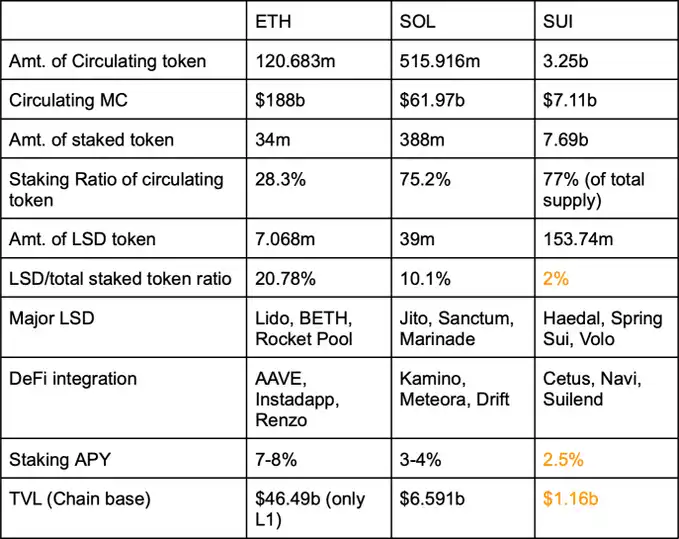
One major issue in Sui's liquidity staking derivatives market is its low staking annual percentage yield, at about 2.5%, while Solana's APY is 7-8% and Ethereum's is 3-4%.
By adopting a dynamic validator selection mechanism and the innovative Hae3 framework, including the three major components of HMM, HaeVault, and HaeDAO, Haedal has significantly improved the staking performance of the Sui network, surpassing other LSD protocols. Haedal monitors the status of all network validation nodes and selects the node with the highest APR for staking. When unstaking, Haedal prioritizes withdrawing funds from nodes with lower APR, a strategy that continuously maintains high APY for liquidity staking tokens.
HMM (Haedal Market Maker) optimizes the liquidity on various DEXs on the Sui blockchain by combining oracle pricing and real-time market data, collecting a 0.04% transaction fee.
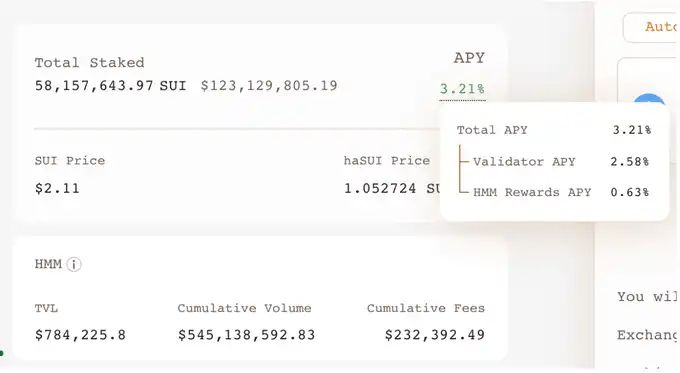
From February to March, the trading volume increased from $59.13 million to $284.15 million, generating a fee of $236,000, with an average TVL of $800,000 during the period. After allocating 50% of the revenue for incentives, haSUI's annualized yield increased by 24.4%, rising from 2.58% to 3.21%.
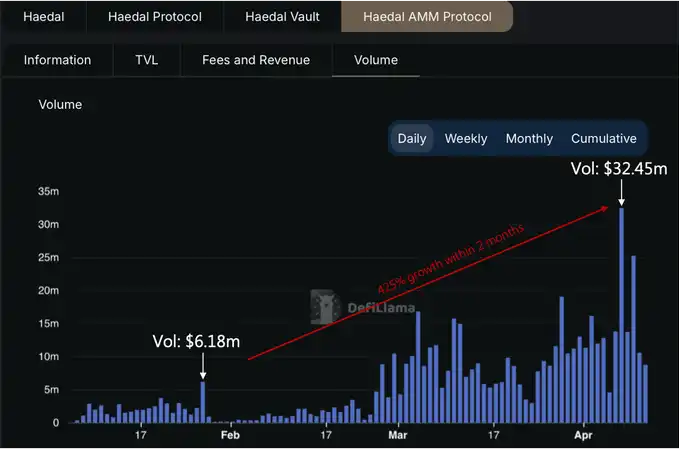
The Cetus Protocol is the largest DEX in the Sui ecosystem, with a daily trading volume of $92 million. Haedal, launched on January 6, 2025, currently has a daily trading volume of $5.69 million, equivalent to 6.12% of Cetus's trading volume. Through the adoption of an oracle pricing mechanism, HMM is poised for growth and is expected to achieve rapid revenue growth by capturing arbitrage trading volume.
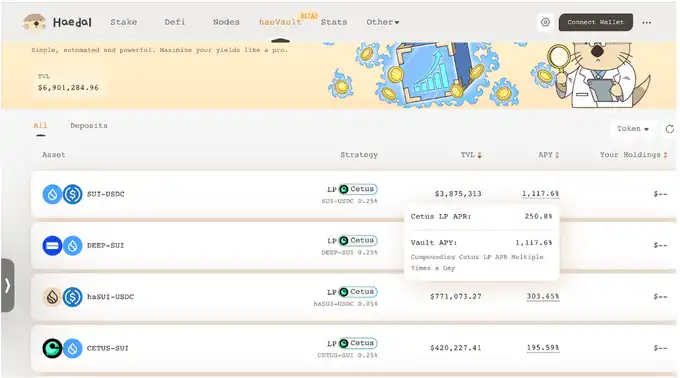
The Haedal Vault simplifies the liquidity provision process for users with idle funds, eliminating the cumbersome management of LP positions, allowing users to easily deposit funds and earn higher returns.
HaeVault enhances yield through a super narrow rebalancing strategy. Taking the SUI-USDC pair as an example, while the Cetus platform offers an annual yield of 250.8% (based on Cetus data), HaeVault has achieved a 1117% annual yield, with a net yield as high as 938% after deducting a 16% fee.
Hae3 is deeply integrated into the Sui DeFi ecosystem (TVL exceeding $1 billion). The HMM protocol captures DEX fee revenue, the Haedal Treasury optimizes liquidity provider returns, and the HaeDAO confers governance decision-making power. Volo and Suilend, focused on basic staking and lending services, lack this synergistic effect, making Haedal a superior yield optimizer.
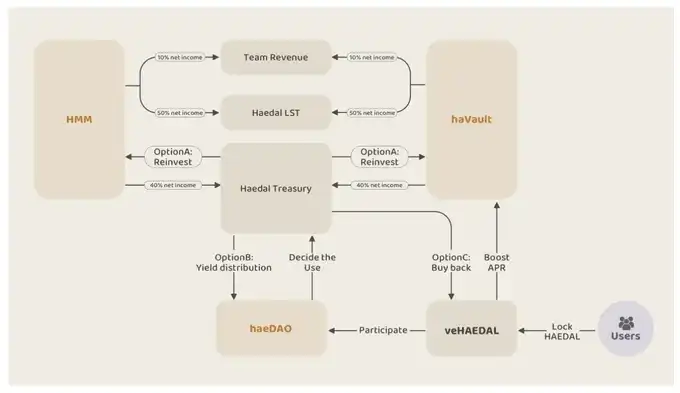
The use case of the HAEDAL token further solidifies its utility value. By locking it as a veToken, one can participate in HaeDAO governance or use it to boost the Treasury's annual yield. Additionally, potential airdrop opportunities (a common occurrence in the Sui ecosystem) provide additional advantages.
Haedal shows strong core metrics: TVL reaching $1.1736 billion (in comparison to Suilend's $1.174 billion and Volo's $50 million), with over 44,000 active wallets and 794,000 holders. Currently, Haedal leads in trading volume, annual yield, and holder scale, in the three key metrics.
The support of VC firms such as Hashed, Comma3, OKX Ventures, and Animoca Brands further illustrates its potential.
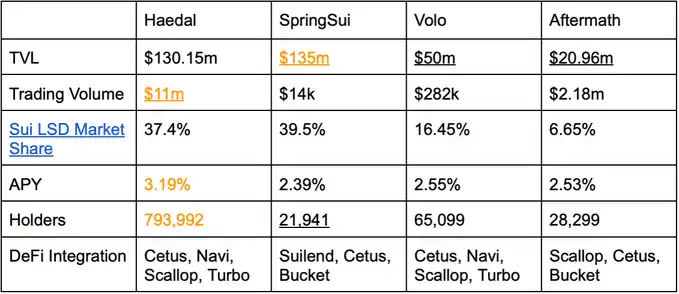
Haedal stands out with its high-growth market (LSD penetration rate is only 2%, with 10x upside potential), innovative products, and strong fundamentals. With the expansion of the Sui ecosystem, the protocol is well-positioned in the liquidity staking space and is poised to become an industry leader.
You may also like

NVIDIA's Jensen Huang's new article: The "Five-Layer Cake" of AI

In-depth Analysis of ERC-8183: The Answer to the Trust Issue of Ethereum-Powered AI Agents
Stock Tokenization Revolution: Market Dynamics, Product Architecture, and Regulatory Moat Panorama Report

The current Lobster Skill is just yesterday's Fruit Ninja, only meant to get you acquainted.

Key Market Intelligence on March 10th, how much did you miss out on?

IOSG: From Interest-Bearing Stablecoins to Crypto Credit Products

NVIDIA CEO Jensen Huang's Latest Article: The "Five Layers of AI"
Daily Observation of Cryptocurrency Concept Stocks: Nasdaq Bets on Stocks on the Blockchain, Strategy Buys Another 17,994 BTC, ETH Treasury Stocks Enter Production Period
One-click onboarding to RootData, allowing project information to be accurately presented on over 200 platforms including Binance Wallet, Gate, TP, and more
To the Builders who are still persevering in the crypto industry
Oil Price Cools Off, Crypto Bounces Back

a16z Releases Top 100 AI Applications List, Models Are Moving Out of the Browser and App

If you only follow the news, you may have misconstrued this Iran conflict

ERC-8183: Write a Rule for a $3M On-Chain Agent Business

AI Mistakenly 'Tips' $260,000, Makes It All Back in 24 Hours

Arthur Hayes: Why is HYPE a 5x Moonshot?
OpenClaw Money-Saving Strategy: Saving Two Thousand a Month - What Am I Doing Right?


 App
App