
Market Maker Operations Behind the Scenes: The Full Operation Chain of a Coin Circle "Harvester"


Original Article Title: "Behind the GPS, SHELL Meltdown: The Complete Operation Chain of a Crypto Harvesting Machine"
Original Article Author: Fairy, ChainCatcher
Liquidity is the lifeline of maintaining price stability, and liquidity providers are the guardians of this lifeline. However, what chaos ensues when these guardians turn into "predators"?
Within 20 minutes of GPS's listing on an exchange, the price plummeted below the opening price, dropping 74% from a high of $0.15. SHELL fell from $0.7 to $0.26. Both GPS and SHELL tokens displayed nearly identical price charts, as if manipulated by the same invisible hand.
With Binance's investigation and continuous community whistleblowing, this event quickly became the weekend topic for everyone. A hidden interest chain slowly emerged, and names like Web3Port, Whisper, and May Liu were thrust into the spotlight. The backstage of the meltdown was more astonishing than imagined...
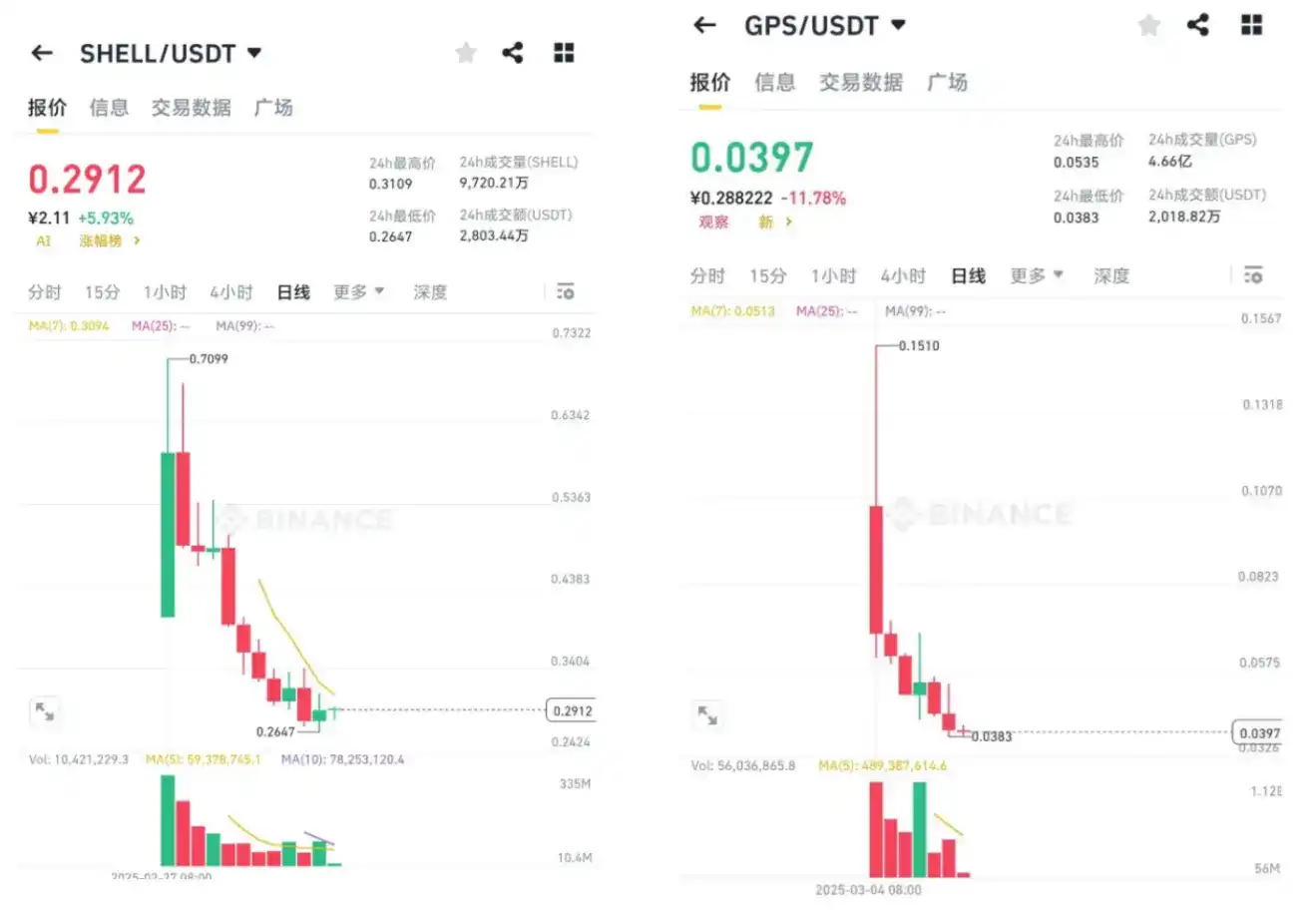
GPS, SHELL Price Chart
One-Sided Liquidation by Liquidity Provider Leads to Price Collapse
A Binance announcement revealed that the recent abnormal price of GPS was directly caused by a specific liquidity provider. This liquidity provider engaged in only selling operations within 21 hours, entirely neglecting its buy-side obligation, and dumped a large amount of 70 million GPS tokens, profiting approximately $5 million. This sell-off action led to a crash in the token price, nearly depleting market liquidity.
Subsequently, Binance's investigation found that both of these crypto projects had entrusted the same liquidity provider to manage their token liquidity.
As a result, Binance delisted the liquidity provider and prohibited it from continuing market-making activities on the platform. Furthermore, Binance confiscated the profits gained by the liquidity provider through its illicit operations and plans to use these funds to compensate the affected users of the GPS and SHELL projects. The specific compensation plan will be further announced by the project teams.
Unveiling the Mastermind: The Complete Chain of Market Manipulation
As the event escalated, the community swiftly dug deeper, revealing the true face of the mastermind behind the scenes. This event not only exposed a market-manipulating liquidity provider but also uncovered a long-active arbitrage chain in the crypto world.
The crypto KOL @_FORAB revealed that the passive market maker of GPS and SHELL is GSR, while the active market maker is the Shanghai-based team Web3Port.
Further investigation found that Web3Port leveraged token lending to its affiliated market maker Whisper, which, under Web3Port's Binance account, received internal approval and executed consecutive sell-offs, eventually leading to a market crash. Multiple industry insiders confirmed that Web3Port and Whisper are part of the same team, forming a complete arbitrage chain from token acquisition to cash-out.
May Liu and the "Arbitrage Pipeline"
Web3Port partner May Liu's long-standing business operation in the crypto circle has come to light—a specialized arbitrage pipeline targeting project teams and exchanges from Spark Digital Capital to Web3Port, and then to Whisper.
· Spark Digital Capital Era (VC Disguise):
May Liu operated in the crypto circle under the guise of a VC firm, primarily engaging in market-making outsourcing and financial advisory (FA) business. By packaging projects, she obtained free tokens, which Spark Digital Capital then persuaded other VC firms to invest in, turning these genuinely investing VCs into "bagholders," while she engaged in risk-free arbitrage.
· Web3Port Incubator (Free Token in Exchange for Services):
After 2021 and 2022, as VC competition intensified, project teams became increasingly reluctant to provide tokens for free, challenging this arbitrage model. Therefore, May Liu founded the Web3Port Incubator, catering to early-stage projects, providing packaging, guidance, connecting with VC resources, in exchange for 1%-3% of free token allocation.
· Whisper Market Maker (Cash-Out Outlet):
Relying solely on free tokens was insufficient to complete the arbitrage. Therefore, Web3Port also established the Whisper market maker, ostensibly providing liquidity to project teams but actually offering a cash-out channel for "their own free tokens." Through internal authorization, Whisper could conduct large-scale token sell-offs on exchanges like Binance, cash out, and exit, with retail investors becoming long-term "ATMs".
@_FORAB says, "The so-called Binance Express, to some extent, they have indeed achieved it, and for a long time."

A Controversy Arises: Who Should Be Held Responsible for This 'Trash Market'?
Blaming the Market Maker Doesn't Hold Up
@yuyue_chris says, "The project team is essentially an 'ATM,' with the market maker responsible for helping the project team cash out the tokens and distributing the proceeds according to the agreed-upon ratio. In this relationship of intertwined interests, the unilateral action of the market maker to sell off large quantities against the project team's wishes is highly unlikely."
@silverfang88 says, "I think the decision to dump was most likely made jointly by the project and the market maker. In a bearish market, the market maker may advise the project team to sell early, not to hold, because 'Binance new listings always cascade sell,' and the project team acknowledges this, eventually reaching a consensus that together triggered the continuous sell-off in the market.
On the other hand, the project team itself failed to attract enough buying pressure, with insufficient market depth. It couldn't withstand the selling pressure or expand the order book, leading to sell orders consistently dominating, driving the price downward.
Game of Greatness mentioned how the NYSE's past market makers used openly available exchange information to exploit information asymmetry and manipulate the market to harvest retail investors."
@0xJamesXXX says, "Another overlooked issue is that according to the project team's publicly disclosed tokenomics, investors/incubators' tokens are far from unlocking. But why does this institution have so many already unlocked tokens to sell? Is the project team deceiving investors? Or are they using other unlocked tokens, like those received through airdrops, to sell these tokens?"
All Parties Acting Evil for Self-Gain, the Entire Value Chain Needs Reflection
@forgivenever says, "The reason the market is currently in this predicament is that the entire industry's value chain is full of all parties acting evil, yet pretending to be ignorant.
Blaming individual scapegoats does not help solve the problem. What truly needs reflection is how exchanges, VCs, project teams, KOLs, market makers, and all other links have collectively led to the situation where retail investors are repeatedly harvested."
Regarding Binance's handling of this incident, there are also many opinions in the market:
@armonio_liang said, "If Binance's move is aimed at reshaping industry rules and promoting the improvement of the exchange regulatory system, I support it. Looking back at Wall Street's development, many regulatory systems originated from industry self-regulation to achieve a healthier market environment.
However, if this action is merely a one-time clean-up operation aimed at reallocating the interests between institutions and retail investors, then the exclusion of market makers appears more arbitrary and less convincing than in traditional financial markets."
Supporters: Binance Cleansing the Market Environment
"Thumbs up for Binance. If there is no cost to wrongdoing, even the originally neutral will gradually lean towards evil."
"Protecting user interests, combating violations, Binance's move is very powerful. Hopefully, other exchanges can follow suit to jointly maintain market order."
"Binance has shown its commitment to the community and its pursuit of industry fairness."
Opponents: Intervening in Market Free Competition
"Although the approach is very just, this is not very decentralized."
"Binance's 'iron-fist' rectification this time, is it aimed at protecting retail investors' interests, or is it intended to further strengthen its control over the market? After all, the subtle relationship between exchanges and market makers is well known in the industry, and Binance itself may not necessarily be able to stay outside this system."

This storm triggered by the GoPlus and MyShell events has brought out deep-seated conflicts of interest and regulatory flaws in the crypto industry. Blaming individual market makers for market chaos is oversimplifying and overlooking the roles of exchanges, VCs, projects, KOLs, and others in the benefit chain.
So, who should be held responsible for this 'trash market'?
In the future, it may only be an endless 'Great Game'...
You may also like

How much longer can Ethereum's last big buyer hold on?

The pricing controversy of Trade.xyz exposes the fatal weakness of Pre-IPO perpetual contracts

World Cup 2026 Coming – WEEX Celebrates with $1M Prize Pool & Michael Owen Live

Galaxy in-depth report: Is Solana still worth paying attention to?
Young people in South Korea make a "final effort" in the epic bull market

Dialogue with OmenX Founder: Why does the prediction market need an evolution from "spot" to "derivatives"?
When the P2P illicit funds from ten years ago turned into 60,000 bitcoins

Morning News | CME Group launches Nasdaq Cryptocurrency Index futures; Asset management giant Janus Henderson strategically invests in Ethena
Why did Oracle deliver the strongest financial report in history, yet its stock price fell?

Bitcoin Layer 2 Network Botanix: Why Did We Choose to Dissolve?

Morning Report | OpenAI has submitted an S-1 registration statement draft to the U.S. SEC; Morpho completes $175 million financing

Galaxy Deep Research Report: How Hyperliquid's HIP-4 Upgrade Changes the Landscape of Prediction Markets?

Latest research from 13 top universities including Cornell University: The current state, challenges, and misconceptions of the fusion of Crypto and AI
Deconstructing Anthropic: The Best AI Company, Possibly Also a Type of Organizational Invention

Every exchange is a "Universal Exchange."

The counterattack of traditional finance: Alliance chains are quietly reviving
Pantera Capital Partner: How Tokenization is Restructuring the Private Equity and Early Investment Ecosystem?

Mastercard Launches Agent Pay for AI, Plans to Record AI Agent Payment Authorizations on Polygon
Mastercard launched Agent Pay for AI, a new payment protocol designed to help AI agents make small payments such as pay-per-use access to data and APIs. The system plans to record human-granted AI agent permissions on Polygon, focusing on verifiable authorization, identity, and payment controls.
How much longer can Ethereum's last big buyer hold on?
The pricing controversy of Trade.xyz exposes the fatal weakness of Pre-IPO perpetual contracts
World Cup 2026 Coming – WEEX Celebrates with $1M Prize Pool & Michael Owen Live
Galaxy in-depth report: Is Solana still worth paying attention to?
Young people in South Korea make a "final effort" in the epic bull market
Dialogue with OmenX Founder: Why does the prediction market need an evolution from "spot" to "derivatives"?


