
- Buy Crypto
- Markets
 Futures
- Spot
- Copy Trade
- Earn
- More
Is the U.S. Stock Market Facing a Crash Risk Tonight as Well?

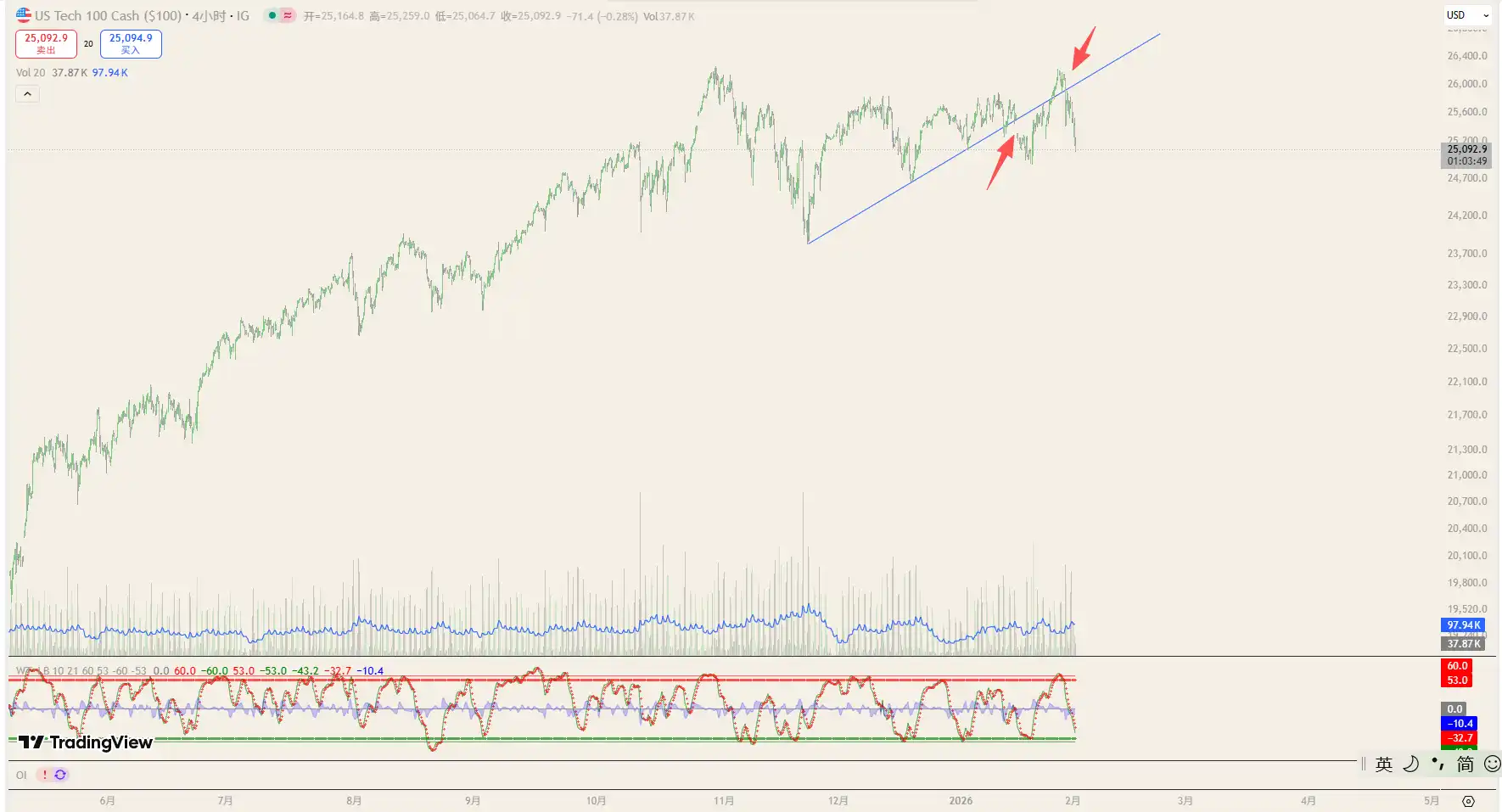
Following the plunge of gold and silver, US stocks are also under pressure. On February 2, Nasdaq index futures fell nearly 1% in pre-market trading, the S&P 500 index has retraced 0.43% from its peak, and the fear index VIX surged to 17.44, indicating a significant shift in market sentiment towards caution.
Technically, the Nasdaq index has been oscillating at high levels for three months, forming a rising wedge pattern. Now, this critical uptrend line has been breached for the second time, dealing a severe blow to market confidence.
If tonight's daily closing price is below the previous low, forming a "Lower Low," then a larger downtrend may unfold.
Adding to market unease is the continued fallout from last weekend's "Epstein Files." This batch of over 3 million pages of documents has implicated Kevin Warsh, the next Federal Reserve Chair nominee selected by the Trump administration.
His name appeared on the guest list for the 2010 "St. Barts Christmas Party" email. This has transformed distant political gossip into a tangible risk hanging over the market.
Escalation of Political Risk
Market panic primarily stems from a reassessment of policy uncertainty in the "Trump 2.0" era. Warsh is a staunch hawk, and his nomination almost signals the end of the low-interest-rate era.
Warsh has long been a vocal critic of the Federal Reserve, believing that a "regime change" is necessary. He has publicly rebuked the Fed for cutting rates by a full percentage point when inflation exceeded the target in 2024, only to backtrack afterwards, damaging its credibility.

Kevin Warsh, the next Federal Reserve Chair nominee selected by the Trump administration
Warsh's core argument is that the Fed's bloated balance sheet distorts the healthy functioning of the economy and inflates asset bubbles. He advocates for balance sheet reduction, even if it means achieving it through tightening policies. This combination of "hawkish rate cuts" has raised concerns in the market about a sharp tightening of future monetary policy.
The release of the Epstein Files has exposed a significant, unpredictable political risk to the market. While there is currently no evidence of Warsh's involvement in illegal activities, his association with this century-defining scandal itself poses a major political liability, further complicating an already controversial nomination.
In addition, the Trump administration's iconic tariff policy has also caused market concerns due to its uncertainty. If a new round of tariffs expands in scope, it will not only impact consumer confidence and corporate profits but may also further swell the already huge fiscal deficit.
Forecasts indicate that in just the first three months of 2026, the U.S. fiscal deficit will reach $601 billion. This fiscal outlook, combined with the political trust crisis exposed by the Epstein files, collectively forms an extremely fragile market environment.
Global Markets and Commodity "Bloodbath"
The commodity market was the first to ignite the "long liquidation" stampede. Traditional safe-haven assets such as gold and silver experienced an epic collapse, with gold prices plummeting by 12% at one point, and silver flash-crashing by 36%, marking the largest single-day decline since 1980, with a trading volume of 30 billion under ETFs. High-leverage long positions were swiftly liquidated within a short period.
As prices fell, the Chicago Mercantile Exchange (CME) quickly raised margin requirements for gold and silver futures. For example, the margin ratio for non-high-risk accounts in silver futures was increased from 11% to 15%. This forced many underfunded long traders to be liquidated, triggering further sell-offs that crushed prices, creating a vicious cycle. According to statistics, the liquidation amount in tokenized futures alone reached as high as $140 million within 24 hours.
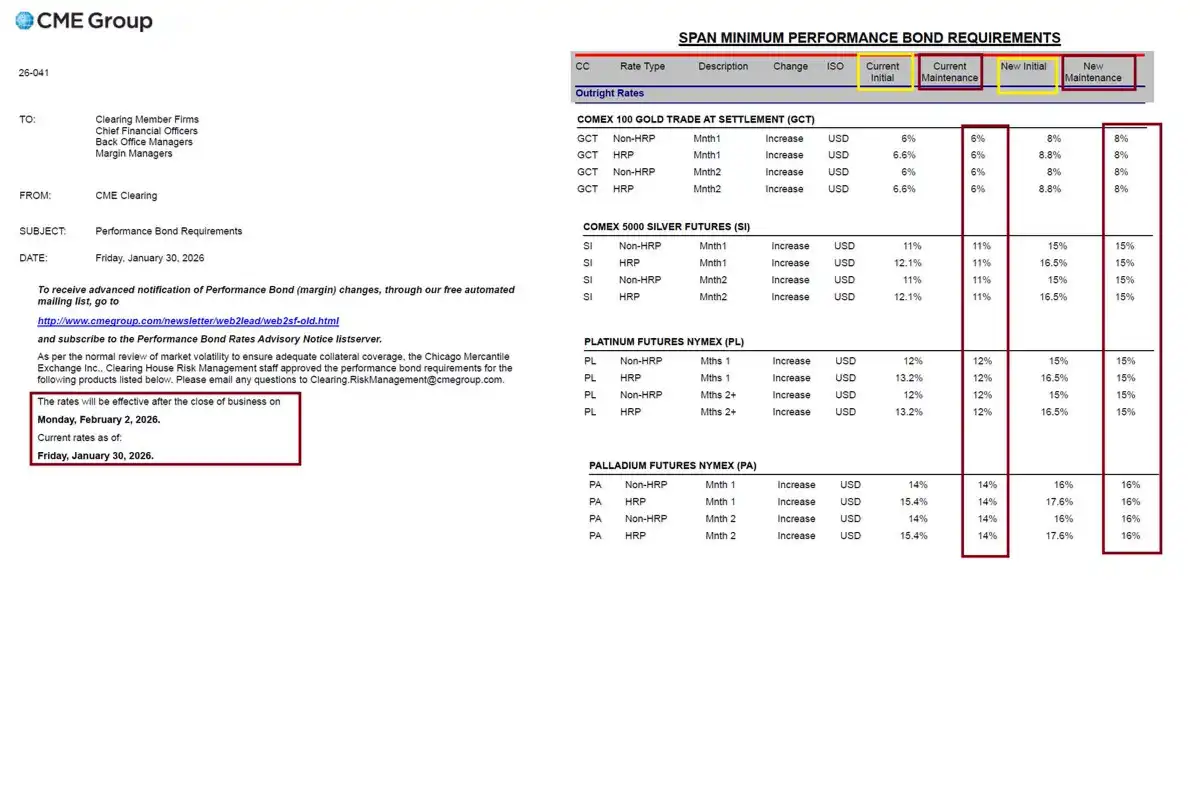
The Chicago Mercantile Exchange announced the margin ratio was increased from 11% to 15%
This storm also spread to the domestic market, with multiple gold shops in Shuibei, Shenzhen, experiencing a "bankruptcy" due to participating in unqualified gold futures gambling transactions, involving an amount of possibly hundreds of billions, affecting thousands of investors.
Crude oil prices were also not spared, falling by 5.51% to $61.62 per barrel. The softness in the Asian stock markets had already sounded the alarm, with the Nikkei index falling by 1.11% and the Hang Seng index plummeting by 3.15%. Bitcoin, as a risk asset indicator, also dropped below the psychological level of $75,000. Behind this series of chain reactions, a global deleveraging event may be unfolding.
When investors in one market (such as commodity futures) are forced to liquidate due to high leverage, they have to sell assets in other markets (such as Asian stocks, bitcoin) to raise margin, triggering cross-market risk contagion. If this liquidity drought continues, the next assets to be sold off could potentially be the overvalued U.S. stocks.
Economic Data and the AI Bubble
The cracks at the economic level are becoming increasingly clear. The upcoming job report has become the focus of the market's attention. Once the data shows an unexpected cooling in the labor market, concerns about an economic recession will quickly intensify. The Federal Reserve is currently maintaining interest rates, but faced with persistent inflation, its policy space is extremely limited. If inflation fails to recede as expected, future rate hikes will be inevitable.
The yield on the 10-year U.S. Treasury bond has risen to 4.218%, and the massive amount of interest the U.S. government needs to pay on its debt each year is further exacerbating its fiscal situation. Historically, an inverted yield curve has repeatedly been a reliable leading indicator of an economic recession, and the market is once again approaching this dangerous edge.
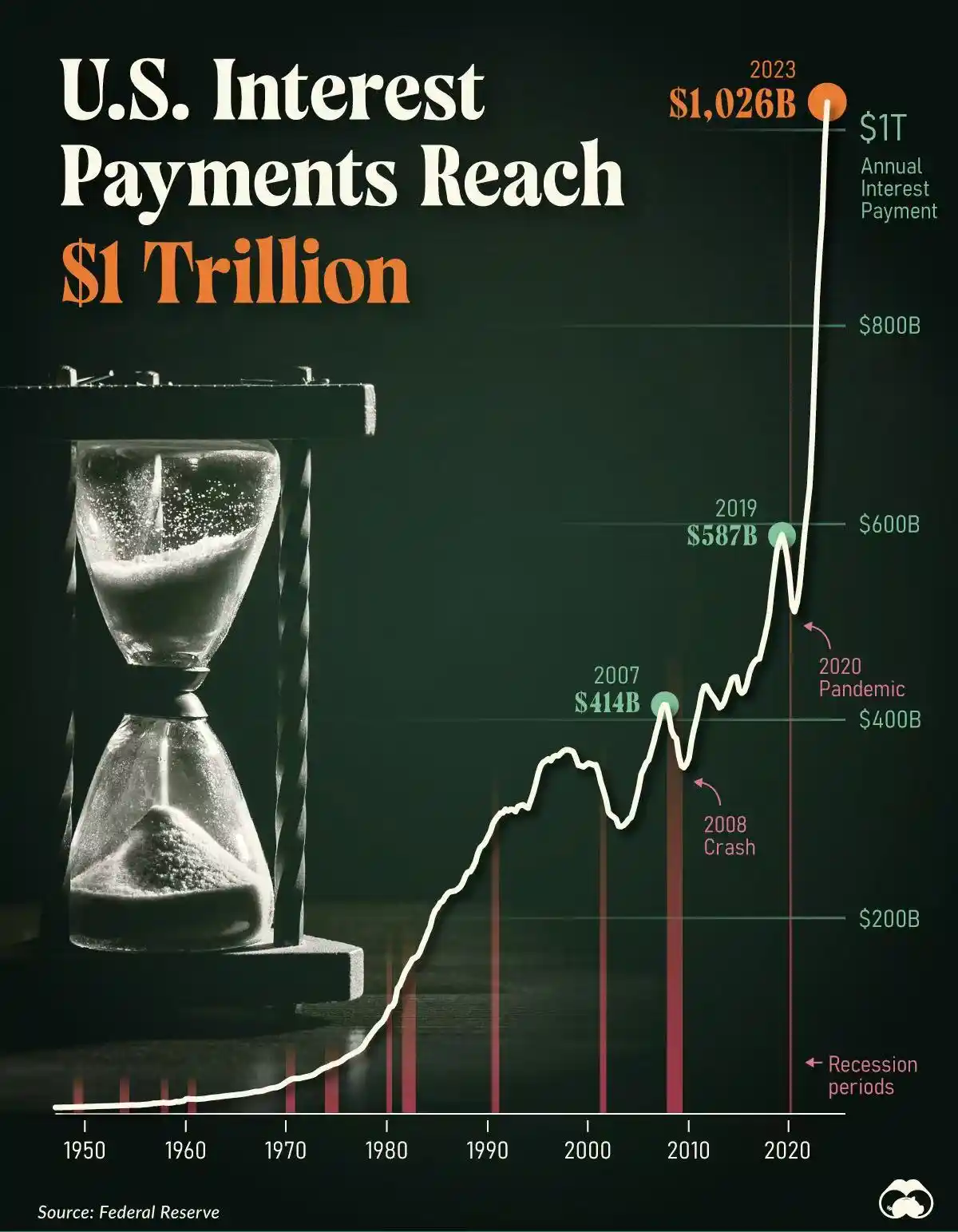
Historical trend of total U.S. government debt interest payments, which have now surpassed $1 trillion
Meanwhile, the AI narrative that underpinned the market prosperity of 2025 is also showing cracks. The recent weakness in the Nasdaq index, especially in software stocks becoming the most oversold sector in the S&P 500, indicates that the market's enthusiasm for AI is cooling off.
Investors are beginning to realize that the commercialization and profit realization of AI are much longer and more challenging than imagined.
The upcoming earnings season, especially the financial reports of tech giants like Amazon and Alphabet, will be a "litmus test" to evaluate the true capability of AI. If the reports fall short of expectations, a large-scale sell-off may be hard to avoid.
The Ghost of 1979
The current geopolitical and macroeconomic environment bears striking similarities to 1979, causing many seasoned investors to feel uneasy.
1979 marked the end of the era of detente in the Cold War. In December of that year, the Soviet Union invaded Afghanistan, leading to a sharp deterioration in U.S.-Soviet relations and a peak in global geopolitical tensions.
Almost simultaneously, the Iranian Revolution triggered the second oil crisis, causing oil prices to skyrocket and the global economy to fall into a state of "stagflation" (economic stagnation combined with high inflation). Back then, under political pressure, the Federal Reserve failed to take timely decisive action, resulting in uncontrolled inflation. It ultimately took the new chairman, Paul Volcker, implementing a sharp rate hike through "shock therapy" to contain it, but not without the cost of a deep economic recession.
Today, we are facing a similar situation once again: Middle East geopolitical tensions. According to prediction market Polymarket, as of February 2, the market believes there is a 31% probability of the United States striking Iran by the end of this month, with an insider whale betting big on regime change in Iran.
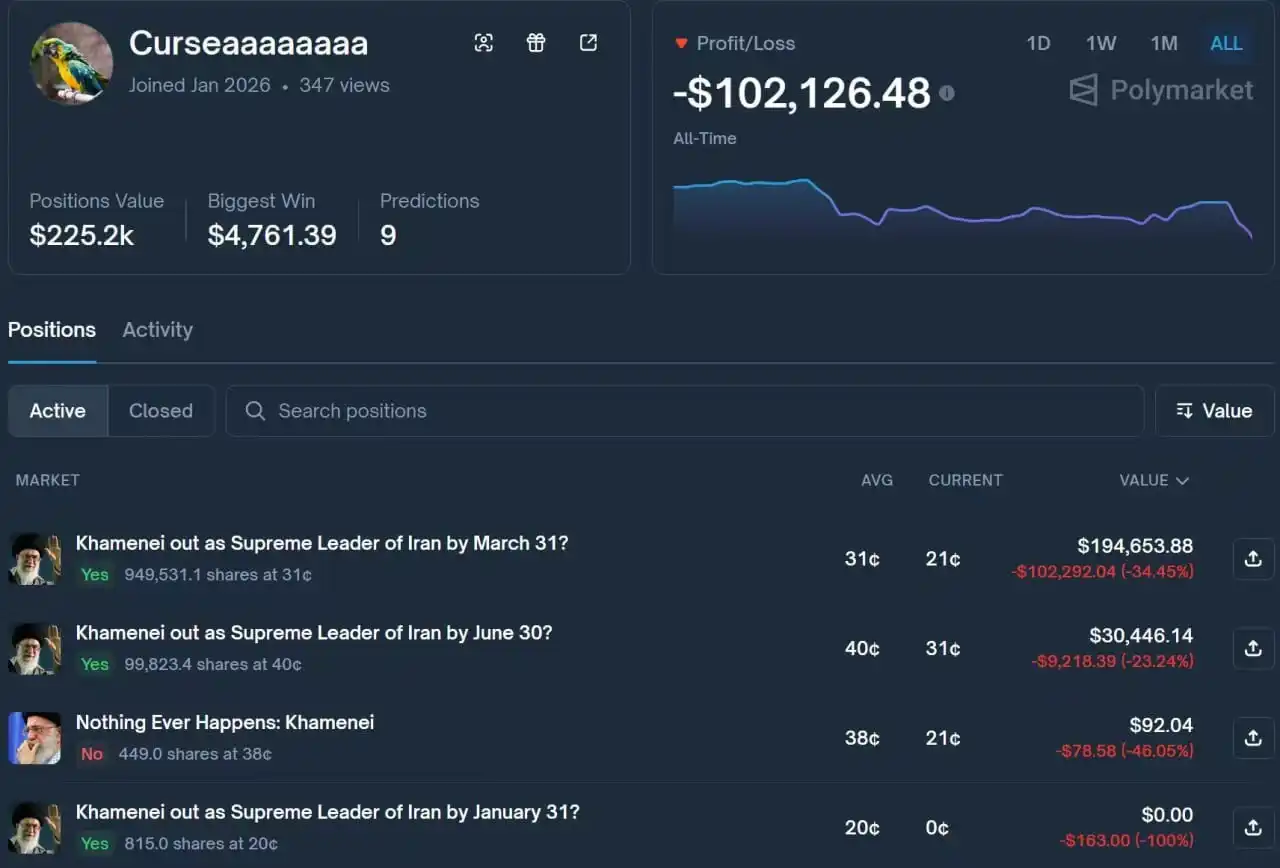
Polymarket insider whale heavily bets on regime change in Iran, total bet $336.7k | Source: Polybeats
Meanwhile, energy prices are experiencing significant volatility, and global inflation pressures remain high. Concerns about potential interference by the Trump administration in the Federal Reserve's independence, along with the nomination of hawkish figure Warsh, are reminiscent of past policy mistakes made under political pressure.
If history repeats itself, the aggressive tightening policies implemented to control inflation could bring an end to the current artificially prolonged bull market, leading to a crisis of confidence in the US dollar and a significant stock market correction similar to the late 1970s to early 1980s.
For investors who have been riding high in the euphoria of 2025, now may be the time to reassess risks and prepare for potential market turbulence ahead.
You may also like

US & Canada Crypto Tax Season 2026: Official Tax Reporting Support from WEEX × KoinX
Prepare for US & Canada crypto tax season 2026. Learn how to export your WEEX transaction history and access official reporting support through our partnership with KoinX.

Conversation between Tom Lee and "The Big Short" Author: AI has detected bubble signal, crypto correction due to gold liquidity being "siphoned off"

The true reason for Claude's ban, Kraken accessing the Federal Reserve payment system, What is the English community paying attention to?

「Buying the Dip」 of 400,000 BTC: Is $74,000 a Rebound or a Reversal?

OpenClaw, Another Batch of Middle Class Jobless

Morning News | Backpack will launch on-chain IPO subscription service; Predict.fun strategically acquires on-chain prediction platform Probable; SoFi partners with Mastercard for strategic cooperation

Inventorying the Washington power in the crypto space, who is speaking out for U.S. crypto legislation?

650 million dollars, 1.5 billion dollars, 2 billion dollars, the crypto VC landscape has changed!

Why prediction markets are the largest untapped collateral pool in DeFi

500% XAUT Staking, Zero-Fee Gold Futures and $100K Rewards: Why Traders Are Turning to WEEX for Tokenized Gold
Explore WEEX's $100,000+ gold campaign featuring 500% XAUT staking, zero-fee gold contracts, and $30,000 PAXG rewards. Trade tokenized gold today.

AI within artillery range
“The cloud” is a metaphor, but the data center isn’t.

March 4th Market Key Intelligence, How Much Did You Miss?

Taking Stock of Crypto's Washington Power Players: Who is Advocating for US Crypto Regulation?

DDC Enterprise Limited Announces 2025 Unaudited Preliminary Financial Performance: Record Revenue Achieved, Bitcoin Treasury Grows to 2183 Coins
On March 4, 2026, DDC Enterprise Limited (NYSE American: DDC) today announced preliminary, unaudited full-year financial performance for the year ended December 31, 2025. The company expects to achieve record revenue and record positive adjusted EBITDA, primarily driven by continued growth in its core consumer food business and overall margin improvement. The final audited financial report is expected to be released in mid-April 2026.
Revenue: Expected to be between $39 million and $41 million, reaching a new company high.
Organic Growth: Excluding the impact of the company's strategic contraction of its U.S. operations, core revenue is expected to grow 11% to 17% year over year.
Gross Profit Margin: Expected to be between 28% and 30%, reflecting continued operational efficiency improvements.
Adjusted EBITDA: The company expects to achieve a positive full-year result in 2025, a significant improvement from a $3.5 million loss in 2024, mainly due to rigorous cost controls and a higher-margin sales mix.
In 2025, DDC's core consumer food business maintained strong operational performance.
The company also disclosed Core Consumer Food Business Adjusted EBITDA, a metric that further excludes costs related to its Bitcoin reserve strategy and non-cash fair value adjustments related to its Bitcoin holdings from adjusted EBITDA to more accurately reflect the core business performance.
In 2025, Core Consumer Food Business Adjusted EBITDA is expected to be between $5.5 million and $6 million.
In the first half of 2025, DDC initiated a long-term Bitcoin accumulation strategy, holding Bitcoin as its primary reserve asset.
As of December 31, 2025: The company holds 1,183 BTC.
As of February 28, 2026: Holdings increased to 2,118 BTC
Today's additional purchase of 65 BTC brings the company's total holdings to 2,183 BTC
DDC Founder, Chairman, and CEO Norma Chu stated, "We are proud to have closed 2025 with record revenue and positive adjusted EBITDA, demonstrating the steady growth of the company's consumer food business and the ongoing improvement in profitability. We are building a disciplined, growth-oriented food platform and strategically allocating capital to Bitcoin assets with a long-term view, aligning with our core beliefs. We believe that this dual-track model of 'Steady Consumer Business + Strategic Bitcoin Reserve' will help DDC create lasting long-term value for shareholders."
For the full year 2025, the company defines "Adjusted EBITDA" (a non-GAAP financial measure) as: Net income / (loss) excluding the following items:· Interest expense· Taxes· Foreign exchange gains/losses· Long-lived asset impairment· Depreciation and amortization· Non-cash fair value changes related to financial instruments (including Bitcoin holdings)· Stock-based compensation
DDC Enterprise Limited (NYSE: DDC) is actively implementing its corporate Bitcoin Treasury strategy while continuing to strengthen its position as a leading global Asian food platform.
The company has established Bitcoin as a core reserve asset and is executing a prudent, long-oriented accumulation strategy. While expanding its portfolio of food brands, DDC is gradually becoming one of the public company pioneers in integrating Bitcoin into its corporate financial architecture.

Uncovering YZi Labs 229 Investment: Over 18% of the portfolio is already inactive, with an average project transparency score of 78

The business of crypto VC is becoming promising

China's AI Compute Power Counterstrike

Global Assets Plunge: Hormuz, Chips, and a South Korean Holiday
US & Canada Crypto Tax Season 2026: Official Tax Reporting Support from WEEX × KoinX
Prepare for US & Canada crypto tax season 2026. Learn how to export your WEEX transaction history and access official reporting support through our partnership with KoinX.


 App
App