
FTX's First Funding Round Unwinding: Unlocking 11.2 Million SOL Triggers Selling Pressure Anxiety


Original Title: "FTX First Round of Payouts Commences, Unlocking of 11.2 Million SOL Tokens Causes Market Sell Pressure Anxiety, an Overblown 'Crying Wolf'?"
Original Author: Frank, PANews
On February 18, 2025, the FTX first-round creditors' payouts officially started, marking a crucial phase in this two-year-long bankruptcy liquidation. However, market attention is now focused on another potential risk: on March 1, 11.2 million SOL tokens from the FTX bankruptcy auction are set to unlock, valued at up to $1.9 billion. Despite the payouts appearing "mild" with fiat settlement, the expected large circulation of SOL has raised market concerns. The aftershocks of FTX's asset sell-off are poised to once again impact the crypto ecosystem. Is the spreading panic an overreaction, or has the risk not been fully priced in yet?
Over 50 Billion Still Outstanding in First Round
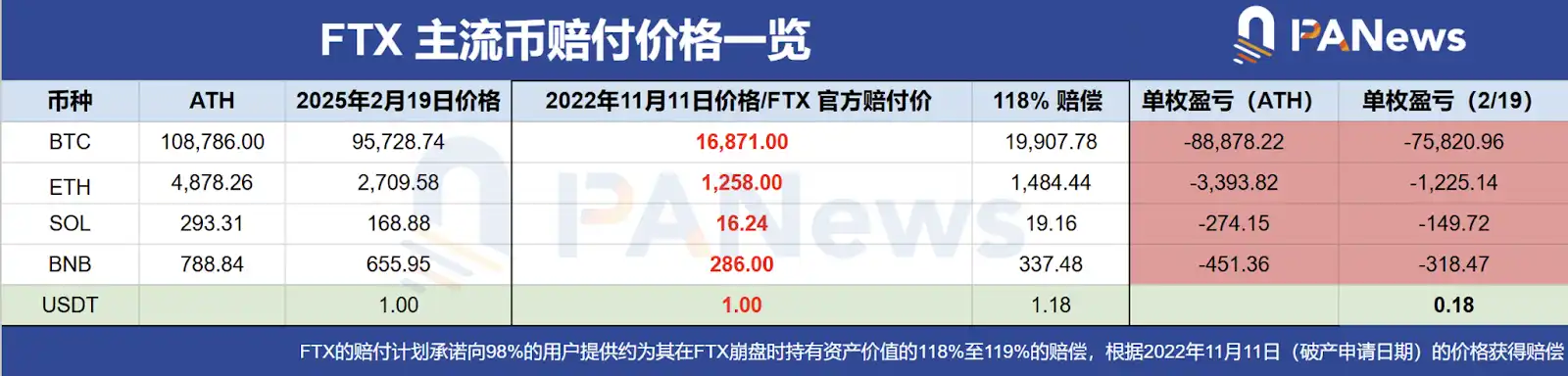
Public information indicates that the creditors in this round receiving payouts are initial beneficiaries, referring to small creditors with claims of $50,000 or less. According to FTX's restructuring plan, they will receive full repayment and enjoy a 9% annual interest. These users may ultimately receive a 119% fiat-denominated repayment.
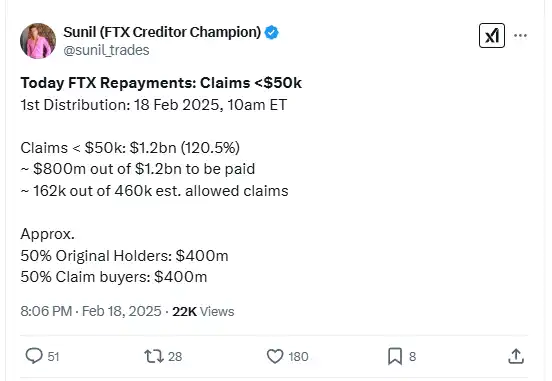
According to FTX creditor Sunil, the current payout in this round has already disbursed around $800 million, covering 162,000 accounts, which represent 35% of the estimated 460,000 eligible claim accounts. Moreover, payouts exceeding $50,000 will have to wait until after May 30.
Previous reports indicated that the overall payout amount for the first phase ranged from $65 to $70 billion. It is expected that this round of payouts will continue until March 4. However, FTX has not yet disclosed the actual payout amount from the first round.
From a payout perspective alone, since FTX has opted for fiat payouts, the commencement of payouts may not cause significant turbulence in the crypto market. It might even bring in some new entry funds into the market.
Nearly $2 Billion Worth of OTC SOL Token Unlocking
The market's anxiety about FTX primarily stems from the auction of crypto assets like Solana. Documents as of 2023 showed that FTX's asset total was only $47.7 billion, creating a $68 billion gap compared to the estimated $115 billion payout at the time. As the crypto market ushered in a bull run in 2024, the crypto assets held by FTX saw a significant surge.
FTX's largest blood transfusion recipient is Solana, with the SOL token seeing a surge of over 28 times its value since December 2022. As one of Solana's key investors, FTX holds a significant amount of locked SOL tokens. According to monitoring data from @ai_9684xtpa, FTX has already conducted three auctions, selling a total of 41 million SOL as of February 17. Among these, 11.2 million SOL will unlock on March 1.

Reportedly, the 41 million tokens were not sold directly on the secondary market but were sold to Galaxy (purchased 25.52 million tokens at $64), Pantera and other buyers (purchased 13.67 million tokens at $95), Figure and other buyers (purchased 1.8 million tokens at $102). Overall, these tokens brought FTX $2.932 billion in revenue, becoming its largest category of liquidation income in the crypto asset class.
Regarding the unlocked SOL tokens, this transaction likely took place through previous auctions, and the unlocking now signifies the actual delivery. Regardless of the ultimate beneficiary, these tokens will enter circulation, with the known buyers' costs significantly below market price. Therefore, there is indeed a risk of profit-taking selloff, but the upcoming unlocked SOL tokens represent only 2.3% of the current circulating supply.
Sui Has Repurchased Equity, Disposal Methods for APT, AVAX, and Other Assets Unknown
In March 2024, FTX announced the sale of its investment in Mysten Labs to Sui Network for $95 million. Mysten Labs is the development company behind the Sui network. By the end of 2024, the value of these sold equity and tokens reached a peak of $4.6 billion. For the market, if FTX retains these tokens, the SUI market could face increased pressure.
Aside from Solana and Sui, Aptos was also one of FTX's initial key investments in public blockchains. According to media reports, in 2022, FTX Ventures and Jump Crypto led a $150 million investment in Aptos. However, the final disposition of this equity has not been disclosed by Aptos to date. According to data provided by FTX in March 2023, they held 5 million APT tokens at that time. However, in ARKM's FTX on-chain address, there is currently no information available about APT tokens. Based on the price as of February 19, the value of this APT portion is approximately $31.65 million.
As of February 19, in the FTX on-chain address, the largest holding token is FTT, with a total of 257 million tokens, worth about 505 million US dollars. The total market value of FTT is only 657 million US dollars. If the holding is sold off, a price impact could pose the greatest risk. FTX once asked users to fill in the purchase price of FTT, but in the fiat valuation compensation, FTT is temporarily counted as 0. It is still uncertain how FTT holders will be compensated.
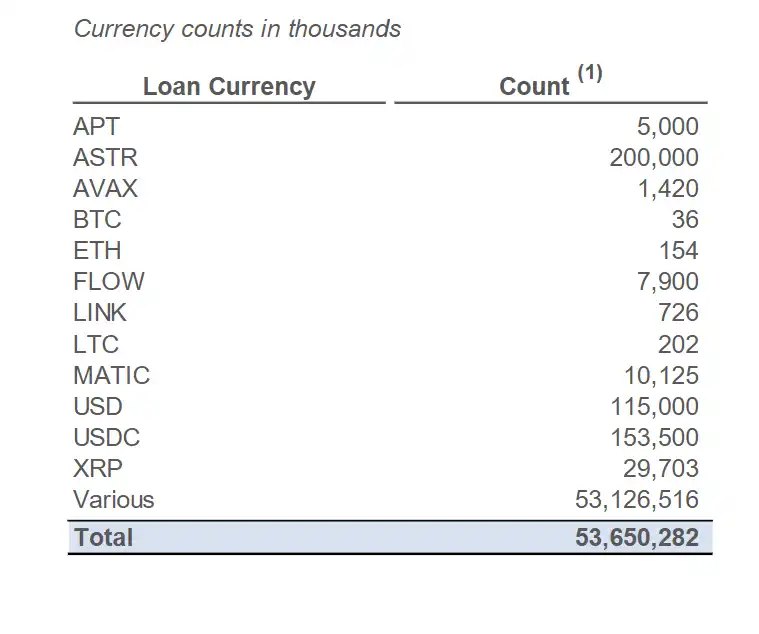
In the document disclosed in 2023, it is shown that FTX also holds 1.42 million AVAX tokens (worth 33.76 million US dollars), 36,000 BTC (worth 346 million US dollars), 154,000 ETH (worth 410 million US dollars), 29.7 million XRP (worth 76.32 million US dollars), and other major crypto assets. However, as of February 19, these assets are no longer visible in FTX's public wallet address as they have been sold off during the liquidation period. As of February 19, the on-chain address holding value of FTX is about 1.269 billion US dollars.
With the commencement of FTX's settlement, the FTX bankruptcy event is finally nearing its end. After more than two years of transformation, the entire crypto industry has begun a new pattern, and the impact of FTX on the industry has gradually become a part of history. The recent market downturn allegedly triggered by FTX seems more like a storm in a teacup or the panic sentiment of the current market turbulence period.
You may also like

CFTC Reportedly Plans New Prediction Market Rules Focused on Manipulation Risk and Public Interest Review
The CFTC is reportedly preparing new prediction market rules focused on manipulation risk, public interest review, and retail trader protections.

Meet the new WEEX trial fund—your gateway to greater profits

WEEX Labs Lands at Dutch Blockchain Week: A Disruptive Crypto × AI Conversation Sets Sail in Amsterdam

SK Hynix Reportedly Plans U.S. ADR Listing as Early as August, With SEC Approval Possible in Late June
SK Hynix may pursue a U.S. ADR listing as early as August, with SEC approval reportedly possible in late June amid strong AI chip supply chain demand.

SpaceX vs Tesla vs xAI: Which Elon Musk Trade Has the Biggest Upside in 2026?
OpenAI Reveals It Has Confidentially Submitted an S-1 to the SEC, Keeping the Door Open for a Future IPO
On June 9, according to an OpenAI announcement, the company recently confidentially submitted a draft S-1 registration statement to the U.S. Securities and Exchange Commission (SEC), beginning the preliminary compliance process for a potential initial public offering. OpenAI said it chose to disclose this proactively because it expected the news might leak; however, the company has not yet set a specific listing timeline, and related arrangements may still take some time.

Latest research from 13 top universities including Cornell University: The current state, challenges, and misconceptions of the fusion of Crypto and AI
Deconstructing Anthropic: The Best AI Company, Possibly Also a Type of Organizational Invention
Apollo and Blackstone Reportedly Back $35 Billion Anthropic Chip Financing as Deal Details Remain Unclear
On June 9, according to currently available news alerts, Apollo and Blackstone Group participated in a $35 billion financing for an Anthropic “chip project.” Based on the original wording of the report, the funding has already been raised, but public information remains limited. The financing structure, use of proceeds, project entity, and whether Apollo and Blackstone participated through equity, debt, or project financing have not yet been disclosed.

Humanity Protocol Security Incident Escalates: More Than $31 Million Stolen From Related Addresses as Attacker Continues Selling H for ETH
On June 9, according to monitoring by Onchain Lens, more than $31 million has been stolen from addresses linked to Humanity Protocol, and the attack is still ongoing, with the hacker continuously swapping H tokens for ETH. Project founder Terence Kwok later confirmed the security incident on X, saying the issue involved a private key leak.

Bloomberg: As Bitcoin Weakens, Stablecoins and RWA Continue to Drive Expansion in Crypto Businesses
In June, Bloomberg reported that despite Bitcoin falling below $60,000 last week, wiping out about $235 billion in market value within seven days, and dropping close to 50% from last year’s peak, some core businesses in the crypto industry are still expanding, mainly in stablecoins, real-world asset tokenization (RWA), payments, and infrastructure. The report also noted that overall altcoin activity has contracted significantly: altcoin market capitalization has fallen from a peak of about $431 billion in November 2021 to around $170 billion, and among the tens of millions of tokens issued in recent years, fewer than 1,700 still maintain meaningful trading activity.

Galaxy Deep Research Report: How Hyperliquid's HIP-4 Upgrade Changes the Landscape of Prediction Markets?
Binance Research: RWA Market Expected to Expand Nearly 6x from Early 2025, with Public Equities and Onchain Payments Heating Up Together
In June, Binance Research said in its monthly market report that the real-world asset (RWA) market is expected to grow by about 589% from the beginning of 2025. Bond- and money market fund-related RWA expanded by about $6.5 billion, up 83% year over year, while publicly traded equity RWAs grew by about 422%. The report also noted that monthly crypto debit card transaction volume exceeded $747 million in May, up 48.6% year to date.

Japan to Assess a Framework for Yen Stablecoins and Crypto ETFs as Asia’s Compliant Payments Narrative Heats Up
Recently, according to the original report, Japan is considering the launch of yen stablecoins and cryptocurrency ETFs. Public information remains limited at this stage, and there is still no complete policy text, regulatory draft, or clear implementation timeline, so this is better characterized as a “policy discussion” rather than formal implementation. The original wording also noted that advancing stablecoin regulation in Asia is driving XRP usage and supporting growth in the XRPL ecosystem. However, based on currently available public information, there is not enough evidence to directly establish a clear causal relationship between this round of discussion in Japan and XRP or XRPL.

ZachXBT: Humanity private key leak and abnormal surge in H token should be viewed separately
On June 9, according to related disclosures, on-chain investigator ZachXBT posted an update on Humanity’s roughly $31 million security incident, saying that after further analyzing fund flows, he currently tends to believe the project team was not involved in an “inside job” or a self-staged attack. According to him, the official explanation about the private key leak was broadly accurate, but before the token unlock, the price of H had been artificially pushed higher, and the hacker later took advantage of that market environment; therefore, the private key leak and the earlier abnormal price pumping should be regarded as two separate and independent events. This reframing has shifted the market’s understanding of the nature of the incident. Earlier discussion around Humanity had focused on whether the team directly participated in the attack or used the security incident to cover up internal operations. ZachXBT’s latest remarks shift the focus from “whether it was self-theft” to “whether there were pre-unlock market structure issues.” He also questioned whether the team may have.

Morning Report | OpenAI has submitted an S-1 registration statement draft to the U.S. SEC; Morpho completes $175 million financing

Morning Report | BitMine increased its holdings by 126,971 ETH last week; trader Eugene announced his exit from the crypto market

Wang Chuan: How can one not feel anxious after the neighbor Old Wang made thirty times profit by investing in storage stocks? (Seven) - A quarter-century cycle
CFTC Reportedly Plans New Prediction Market Rules Focused on Manipulation Risk and Public Interest Review
The CFTC is reportedly preparing new prediction market rules focused on manipulation risk, public interest review, and retail trader protections.
Meet the new WEEX trial fund—your gateway to greater profits
WEEX Labs Lands at Dutch Blockchain Week: A Disruptive Crypto × AI Conversation Sets Sail in Amsterdam
SK Hynix Reportedly Plans U.S. ADR Listing as Early as August, With SEC Approval Possible in Late June
SK Hynix may pursue a U.S. ADR listing as early as August, with SEC approval reportedly possible in late June amid strong AI chip supply chain demand.
SpaceX vs Tesla vs xAI: Which Elon Musk Trade Has the Biggest Upside in 2026?
OpenAI Reveals It Has Confidentially Submitted an S-1 to the SEC, Keeping the Door Open for a Future IPO
On June 9, according to an OpenAI announcement, the company recently confidentially submitted a draft S-1 registration statement to the U.S. Securities and Exchange Commission (SEC), beginning the preliminary compliance process for a potential initial public offering. OpenAI said it chose to disclose this proactively because it expected the news might leak; however, the company has not yet set a specific listing timeline, and related arrangements may still take some time.


