
Freezing and Confiscation of Cryptos: Europe Strengthens Cooperation Against Criminal Networks

 Prefer us on Google


Accelerating cooperation to recover criminal assets. The European Union and eight states signed, on October 14 in Strasbourg, a protocol enhancing the tools for freezing, seizing, and confiscating, particularly for crypto assets. This text complements the 2005 Warsaw Convention, dedicated to money laundering and the financing of terrorism. Its goal is to better coordinate authorities in the face of networks whose funds circulate between multiple jurisdictions. However, it remains subject to ratification.
Key Points
- The EU and eight countries signed a protocol from the Council of Europe strengthening the recovery of criminal assets, including crypto assets.
- The mechanism provides for emergency measures and accelerated exchanges between competent authorities.
- Five ratifications, including three from member states of the Council of Europe, are necessary for it to enter into force.
Crypto Assets: A Strengthened Framework for Freezing and Confiscating Criminal Funds
Georgia, Greece, Hungary, Luxembourg, Monaco, Montenegro, San Marino, and the United Kingdom are among the first signatories, alongside the European Union. The ceremony took place during the Octopus conference on cybercrime.
The text falls under the Council of Europe, an organization distinct from the EU. Therefore, it is not a new regulation directly applicable in the Twenty-Seven, but rather an instrument of international cooperation.
The protocol strengthens several mechanisms. It notably provides for emergency freezes or seizures, when conditions allow, without prior notice to the persons concerned. The aim is to prevent the movement or concealment of assets before their potential confiscation.
It also expands the possibilities for confiscation to assets related to other criminal activities and, in certain situations, without a criminal conviction. Assets held by third parties may be affected, with protections for good faith holders.
Cryptocurrencies were not previously unseizable. The novelty lies in the strengthening of common tools and their coordination, rather than the creation of an entirely new power. It is also important to distinguish freezing, which temporarily prevents the disposal of an asset, from confiscation, which organizes its permanent deprivation within the framework provided by law.
Europe strengthens the fight against money laundering and the financing of terrorism -- Source: Compte X JDC
Accelerated Cooperation, but Persistent Technical Obstacles
The protocol strengthens the role of financial intelligence units and provides for specialized structures in tracing and managing assets. It also organizes direct exchanges between services, with response times potentially reduced to three days for certain urgent requests. This timeframe does not mean that funds will be systematically blocked or recovered under the same conditions.
This cooperation addresses a concrete difficulty: spotting transactions is not enough to regain control of assets. It is necessary to identify the competent interlocutors, establish the legal foundations for intervention, and have a means to execute the measure.
The distinction appears notably between funds held by a service provider and cryptocurrencies held directly by an individual. In the latter case, a judicial decision does not automatically provide the private key necessary to move the assets. Self-custody thus constitutes a practical challenge, without placing the assets outside the scope of seizures.
The protocol still needs to go through the ratification procedures. For the European Union, its conclusion notably requires a decision from the Council and the consent of the European Parliament. The Commission presents it as a complement to existing European mechanisms for confiscation, recognition of decisions, and combating money laundering.
The stakes thus go beyond the visibility of transactions on a blockchain. The effectiveness of recovery relies on the articulation between investigation, international cooperation and the real capacity to immobilize funds.
-- Price
This content is provided for general informational purposes only and doesn't constitute financial, investment, legal, or tax advice. Any events, rewards, online promotions, or related information mentioned herein should not be considered a recommendation, solicitation, or invitation to purchase, sell, trade, or otherwise deal in any crypto assets. Crypto assets are highly volatile and may result in loss. The availability of WEEX services, products, and related events may vary by region. You are responsible for ensuring that your participation is in accordance with applicable local laws and regulations.
You may also like

Rayls Bridges Traditional Finance and Decentralized Finance
The Week Ahead: 4 Key Moments for the Crypto Market
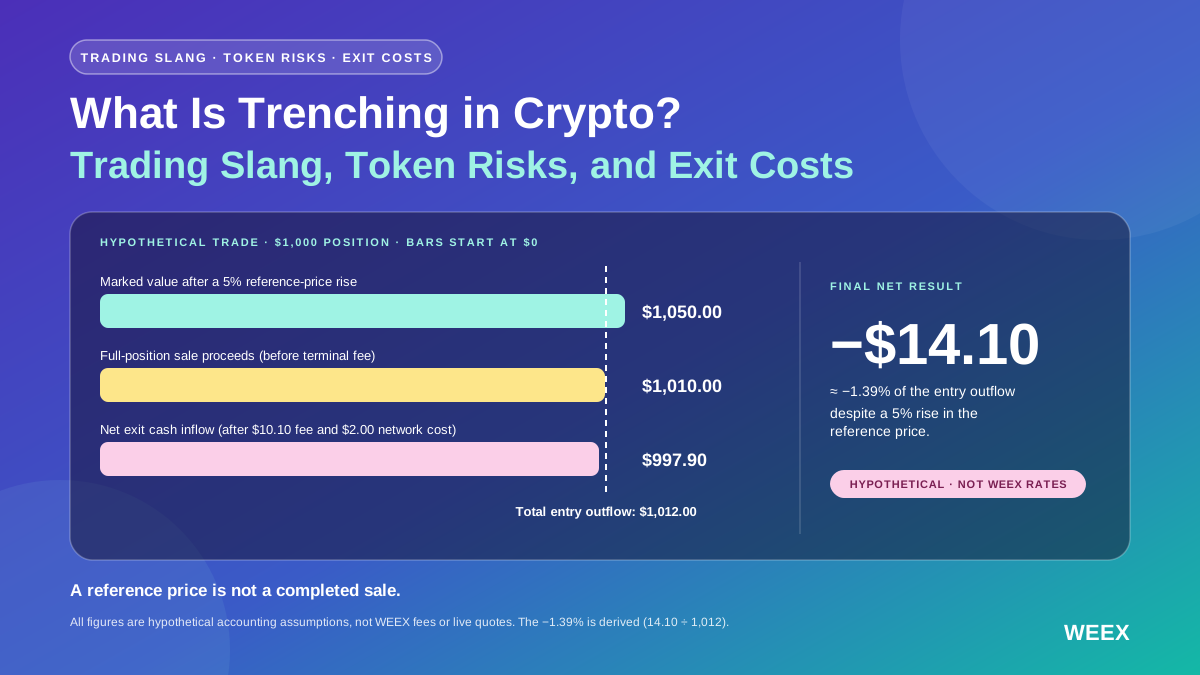
What Is Trenching in Crypto? Trading Slang, Token Risks, and Exit Costs
What is trenching in crypto? Learn the slang, token checks, liquidity risks, and how a rising token can still produce a loss after trading costs.
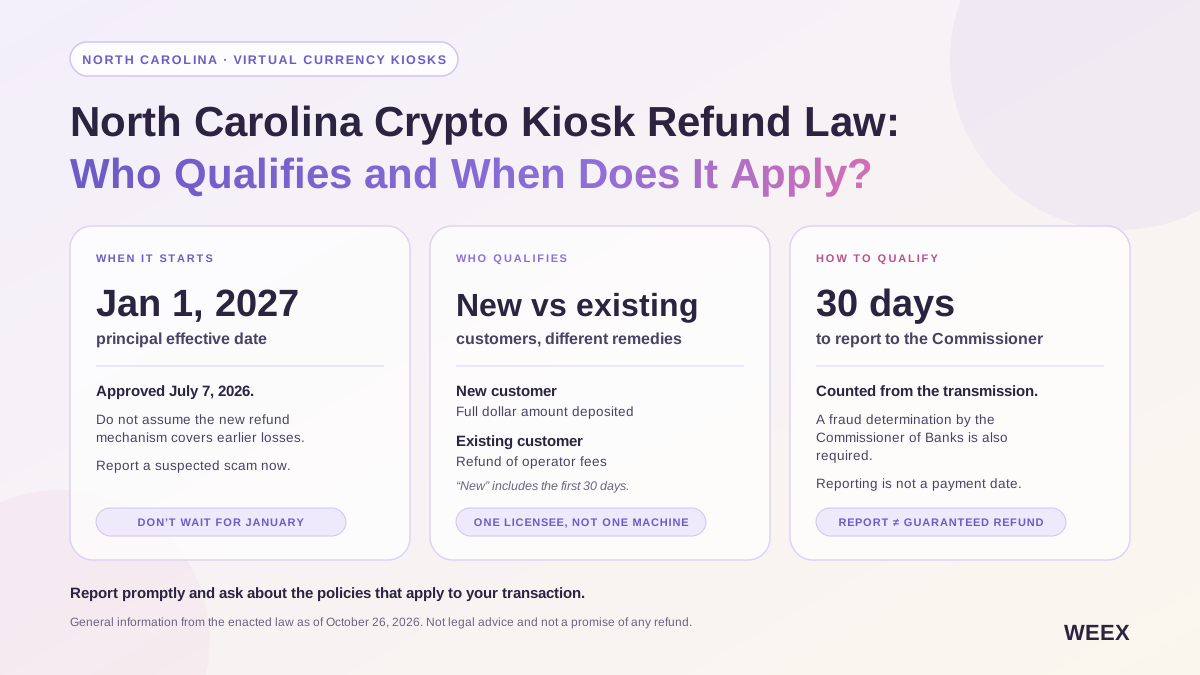
North Carolina Crypto Kiosk Refund Law: Who Qualifies and When Does It Apply?
Understand North Carolina’s crypto kiosk refund law: the January 2027 start date, who qualifies, reporting deadlines, and documents victims should keep.

[Bitcoin $0 Controversy②] "$0 is an Exaggeration"... Reasons Wall Street Disagrees
[ETH Letter] Meritz Securities Reviews Tokenization of Korean Securities Based on OP Stack

Progressive Party Opposes Further Delay of Cryptocurrency Income Tax

JPMorgan's Tokenized Fund on Solana: What MONY and JLTXX Mean for Institutional Adoption of RWA

Real and Fake Cryptocurrency Market Makers: What Makes a Market Maker Legitimate?

Michaël van de Poppe sees four crypto trends: AI, Ethereum, Sui, and digital assets

Coppock Curve and Crypto Trading: How to Use the Trend Reversal Indicator

Bitcoin Records U.S. Constitution Again... This Time with a Mysterious Code

Hedge funds hold $2 trillion in US debt, but their next trade could require fewer bonds
Weekly: $68,000 Theft from Ukrainian in Trust Wallet, Circle's Lawsuit Against Trump Over $2 Billion in UAE, and Historic Solana Update

ZachXBT Accuses CoinDCX of Losing $16 Million in Client Funds

NYSE’s owner is backing 24/7 stock tokens without Wall Street’s usual price rules
JPMorgan Now Offers Two Tokenized Money Market Funds on Solana
Follow the Money: $630 Million for Strive, Tether Activity and Attention to CeFi
HTX Research Analyst Chloe: Despite Significant Net Inflows into Bitcoin Spot ETFs, Macroeconomic Data Suppresses Rebound Potential
Killa: Frequent Short-term Trading Risks Missing Major Market Movements, Patience in Holding Positions is Important
China's fiscal revenue rose 5.1% by September, but land sales continue to decline

90% of Revenue from Meme Coins, Yet Valuation Rivals Pump: What Should Meteora Be Worth?
Former FTX Executive Slams Netflix's New Series: Turning Financial Fraud into a 'Romantic Film' is Absurd

Ripple teams up with $10B payments firm Arf to expand RLUSD use on XRPL

One billion dollars in three days is not enough. Bitcoin faces a significant challenge
WEEX Exclusive:Major Indexes Close Higher; Focus on TSLA, META Stock Earnings | WEEX TradFi Daily(October 22, 2026)
Major Indexes Close Higher; Focus on TSLA, META Stock Earnings | WEEX TradFi Daily(October 22, 2026)
The three major indexes closed higher on October 21, led by the Nasdaq. SpaceX beat earnings expectations and disclosed AI-business revenue; merger discussions with Tesla also helped lift AI and crypto-related stocks. Bitcoin traded near $84,000 and Ethereum near $2,470. LIT led majors on compliance-license expectations. On October 22, investors will watch Procter & Gamble, Southern Copper and Union Pacific before the open, followed by Western Digital and Newmont after the close.

Irish drug lord’s lost Bitcoin fortune comes back to life as $41 million moves to Coinbase

ZachXBT Reports on Cryptocurrency Laundering via FreedomXMR on Hyperliquid

Willy Woo: Good Time to Accumulate Bitcoin
Rayls Bridges Traditional Finance and Decentralized Finance
The Week Ahead: 4 Key Moments for the Crypto Market
What Is Trenching in Crypto? Trading Slang, Token Risks, and Exit Costs
What is trenching in crypto? Learn the slang, token checks, liquidity risks, and how a rising token can still produce a loss after trading costs.
North Carolina Crypto Kiosk Refund Law: Who Qualifies and When Does It Apply?
Understand North Carolina’s crypto kiosk refund law: the January 2027 start date, who qualifies, reporting deadlines, and documents victims should keep.
[Bitcoin $0 Controversy②] "$0 is an Exaggeration"... Reasons Wall Street Disagrees
[ETH Letter] Meritz Securities Reviews Tokenization of Korean Securities Based on OP Stack



