
- Buy Crypto
- Markets
 Futures
- Spot
- Copy Trade
- Earn
- More
Farewell to Idle Funds: How can BFUSD Earn Interest on Binance Earn Become a "Bullet that Earns" on the Crypto Table?

Source: Binance
In the ever-changing crypto market, traders' demands for fund management have evolved beyond simple trading profits to seek higher capital efficiency. As the widely circulated saying in the community goes, "BFUSD won't make you rich overnight, but it will keep you at the table longer." This unique reward asset is quietly transforming professional traders' fund allocation strategies, allowing every bit of your "ammunition" to have the ability to continuously generate returns in Binance Earn.
(Image Source: ChainNews)
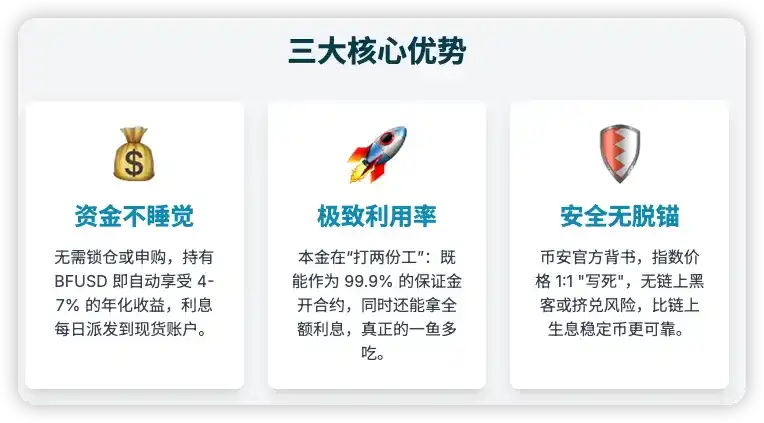
The core value of BFUSD lies in its perfect combination of high-yield finance and trading tool attributes. When you exchange USDT for BFUSD, you receive a "composite asset" that can earn interest without affecting trading. In the current market conditions, BFUSD has an average annualized yield of around 4.5% over the past 30 days, a performance that far exceeds most similar stablecoin yield products. More importantly, holders do not need to lock their assets, the yields are distributed daily, and even BFUSD in spot orders can enjoy these returns. This means that whether it's funds from contract take-profit pullbacks or remaining margin after stop-loss in a contract, they can continue to work in the account, truly achieving "earning high annual interest while not affecting contract trading."
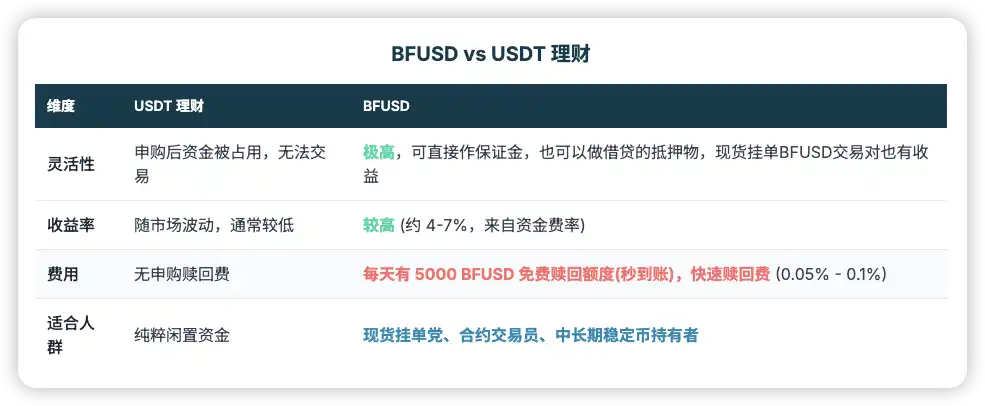
Behind this high capital utilization is BFUSD's advantage over traditional stablecoin yield. It can serve as collateral for contract accounts, Portfolio Margin, and VIP Loans, enjoying a 99.9% high collateral value ratio (CVR) in cross-margin or unified accounts. In contrast, when you subscribe USDT to a wealth management account, those funds are tied up and cannot be used for trading. On-chain interest-bearing assets often come with smart contract vulnerabilities and de-pegging risks. BFUSD, on the other hand, is endorsed by the Binance platform, maintains a fixed index price (1:1), has higher security, and completely eliminates de-pegging concerns.
Therefore, from an asset allocation perspective, BFUSD can play three key roles in fund management strategy: it can act as a defensive layer to stabilize portfolio risk in high volatility ranges; it is a liquidity reserve that can be reallocated at any time to capture arbitrage or trend opportunities; and it is also an important income buffer, providing additional returns through principal-protected finance to effectively increase overall investment returns. It gives traders a new fund management philosophy: "Hold, Open Positions, Borrow, and Earn Interest," all without delay.
(Image Source: ChainNews)
The growth momentum of BFUSD is strong. To show appreciation for the community's recognition of this efficient asset, Binance Savings has specially launched a limited-time exclusive event. From November 3, 2025, to December 2, 2025, the first 1,000,000 BFUSD quota can enjoy a timed-limited benefit of an additional +5% boosted APR on top of the base APR. This is an excellent window for your collateral to serve you at a higher efficiency. Please check your account immediately and do not miss the opportunity to accelerate the growth of your "bullets."
This article is contributed content and does not represent the views of BlockBeats.
You may also like

2025 South Korea CEX Listing Post-Mortem: Investing in New Coins = 70% Loss?

BIP-360 Analysis: Bitcoin's First Step Towards Quantum Immunity, But Why Only the "First Step"?

50 million USDT exchanged for 35,000 USD AAVE: How did the disaster happen? Who should we blame?

The Cryptographic Past of the Middle East

Resolving the Intergenerational Prisoner's Dilemma: The Inevitable Path of Nomadic Capital Bitcoin

Who Will Control AI? Why Decentralized AI May Be the Only Alternative to Government and Big Tech
AI has become critical infrastructure, and governments and corporations are competing to control it. Centralized development and regulation are entrenching existing power structures. The Web3 community is building a decentralized alternative — distributed compute, token incentives, and community governance — before that window closes.

Vitalik wrote a proposal teaching you how to secretly use AI large models

On the eve of the explosion of on-chain options
WEEX AI Hackathon: How Did This AI Trading Winner Succeed?
A self-taught AI trading enthusiast achieved top-10 results at the WEEX AI Hackathon. Learn about the mindset, AI tools, and lessons behind this impressive performance.

One Balance to Rule Them All: Gravitas' On-Chain Prime Broker Ambition

That person who cashed out at the NFT peak is now selling a new shovel in the OpenClaw craze

Inter-generational Prisoner's Dilemma Resolution: The Nomadic Capital and Bitcoin's Inevitable Path

Upstream and downstream are starting to fight, all for the sake of everyone being able to "Lobster"
Circle and Mastercard Announce Partnership, the Next Stage for the Crypto Industry Belongs to Payments

From 5 Mao per kWh of Chinese electricity to a $45 API export: Tokens are rewriting currency units

Why is OpenAI playing catch-up to Claude Code instead?

Vitalik wrote a proposal teaching you how to secretly use AI large models

The doubling of Circle's stock price and the paradigm shift of stablecoins
2025 South Korea CEX Listing Post-Mortem: Investing in New Coins = 70% Loss?
BIP-360 Analysis: Bitcoin's First Step Towards Quantum Immunity, But Why Only the "First Step"?
50 million USDT exchanged for 35,000 USD AAVE: How did the disaster happen? Who should we blame?
The Cryptographic Past of the Middle East
Resolving the Intergenerational Prisoner's Dilemma: The Inevitable Path of Nomadic Capital Bitcoin
Who Will Control AI? Why Decentralized AI May Be the Only Alternative to Government and Big Tech
AI has become critical infrastructure, and governments and corporations are competing to control it. Centralized development and regulation are entrenching existing power structures. The Web3 community is building a decentralized alternative — distributed compute, token incentives, and community governance — before that window closes.


 App
App