
- Buy Crypto
- Markets
 Futures
- Spot
- Copy Trade
- Earn
- More
Doubling in a single day won't make up for a 98% crash - Did Parcl's 'Polymarket Story' Hold Up?

Original Title: "Hard to Conceal 98% Plummet Even with Daily Doubling, Polymarket Won't Be Parcl's Lifesaver"
Original Author: Sanqing, Foresight News
On January 5th, the real estate RWA protocol Parcl partnered with the prediction market giant Polymarket. This collaboration will introduce Parcl's daily house price index to Polymarket's newly launched real estate prediction market series. The two parties will introduce prediction products centered around the housing market, with settlement based on Parcl's published house price index.

Image - Parcl Twitter Announcement of Partnership with Polymarket (Translated)
Polymarket will be responsible for listing and operating the market, while Parcl will provide independent index data. Encouraged by this news, the PRCL token showed strong performance on the day. According to Bitget's market data, PRCL reached a daily high of 0.05217 USDT, marking a 94.21% daily increase, with an intraday peak increase of approximately 138%.
The Lingering "Airdrop Fiasco"
For many long-time users, the name Parcl is associated with "betrayal." Despite the project team stating in their technical papers that their mission was to "break the asymmetry of real estate data and empower users," the token issuance in April 2024 became a turning point in community trust.
After a long-running point system activity, PRCL opened below the listing price, and in the following days, over $120 million was withdrawn from the protocol, leading to a TVL drop of over 60%.
Over time, Parcl's token performance has been significantly disconnected from its narrative, with the PRCL token price falling below $0.02 by the end of 2025, a drop of approximately 97.6% from the April 2024 peak of $0.737.
Now, it is attempting to "whitewash" its identity through a partnership with Polymarket, rebranding itself as a high-quality real estate data platform and oracle.
Is the Daily Updated House Price Index Genuine?
Parcl's selling point is its House Price Index published by Parcl Labs, providing "daily updated" city-level house price data. In its whitepaper, Parcl claims that its data has a high correlation of 0.98 with the traditional Case-Shiller index.
Lack of Transparency in Data Source. The team emphasizes a 24/7 operational data retrieval process to maintain a high-quality, real-time real estate data ecosystem. However, the specific details of original data providers and weighting are not disclosed in the documentation.
Reliance of Data Source on Listing Information. Parcl's real-time nature relies heavily on active listing information rather than just sales transactions.
Listed prices often reflect seller optimism, usually higher than the actual transaction price. This data structure may cause the index to appear more aggressive during market upswings or exhibit larger fluctuations during volatile periods.
Lack of Independent Validation and Institutional Endorsement. While Parcl has outlier filtering mechanisms (such as sampling only the 35th to 65th percentiles), the daily update mechanism is heavily reliant on real-time input of massive amounts of data.
Compared to widely referenced indices like the Case-Shiller Index used by institutions such as the Federal Reserve, Parcl currently relies mainly on self-attestation and endorsements from partners.
Low Transaction Activity
Internal Platform Data: Based on the platform's records over the past six months, only a few markets have transaction volumes in the millions: namely Austin (12.95M), Chicago (3.85M), Miami Beach (2.94M), and Brooklyn (2.2M).
However, most markets have holdings below ten thousand dollars, with only a few maintaining levels in the hundreds of thousands, such as Austin at 321K, Brooklyn at 360K, and Chicago peaking at around 950K.
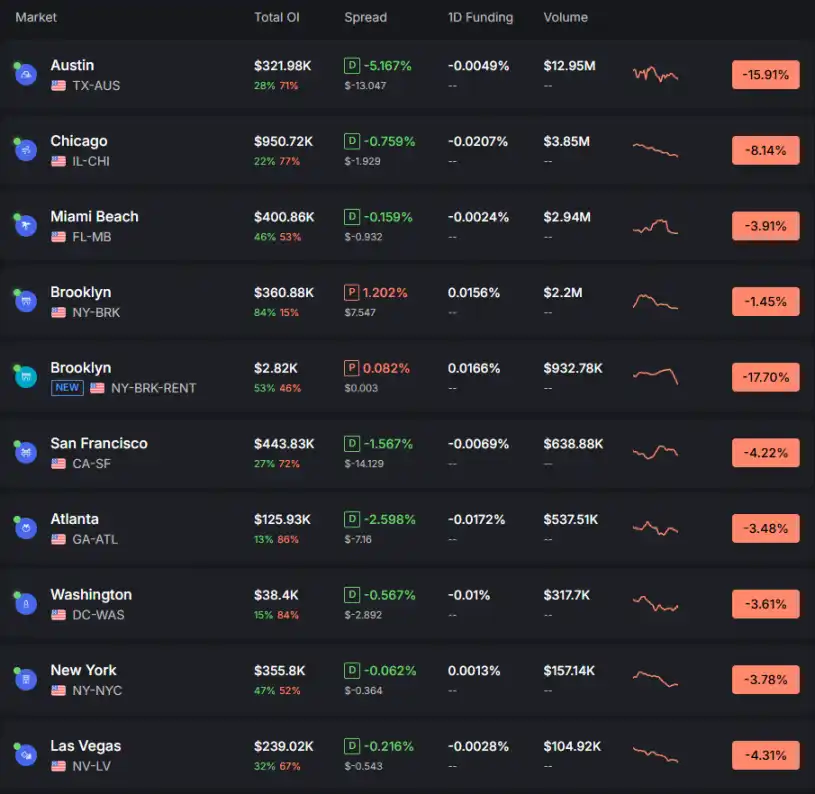
Figure - Top 10 Markets by Transaction Volume in the Past Six Months on Parcl
Polymarket Market Performance: Polymarket has currently launched six real estate prediction markets, including Los Angeles, San Francisco, Austin, Miami, New York, and a nationwide U.S. market.
Despite leveraging Polymarket's significant platform traffic, actual engagement is very low. The market with the highest volume currently is San Francisco, with a transaction volume of only about 11K at the time of writing, while other market transactions are even quieter.
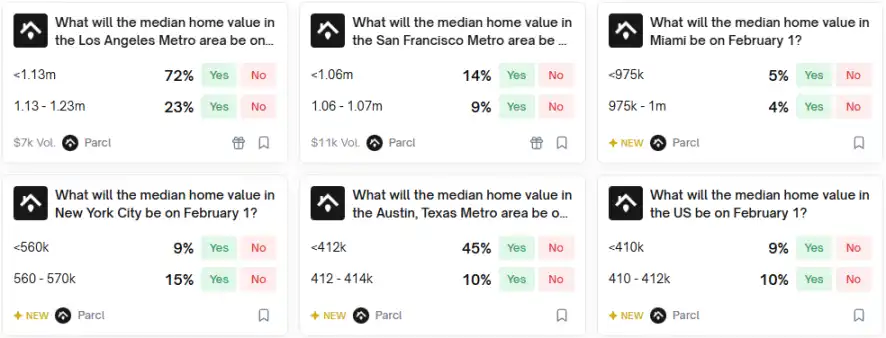
Figure - Polymarket Real Estate Prediction Market
The Regulatory Minefield of the "Dangerous Game"
While the collaboration aims to enhance the transparency of prediction markets, products tied to real estate indices are bound to play a "dangerous game" on thin ice.
Due to the nature of such products as event contracts, Polymarket, upon re-entering the U.S. market, must strictly adhere to CFTC compliance requirements regarding consumer protection and market integrity.
These markets transform housing price fluctuations into bettable agreements, a nature that regulatory bodies like the CFTC may easily deem as unlicensed binary options or financial derivatives.
Given the societal sensitivity of real estate data, the impact of such markets on the pricing power of actual housing prices may become one of the factors policy-makers consider when assessing the need for regulatory intervention. The real-time nature of real estate data may also involve compliance with state privacy or data protection regulations.
Furthermore, the proposed "Public Trust Act for the 2026 Financial Prediction Market" sets higher transparency requirements for the market. As real estate price indices are highly correlated with interest rate adjustments, housing regulations, and other policy changes, the platform would face institutional pressures to prevent insider trading and conflicts of interest.
Additionally, the operational fairness of the Polymarket real estate prediction market inherently depends on the verifiability of the Parcl index. Based on the CFTC's guidelines for event contracts, settlement rules must have an independent verification mechanism to mitigate the risk of data manipulation.
You may also like

Trading Never Sleeps: On-Chain, Crude Oil, and Leverage

On-chain Yield Panorama: The Evolution from Interest-bearing Stablecoins to Crypto Credit Products

RootData announced the integration with OpenClaw, and these gameplay features have gone viral

Key Market Intelligence on March 9th, how much did you miss out on?

a16z: After AI Superpowers, Where to Next for Humanity?

Why Does Oil Go Up When Bitcoin Goes Down?

Decoding 112,000 Polymarket Addresses: The Top 1% Making Money Are Doing These Five Things

AAVE founder issues a warning: DeFi must never become the exit liquidity for Wall Street private credit

How To Create A Frequency So Strong It Makes Reality Obey You
The first-ever WEEX AI Hackathon has concluded, with 10 winners emerging from over 200 global teams. Beyond its $1.8 million prize pool, the event marked a milestone—proving that the future of AI trading belongs to accessible, AI-powered innovation.

The cryptocurrency industry has waited for five and a half years, and what they got is half a ticket

The trend of Ethena reveals what information about the cryptocurrency market

I've been in the crypto industry for five and a half years, and all I got was half a ticket.

Crude Oil Surges 25%, Hyperliquid Unfolds On-Chain Showdown

$20 Billion Valuation, Is Kalshi Engaging in an Arms Race with Polymarket?

Will Not Messing with OpenClaw Lead to Obsolescence in the AI Era? | Lobster Fuss Summit

Anticipating the Market's New Challenge to Political Elections

The Shadow Business Empire of Iran's New Supreme Leader: Oil, Real Estate, and Financial Intrigue



 App
App