
Disappearing Liquidity: Unpacking the Multiple Factors Behind the Cryptocurrency Market's Decline

Original Author: The Kobeissi Letter
Original Translation: zhouzhou, BlockBeats
Editor's Note: This article analyzes the recent downturn in the crypto market, which has been attributed to various factors including the Bybit hack, Ethereum's weakness, the return of stock market volatility, among others. Particularly in a scenario of reduced liquidity, the cryptocurrency market has lost some momentum. Despite the market correction, this does not signify the arrival of a long-term bear market. A technical pullback is healthy, and the crypto market still requires liquidity to thrive.
Below is the original content (slightly rephrased for better readability):
Has liquidity in the cryptocurrency market suddenly disappeared? Over the past week, the crypto market has shed $325 billion in market value.
Today, at 5:00 PM Eastern Time, the market lost $100 billion in just 1 hour, with no significant news events.
What is happening in the crypto market?
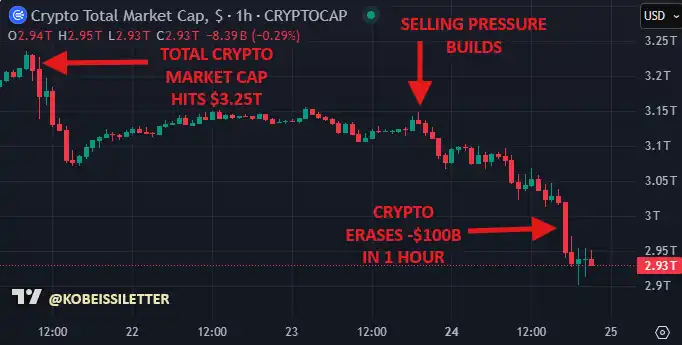
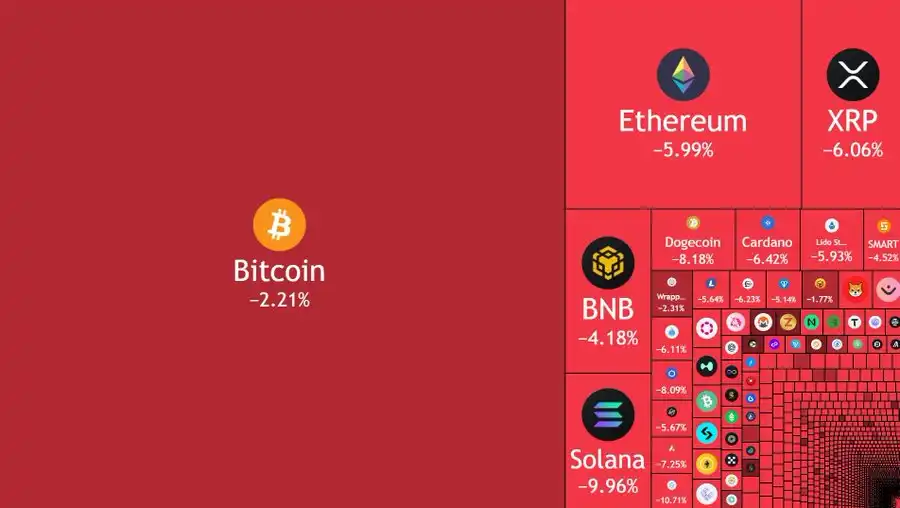
In the past 24 hours alone, we have seen around $150 billion liquidated from the crypto market. The sell-off spread, with almost all crypto assets experiencing significant declines. Even the memecoin market seems to have lost a considerable portion of its liquidity.
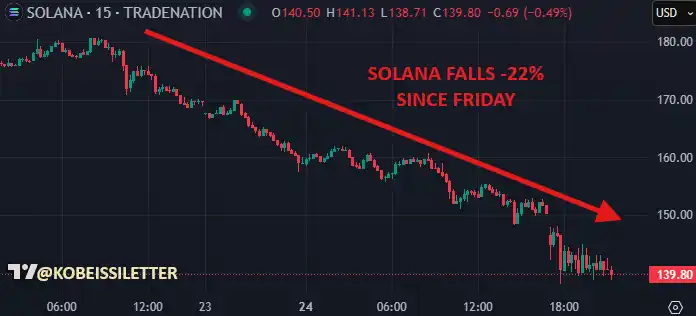
All of this seemingly started with Solana, which has dropped by 22% since last Friday. During the memecoin craze, Solana exhibited extremely strong relative strength. However, as the memecoin frenzy gradually faded, Solana also began to retreat. For a while, Solana's sell-off was mostly independent of Bitcoin's movements.
However, as the S&P 500 index began to decline on Friday, Bitcoin also started to follow suit. As shown below, the S&P 500's drop accelerated the sell-off in Bitcoin. Currently, after breaking below the $98,000 support today, Bitcoin has lost its relative strength.

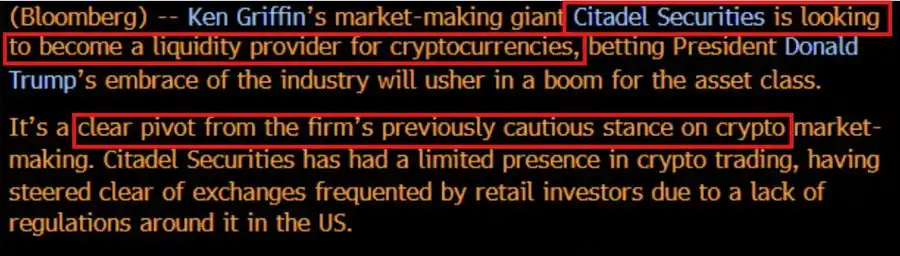
This is quite strange and happened just after Citadel made a significant shift in its cryptocurrency stance. Today, Bloomberg reported that Citadel Securities, a $650 billion market cap company, is seeking to become a liquidity provider for Bitcoin and cryptocurrencies, with the market treating this news as a 'sell the news' event.
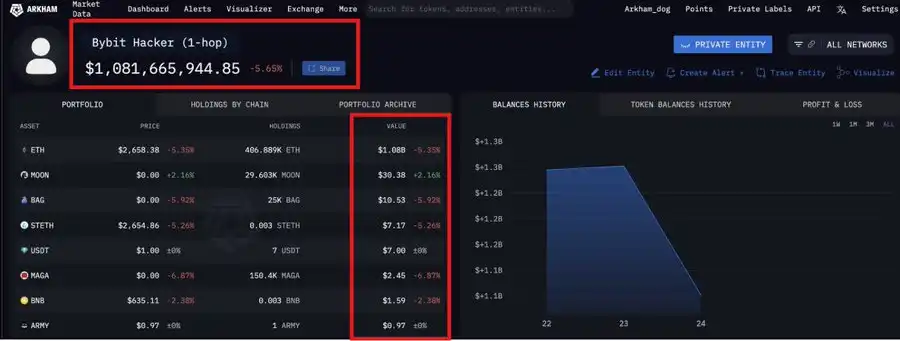
The market sentiment also seems to have been hit by the Bybit hack on February 21, with Arkham Intelligence calling it the "largest financial theft in history." The closest comparable event was the theft of the Central Bank of Iraq in March 2003, resulting in a $1 billion loss.
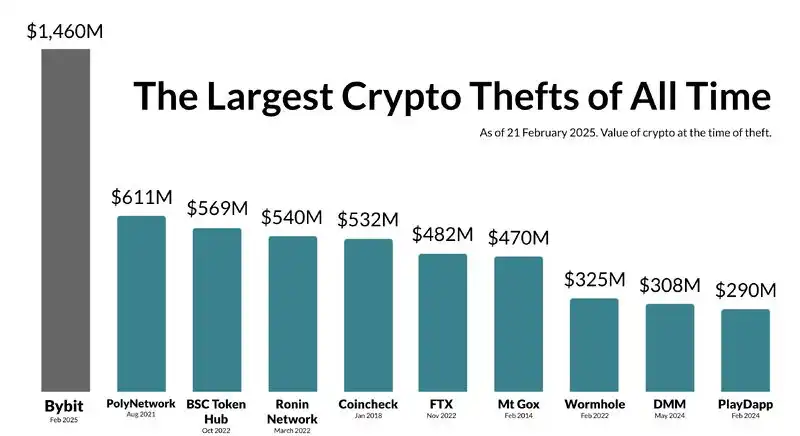
In fact, the losses from the Bybit hack event are more than twice the size of the second-largest hack in crypto history. The largest cryptocurrency hack in 2021 was the $611 million PolyNetwork hack. Ethereum's weakness has also added more pressure to the entire crypto market, with the hack event further eroding market confidence.
The technical aspect also seems to have lost momentum. However, this does not mean that the crypto market is about to enter a prolonged bear market. In this bull market cycle, we have seen numerous instances of Bitcoin retracements exceeding 10%, and a technical pullback is considered healthy.

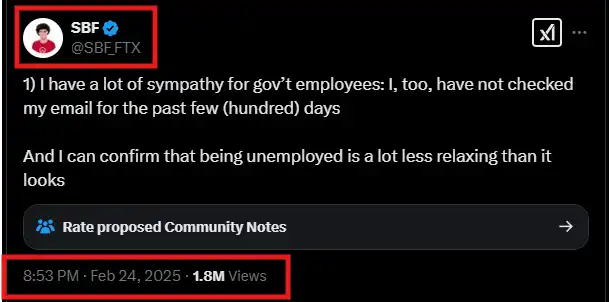
Adding to the woes, Sam Bankman-Fried returned to X platform during the crypto market crash, with SBF expressing his "sympathy for government employees." This comes at a time when DOGE and Elon Musk are preparing for more large-scale layoffs in the federal government.
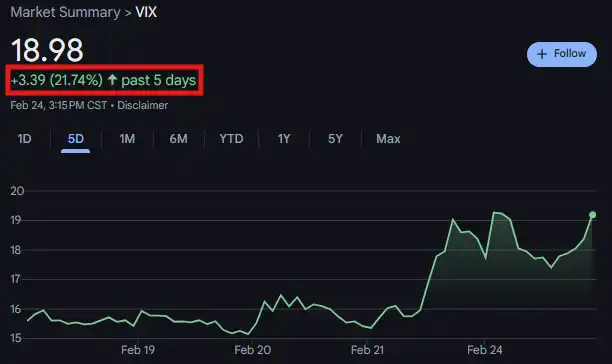
Finally, as stock market volatility returns, risk assets like Bitcoin experience pullbacks. We have seen historically high risk appetite levels in 2024 and entering 2025. The pullback in risk appetite indicates a reduction in liquidity in the crypto market, a scenario that has happened before.
Overall, currently there is no single factor driving the cryptocurrency selloff, but rather a combination of multiple factors that have led to a decrease in liquidity. The crypto market needs liquidity to thrive.
You may also like

Mastercard Launches Agent Pay for AI, Plans to Record AI Agent Payment Authorizations on Polygon
Mastercard launched Agent Pay for AI, a new payment protocol designed to help AI agents make small payments such as pay-per-use access to data and APIs. The system plans to record human-granted AI agent permissions on Polygon, focusing on verifiable authorization, identity, and payment controls.

Curve Deploys Llamalend v2 on Optimism With 250,000 OP Incentives
Curve launched Llamalend v2 on Optimism with 250,000 OP incentives from the Optimism Foundation. The upgrade expands Llamalend beyond its earlier crvUSD-focused model, adding broader collateral support, LlamaRisk market reviews, and the ability to use Curve LP tokens as collateral.

Raydium Old Liquidity Pool Reportedly Exploited, With $1.34 Million Moved to Ethereum and Tornado Cash
An old Raydium liquidity pool was reportedly exploited for around $1.34 million in USDC, RAY, and wSOL, with the stolen funds bridged to Ethereum and deposited into Tornado Cash. The incident highlights the tail risks of legacy DeFi pools, old contracts, and cross-chain fund laundering paths.

Kalshi Executive Challenges “SBF Backed AI Unicorns” Narrative, Says Leopold Aschenbrenner Was Key Figure
Kalshi executive John Wang questioned the “SBF backed AI unicorns” narrative, saying Leopold Aschenbrenner was the key figure behind major AI investment decisions.

Pantera Capital Partner: How Tokenization is Restructuring the Private Equity and Early Investment Ecosystem?

New York Proposes Stricter Stablecoin Issuer Rules Aligned With Federal GENIUS Act
NYDFS proposed stricter stablecoin issuer rules aligned with the GENIUS Act, covering reserves, custody, redemption timelines, audits, and capital buffers.
Every exchange is a "Universal Exchange."

The counterattack of traditional finance: Alliance chains are quietly reviving

CryptoQuant Says Bitcoin Profitable Supply Is Near 45% Pressure Zone as On-Chain Data Points to Market Repricing
CryptoQuant said Bitcoin’s profitable supply is nearing the 45% pressure zone, signaling rising market stress, unrealized losses, and a possible on-chain repricing phase.

Bitcoin Falls Below 200-Week Moving Average as On-Chain Data Shows Over Half of Supply in Loss
Bitcoin dropped below its 200-week moving average as on-chain data showed over 50% of circulating supply is now in loss, signaling rising market stress.

CFTC Reportedly Plans New Prediction Market Rules Focused on Manipulation Risk and Public Interest Review
The CFTC is reportedly preparing new prediction market rules focused on manipulation risk, public interest review, and retail trader protections.

Meet the new WEEX trial fund—your gateway to greater profits

WEEX Labs Lands at Dutch Blockchain Week: A Disruptive Crypto × AI Conversation Sets Sail in Amsterdam
SK Hynix Reportedly Plans U.S. ADR Listing as Early as August, With SEC Approval Possible in Late June
SK Hynix may pursue a U.S. ADR listing as early as August, with SEC approval reportedly possible in late June amid strong AI chip supply chain demand.

SpaceX vs Tesla vs xAI: Which Elon Musk Trade Has the Biggest Upside in 2026?
OpenAI Reveals It Has Confidentially Submitted an S-1 to the SEC, Keeping the Door Open for a Future IPO
On June 9, according to an OpenAI announcement, the company recently confidentially submitted a draft S-1 registration statement to the U.S. Securities and Exchange Commission (SEC), beginning the preliminary compliance process for a potential initial public offering. OpenAI said it chose to disclose this proactively because it expected the news might leak; however, the company has not yet set a specific listing timeline, and related arrangements may still take some time.
Latest research from 13 top universities including Cornell University: The current state, challenges, and misconceptions of the fusion of Crypto and AI
Deconstructing Anthropic: The Best AI Company, Possibly Also a Type of Organizational Invention
Mastercard Launches Agent Pay for AI, Plans to Record AI Agent Payment Authorizations on Polygon
Mastercard launched Agent Pay for AI, a new payment protocol designed to help AI agents make small payments such as pay-per-use access to data and APIs. The system plans to record human-granted AI agent permissions on Polygon, focusing on verifiable authorization, identity, and payment controls.
Curve Deploys Llamalend v2 on Optimism With 250,000 OP Incentives
Curve launched Llamalend v2 on Optimism with 250,000 OP incentives from the Optimism Foundation. The upgrade expands Llamalend beyond its earlier crvUSD-focused model, adding broader collateral support, LlamaRisk market reviews, and the ability to use Curve LP tokens as collateral.
Raydium Old Liquidity Pool Reportedly Exploited, With $1.34 Million Moved to Ethereum and Tornado Cash
An old Raydium liquidity pool was reportedly exploited for around $1.34 million in USDC, RAY, and wSOL, with the stolen funds bridged to Ethereum and deposited into Tornado Cash. The incident highlights the tail risks of legacy DeFi pools, old contracts, and cross-chain fund laundering paths.
Kalshi Executive Challenges “SBF Backed AI Unicorns” Narrative, Says Leopold Aschenbrenner Was Key Figure
Kalshi executive John Wang questioned the “SBF backed AI unicorns” narrative, saying Leopold Aschenbrenner was the key figure behind major AI investment decisions.
Pantera Capital Partner: How Tokenization is Restructuring the Private Equity and Early Investment Ecosystem?
New York Proposes Stricter Stablecoin Issuer Rules Aligned With Federal GENIUS Act
NYDFS proposed stricter stablecoin issuer rules aligned with the GENIUS Act, covering reserves, custody, redemption timelines, audits, and capital buffers.

Popular coins
Latest Crypto News


