
- Buy Crypto
- Markets
 Futures
- Spot
- Copy Trade
- Earn
- More
Bloomberg: Top 3 Asian Exchanges Are Boycotting "Crypto Treasury" Firm

Original Title: Asia's Biggest Stock Exchanges Push Back Against Companies Hoarding Crypto
Original Authors: Alice French, Richard Henderson, Kiuyan Wong, Yasutaka Tamura
Original Translation: Joe Zhou, Foresight News
· The Hong Kong Exchanges and Clearing Limited (HKEX) has questioned at least five companies planning to transition into Digital Asset Treasury (DAT) companies, stating that current regulations prohibit companies from hoarding excessive amounts of liquidity.
· Resistance to DAT has also been observed in India and Australia. Local exchange platform operators hold similar concerns, and these attitudes may hinder the plans of many cryptocurrency treasury companies.
· Japan is a unique case in the Asia-Pacific region. Local listing rules for digital asset treasury companies are relatively lenient, providing them with greater flexibility. Nevertheless, signs of friction are beginning to emerge — for example, the proposal by MSCI to exclude large cryptocurrency treasury companies from its global indices.
The three major securities exchanges in the Asia-Pacific region are pushing back against companies masquerading as publicly listed companies whose primary business is hoarding cryptocurrency.
According to sources familiar with the matter, the Hong Kong Exchanges and Clearing Limited (HKEX) have questioned at least five companies in recent months that are planning to pivot their core business towards a digital asset treasury strategy, citing rules that prohibit holding large amounts of liquid assets. As of now, these companies have not yet received approval. In India and Australia, so-called Digital Asset Treasury (DAT) companies have also encountered similar resistance.
This resistance targets both cryptocurrency itself and publicly listed company vehicles with hoarding cryptocurrency as their core focus, posing a risk to the digital asset market that has seen mostly upward trends throughout 2025.
Bitcoin hit a historic high of $126,251 on October 6, with a year-to-date increase of 18%. This upward trend has largely been driven by the emergence of numerous companies specializing in hoarding Bitcoin. The model pioneered by Bitcoin behemoth MicroStrategy, led by Michael Saylor and valued at $70 billion, has spawned hundreds of imitators globally. Many of these companies have market valuations exceeding the total value of their held cryptocurrency assets, underscoring strong investor demand.
Recently, the acquisition pace of the Digital Asset Treasury company (DAT) has slowed down, and its stock price has also experienced a decline, in sync with the sharp sell-off in the overall crypto market. According to a recent report by Singapore's 10X Research, retail investors have lost approximately $17 billion in DAT trading.
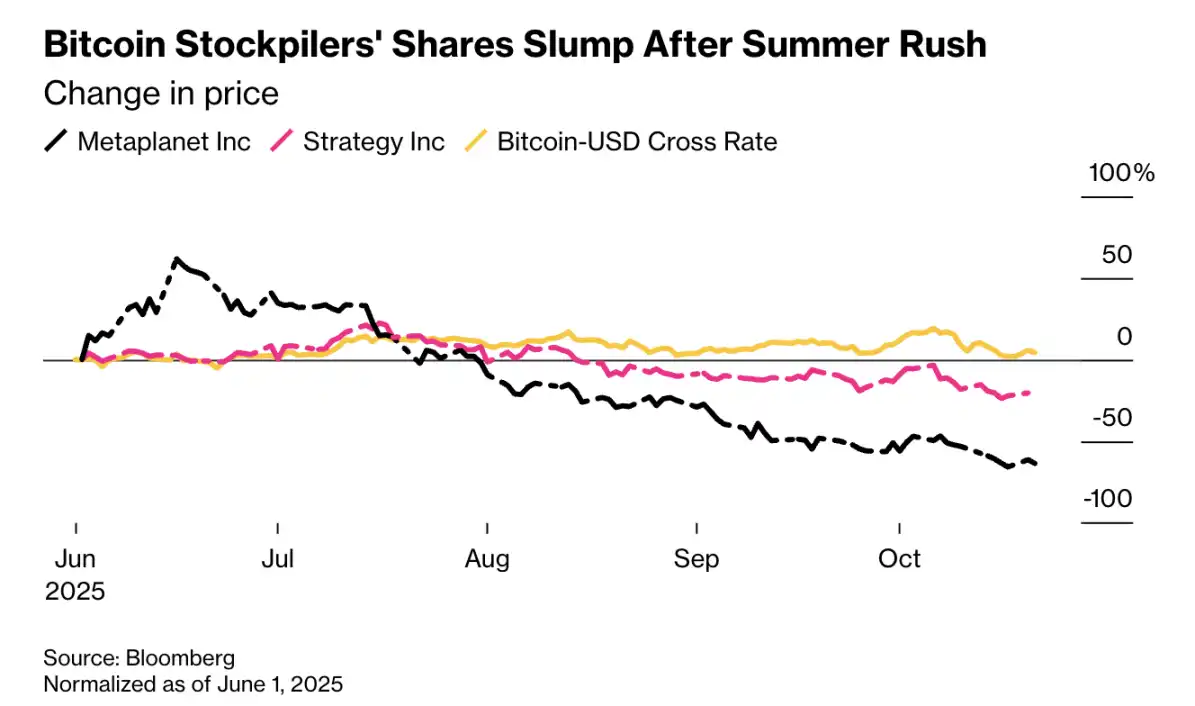
In the Asia-Pacific market, the concerns of exchange operators may completely hinder the plans of cryptocurrency hoarders.
「Listing rules directly determine the speed and standardization of operation of the cryptocurrency treasury model,」 said Rick Maeda, a cryptocurrency analyst at Tokyo-based Presto Research. He added that if rules are 「predictable and lenient,」 they can attract funds and boost investor confidence; whereas a stricter environment would slow down the execution speed of digital asset treasury companies.
Cash Companies in Listed Entities
According to the rules of the Hong Kong Stock Exchange, if a listed company's assets are mainly composed of cash or short-term investments, the company will be considered a 「Cash Company」, and its stock may be suspended from trading. The purpose of this measure is to prevent shell companies from equating their listing status with money laundering.
Simon Hawkins, a partner at the law firm Latham & Watkins, stated that for companies intending to hoard cryptocurrency, approval depends on whether they can 「prove that acquiring cryptocurrency is a core part of their business operations」.
Insiders say that for formerly British colonial-listed companies, it is currently prohibited to transform into pure cryptocurrency hoarding companies.
A Hong Kong Stock Exchange (HKEX) spokesman declined to comment on specific companies of concern but stated that its framework 「ensures that all companies applying for listing and already listed companies have viable and sustainable businesses and operations with substantive content.」
In a similar case, the Bombay Stock Exchange recently rejected the preferential share listing application from Jetking Infotrain. The company had stated that it would invest part of the fundraising into cryptocurrency. A filing document showed that the company is appealing this decision. BSE (Bombay Stock Exchange) and Jetking did not respond to requests for comments.
In Australia, the Australian Securities Exchange (ASX Ltd.) prohibits listed companies from allocating 50% or more of their balance sheet funds to cash or cash-like assets. Steve Orenstein, CEO of software company Locate Technologies Ltd., stated that this clause makes adopting a cryptocurrency treasury model 「almost impossible.」 According to a spokesperson, this enterprise, which transitioned from a software company to a Bitcoin buyer, is currently relocating its listing from Australia to New Zealand, where the New Zealand Exchange (NZX Ltd.) is willing to accept digital asset treasury companies (DAT).
A spokesperson for the Australian Securities Exchange (ASX) stated that if a listed company turns to investing in Bitcoin or Ethereum, it is "advised to consider structuring their investment product as an Exchange Traded Fund (ETF)." Otherwise, they are "likely not to be seen as suitable for listing on the official list."
They mentioned that while the ASX does not prohibit adopting a cryptocurrency treasury strategy, they also cautioned that any conflicts with listing rules must be handled carefully.
Japan's "Hodlers"
Japan stands out as a notable case in the Asia Pacific region. In the country, it is common for listed companies to hold significant cash reserves, and the listing rules for Digital Asset Treasury companies (DAT) are relatively lenient, providing them with greater flexibility.
Hiromi Yamaji, CEO of Japan Exchange Group, stated during a press conference on September 26: "Once a company is listed, if it has made proper disclosures — such as disclosing that it is purchasing Bitcoin — to immediately recognize these actions as unacceptable would be quite difficult."
According to BitcoinTreasuries.net data, Japan is home to 14 listed Bitcoin buyers, the highest in Asia. This includes the hospitality company Metaplanet Inc., which was an early adopter of the digital asset treasury model and currently holds around $3.3 billion in Bitcoin. Since starting its transformation in early 2024, the company's stock price surged at one point to its highest level in mid-June at 1,930 yen but has since fallen by over 70%.
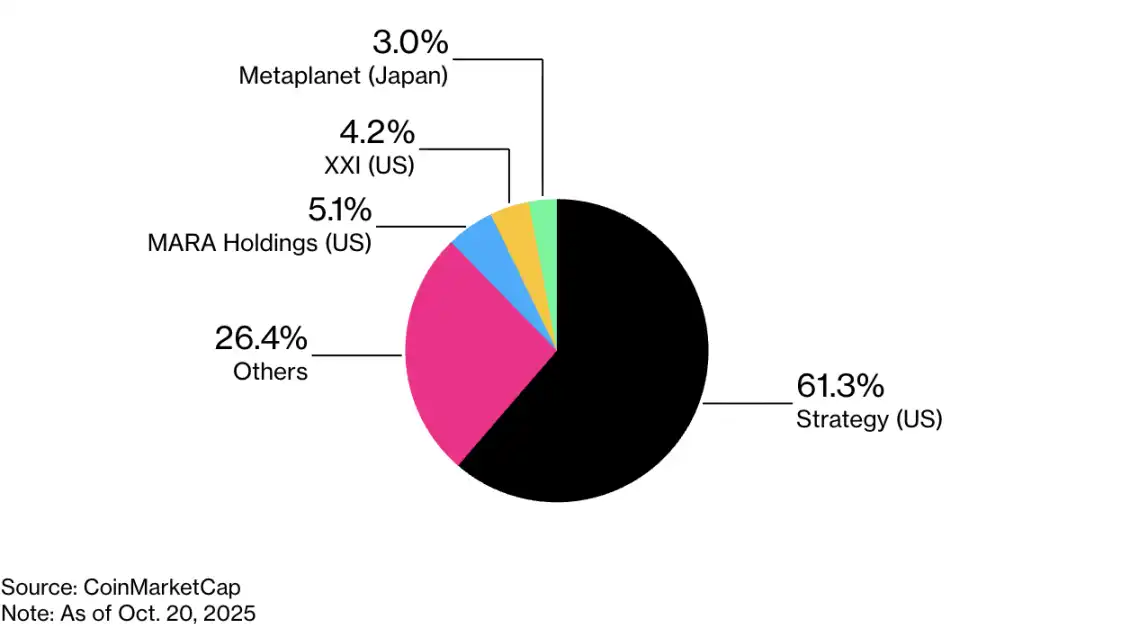
Japan has also seen some more unusual Bitcoin buying plans: Tokyo-based nail salon operator Convano Inc., listed on the stock market, announced in August its plan to raise approximately 434 billion yen ($3 billion) to buy 21,000 Bitcoins. At the time, the company's market value was only a small fraction of this fundraising amount.
Even for Japan's cryptocurrency "Hodlers," signs of friction have emerged. MSCI, one of the world's largest index providers, recently proposed excluding large Digital Asset Treasury companies (DAT) from its global indexes following an investigation into Metaplanet's $1.4 billion international equity issuance in September. Metaplanet joined the MSCI Japan Small Cap Index in February this year and stated it would use most of the funds raised to buy Bitcoin, subsequently purchasing an additional 10,687 tokens. Metaplanet did not respond to requests for comment.
MSCI stated in an announcement that the Digital Asset Treasury (DAT) "may exhibit characteristics similar to investment funds," and therefore does not qualify for inclusion in its index. MSCI suggested implementing an exclusion for companies where crypto assets make up 50% or more of their total assets.
Japanese stock analyst Travis Lundy wrote in a report on Smartkarma that if excluded from the index, the Digital Asset Treasury (DAT) would no longer benefit from passive fund inflows from funds tracking that index. He added, "This could potentially undermine the argument for its price-to-book premium."
You may also like

Guarding billions in assets, yet unable to sustain itself: Tally bids a dignified farewell after five years

SEC’s Stance on Crypto Assets: Most Not Considered Securities
Key Takeaways: The SEC’s new interpretation categorizes most crypto assets as non-securities under federal law. This move aims…

South Korea’s New Crypto Seizure Guidelines After Asset Mismanagement Incidents
Key Takeaways: South Korea’s National Police Agency (KNPA) has drafted guidelines for crypto seizure, with a focus on…

Institutional Confidence in Crypto’s 2026 Growth Trajectory
Key Takeaways: A significant 73% of institutional investors plan to increase their crypto holdings by 2026. Exchange-traded products…

Ethereum Reduces Bridge Times by 98% with Fast Confirmation Rule
Key Takeaways: Ethereum introduces the Fast Confirmation Rule (FCR) aiming to cut bridge times from L1 to L2…

Crypto Firms Advocate DeFi Education in US Colleges
Key Takeaways: Twenty-one crypto organizations have called on US colleges to integrate decentralized finance (DeFi) into their curricula…

RedotPay Reorganizes Amidst Funding Tries and IPO Goals
Key Takeaways: RedotPay is facing leadership changes and concerns over its connections with mainland China while eyeing a…

Bitcoin ETF Streak Nears October Highs While Inflows Lag Behind
Key Takeaways: US spot Bitcoin ETFs have continued their inflow streak for seven straight days, accumulating $1.2 billion…
Connecticut Suspends Bitcoin Depot as Revenue Prospects for 2026 Worsen
Key Takeaways: Connecticut halts Bitcoin Depot’s operations, citing regulatory breaches related to the Money Transmission Act. Bitcoin Depot…

DAO Governance Platform Tally Shuts Down Due to Market Challenges
Key Takeaways: Tally, after operating for five years, is shutting down due to a lack of viable business…
Trump Memecoin Shows Volatility Amid Mar-a-Lago Event
Key Takeaways: TRUMP memecoin holders surpassed 83 wallets with over one million tokens after a luncheon announcement with…
Bitcoin Surge in Australian E-commerce Faces Banking Hurdles: In-depth Analysis
Key Takeaways: Cryptocurrency usage in Australia for purchasing goods and services doubled from 6% to 12% in 2026.…

Meta Shuts Down Horizon Worlds VR for Mobile-Centric Strategy
Key Takeaways: Meta is transitioning Horizon Worlds from a VR to a mobile-centric platform starting June 2026. The…

Bitcoin Exchange Inflows Surge Amidst $75,000 Resistance
Key Takeaways: Bitcoin inflows to exchanges have spiked to 6,100 BTC, hinting at potential selling pressure. The large…
Bitrefill Identifies Lazarus Group Behind Cyberattack and Stolen Funds
Key Takeaways: Bitrefill suffered a cyberattack on March 1, likely orchestrated by the infamous Lazarus Group using sophisticated…
Coin Center Advocates for Rulemaking Over No-Action Letters in Crypto Regulation
Key Takeaways: Coin Center challenges the SEC’s reliance on no-action letters, promoting a shift toward comprehensive rulemaking in…
On the eve of the Fed meeting, are traders starting to bet on a rate hike?
Can AI Make $200 a Day with Weather Forecasting?
Guarding billions in assets, yet unable to sustain itself: Tally bids a dignified farewell after five years
SEC’s Stance on Crypto Assets: Most Not Considered Securities
Key Takeaways: The SEC’s new interpretation categorizes most crypto assets as non-securities under federal law. This move aims…
South Korea’s New Crypto Seizure Guidelines After Asset Mismanagement Incidents
Key Takeaways: South Korea’s National Police Agency (KNPA) has drafted guidelines for crypto seizure, with a focus on…
Institutional Confidence in Crypto’s 2026 Growth Trajectory
Key Takeaways: A significant 73% of institutional investors plan to increase their crypto holdings by 2026. Exchange-traded products…
Ethereum Reduces Bridge Times by 98% with Fast Confirmation Rule
Key Takeaways: Ethereum introduces the Fast Confirmation Rule (FCR) aiming to cut bridge times from L1 to L2…
Crypto Firms Advocate DeFi Education in US Colleges
Key Takeaways: Twenty-one crypto organizations have called on US colleges to integrate decentralized finance (DeFi) into their curricula…


 App
App