
 Buy Crypto
- Markets
 Futures
- Spot
- Copy Trade
- Earn
- More
Bloomberg: Romania Presidential Election Meddled by Crypto Traders


Original Title: Did Romania's "King of TikTok" Really Sway a Presidential Election?
Original Author: Simona Weinglass, Bloomberg
Original Translation: Saoirse, Foresight News
In the real world, Bogdan Peschir is a 36-year-old cryptocurrency trader from the fairytale-like town of Brasov in Transylvania. From his balcony, he can see the red-roofed houses, Gothic churches, and the changing seasons on Tampa Mountain. But on TikTok, he is Bogpr, the platform's biggest "giver."
Peschir particularly enjoys tipping live streamers. If you are live on TikTok and do something to catch his attention and approval—such as jumping into a canal or performing a backflip—he might watch and send you animated gifts that float across the screen. These gifts range in price from a few cents to hundreds of dollars, which recipients can cash out. At this scale, digital gifts are no longer just strangers' likes.
Peschir tips incessantly, with a fan count approaching 200,000. His continued spending unlocks flashier and more expensive gifts: virtual Thunder Eagles, Fire Phoenixes. By the fall of 2024, he reached level 50 on TikTok, firmly establishing himself as one of Europe's top tippers. He also gained a rare privilege: the ability to send a soaring animated Pegasus to streamers he approves of. This type of fame is quite special, but Romanian prosecutors say this influence is incredibly potent. They arrested Peschir, accusing him of using money and clout to assist a maverick far-right candidate in winning the first round of the Romanian presidential election in November 2024.
This candidate, Călin Georgescu, experienced an almost overnight surge. Polls three weeks before the election showed him at only 1% support, without even qualifying for the national televised debates. Yet, he secured 22.9% of the vote in the first round, surpassing 12 other opponents. Within three days, Romania's Supreme Council of Defense announced foreign interference in the election. Five partially redacted intelligence reports were declassified, alleging the involvement of a "state actor" in the voting process. Germany and the U.S. pointed directly at Russia.
The entire operation was conducted online, primarily through TikTok. Tens of thousands of fake accounts created the illusion of Georgescu's overwhelming popularity, thrusting him into everyone's feeds. According to a report from the French government, the hashtag #calingeorgescu was viewed 73.2 million times on TikTok within seven days—a unprecedented level of engagement for a country with a population of 19 million, where around 9 million use TikTok. Prosecutors claim Peschir was involved: he redirected his tipping to promote Georgescu's creators and liked and commented on content supporting the candidate. In messages to acquaintances, he wrote, "I'm doing everything I can here to boost his exposure."
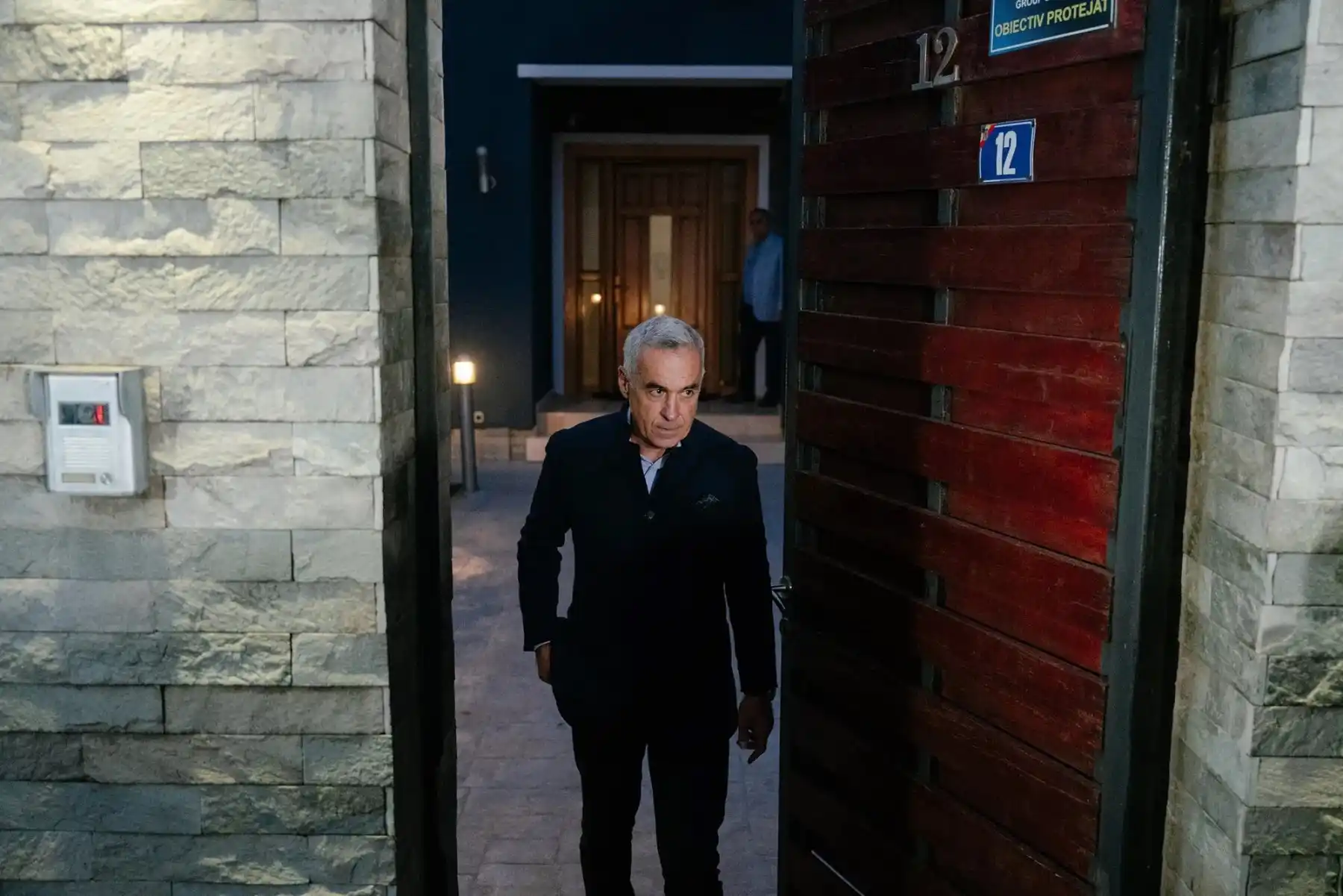
Two days after winning the first-round vote in the Romanian presidential election, Călin Georgescu was 10 days away from having his victory annulled.
Photographer: Andrei Pungovschi / Getty Images
Prosecutors suspect that these actions were crucial to Russia's plan to support Georgescu's rise to power, possibly even part of a coordinated effort. They stated that Peschir's role in boosting Georgescu's popularity was "decisive." Romania's elected president after Georgescu's disqualification, Nicușor Dan, has also publicly criticized Peschir. However, Peschir has not been formally charged to date. He dismissed the government's claims as baseless, stating that he simply enjoys generously tipping TikTok influencers with his hard-earned money, coincidentally being a fan of Călin Georgescu.
For Romania, which was under pro-Soviet dictatorship from 1944 to 1989, the allegation of Kremlin manipulation of elections is particularly sensitive. The Romanian authorities' response has been extremely rare in similar cases. In December 2024, the Romanian Constitutional Court invalidated the election results citing violations of election laws: first, the "opaque use" of digital technology and artificial intelligence, and second, Georgescu's undisclosed campaign funding sources. The court ordered a new election in May 2025 and banned Georgescu from running.
In March 2025, Peschir's arrest made headlines. He entered the Bucharest police headquarters wearing a hat, mask, and sunglasses, reluctantly removing them in front of TV cameras to reveal a neat hairstyle and sharp-featured face. Prosecutors charged him with "electronically bribing voters" and requested his detention pending the completion of the charges. He was released about a month later. Subsequently, a police drone hovered outside his balcony for months, confiscating every new laptop he purchased.
Prosecutors alleged that in the ten months leading up to the election, Peschir spent nearly $900,000 on TikTok gifts, tipping over 250 Romanian influencers. In the last 31 days, he sent $381,000 worth of gifts to accounts supporting Georgescu. The government claimed this was undeclared illegal campaign funding.
Peschir vehemently denied any wrongdoing. "The government has not presented a shred of evidence," he said in an email to Bloomberg Businessweek, "This is a completely fabricated story just to justify an election annulment. He denied being directed by Moscow, stating, "Nobody but God can order me around, and I haven't taken a penny from anyone in years."
The police stated that the case is still under investigation. Business Weekly has reviewed the Romanian intelligence report, as well as the extensive Peschir text message records spanning a hundred pages, and has had conversations and email exchanges with him. These messages in particular seem like a window into the bizarre world of social media influence campaigns. This reclusive figure unexpectedly became an iconic figure in what may be the most successful Russian election interference operation of the 21st century.
Bogpr has been active on TikTok since at least 2023, but he truly skyrocketed to fame in March 2024 — eight months before the general election. At that time, he gifted Romanian singer Nicolae Guță items worth tens of thousands of dollars. According to Peschir himself, this earned him the title of "TikTok King" domestically.
TikTok's economic model revolves around the platform's in-app virtual currency. In Romania, one coin is slightly above 1 cent. Peschir can spend 1 coin to buy a virtual rose, 30,000 coins to buy a lion, and 44,999 coins to buy a "universe." (Whether he has purchased the Pegasus gift worth 42,999 coins is unknown.) Recipients of gifts can convert them into virtual diamonds, which can then be cashed out — approximately half of what the donor spent, with the other half as a commission to TikTok. (The company has refused to disclose the exact commission percentage.)
In the initial months, Peschir's donations to streamers seemed unrelated to the election. He would respond to donation pleas, such as from parents of terminally ill children; he would gift young female streamers who lip-synced and did not speak; and he would give gifts to people just filming themselves driving or chopping wood.
"I would livestream, wear a dress, play an NPC — a non-player character in the game — to get his attention," Roma hip-hop artist Gheorghe-Daniel Alexe (alias Bahoi) said. According to prosecutors, he received gifts from Peschir worth $2,400 in total. Alexe said others would donate too, but Peschir was on a completely different level.
Almost no TikTok creators knew Peschir's real name and appearance. Alexe recalled that he rarely revealed anything about himself, only saying he believed in God and considered giving money his greatest joy. "He said, 'I have too much money, nothing can touch me because there is nothing that can excite me,'" Alexe recounted, "'Only giving can excite me.'
Peschir's generation grew up during a period of intense social transformation. In 1989, the Ceaușescu regime collapsed along with the Iron Curtain, ending the communist dictatorship rooted in the post-World War II Soviet occupation. Romania opened up to the West, joining NATO in 2004 and the EU in 2007. For many years following, the Romanian economy boomed, transforming from a country known for orphans to the second-largest economy in Eastern Europe after Poland. Today, Bucharest, like many European capitals, has street performers, boutique coffee shops, and coworking spaces. But many Romanians have been left behind. According to EU statistics, nearly 30% of the population is at risk of poverty or social exclusion, ranking second highest in the EU.
Far-right forces in Romania began to emerge online as early as the early 2010s. Oana Popescu-Zamfir, Director of the Bucharest think tank GlobalFocus Centre, said these groups included extreme football fans, hip-hop enthusiasts, anti-LGBTQ activists, and advocates of Roma unity. They gradually rallied around a new political party called the Romanian Alliance (AUR) — nationalist, nostalgic, with critics worried about its authoritarian undertones, and its core tenets are embracing tradition and Christianity.
Georgescu was once a member of AUR, holding a similar worldview but with personal quirks. He referred to Ukraine as a "fictional country," praised the pre-World War II far-right organization Iron Guard leader as a "hero" for killing tens of thousands of Jews and political opponents, stating that he "united tens of thousands of people with one goal, one belief, national identity, and the purity of Romanians." He also predicted that in the future, humanity would communicate via telepathy and claimed to have seen aliens. (Georgescu did not respond to this publication's request for comment.)
In mainstream politics, Georgescu is seen as an oddity. But on TikTok, his image is starkly different. In one video, he swims in a frozen lake, showcasing his strong shoulders and arms; in another, he rides a white horse wearing a traditional embroidered shirt. He refers to himself as the "son of a farmer" and the "soul of the nation," alleging that Romania's current leadership is corrupt and selling the country to foreign companies. He claims to be the last hope of this country against the globalist forces that seek to destroy Christianity and Romania's unique identity. Georgescu's ideology is broadly referred to as "sovereignism," pitting ordinary people against elites, nation-states against the EU and NATO, tradition against progressivism.
This rhetoric deeply resonated with Peschir. In a text message, he wrote, "I feel like this person was sent by God. Now we have a chance in Romania."
Undoubtedly, in the weeks leading up to the November 2024 Romanian election, strange events unfolded one after another. Romanian election officials' passwords were leaked and appeared on a Russian hacker forum. A Romanian intelligence report revealed that over 85,000 cyberattacks targeted election infrastructure, seemingly from 33 countries, but the report suggested this was likely an IP spoofing camouflage.
Evidently, one or more powerful forces are attempting to subvert the Romanian election while also trying to cover their tracks.
According to the French media outlet Mediapart, the Romanian intelligence service privately informed their French counterparts that they believed these attacks were orchestrated by Russia. The report stated that Romania had traced one of the attacks back to the Russian Foreign Intelligence Service's (SVR) hacker group APT29 (also known as "Cozy Bear").
In October 2025, President Dan finally publicly stated that the government had traced all intervention activities, including Georgescu's runaway social media blitz, back to Russia. On October 2, Dan presented Romania's interim investigation results to European leaders in Copenhagen.
The President stated that Russia's actions began as early as 2019, when a Russian company started profiling Romanian citizens. Years later, numerous Romanian Facebook groups suddenly emerged, focusing on alternative medicine, religion, recipes, and more, with names like "Only the True God" and "The Beauty of Romania." Dan stated that these seemingly harmless groups aimed to test different propaganda narratives on various Romanian demographics.
The Romanian investigation revealed that Russian digital marketers ultimately identified four main themes: "Romanians are most receptive to narratives about identity, nostalgia, conspiracy theories, religion, and alternative medicine." This was disclosed by Romanian Attorney General Alex Florenta at a press conference two weeks before Dan's visit to Copenhagen.
For example, many groups featured seemingly AI-generated Romanians claiming not to be ashamed of living in rural areas, as well as simple Romanians who had experienced loss but still celebrated birthdays.
As the 2024 elections approached, many of these groups, in addition to sharing recipes, inspirational quotes, and touching stories of regular people, began posting content supporting Georgescu. Meanwhile, TikTok saw a surge of videos and images. Romanian authorities indicated that one of the main sources was a Telegram group called Propagatorcg, where admins centrally managed Georgescu's promotional material, distributed it to volunteers, and provided detailed instructions on which tags to use and how to edit videos, images, and memes to trick the TikTok algorithm into seeing it as original content.
Subsequently, as hundreds of influencers posted Georgescu-related content, the third phase of the campaign was launched: bot accounts. In the two weeks leading up to the vote, 25,000 previously dormant TikTok accounts suddenly became active, heavily engaging with Georgescu-supportive content. Pavel Popescu, Deputy Chairman of the Romanian National Authority for Management and Regulation in Communications (Ancom), stated that these accounts had unique IP addresses and mimicked mobile devices by constantly changing locations, making them difficult to identify as bots and presenting Georgescu's engagement data to the TikTok algorithm as exceptionally genuine.
“Anyone can buy 25,000 bots to give themselves likes, it's not a big deal,” Popescu said, “but when you have 25,000 active accounts, following you everywhere, flooding into the livestream as soon as you go live, that's a whole different story.”
Normally, an account with 10,000 followers goes live and may only have 500 people watching at the same time. But Georgescu's livestream viewership far exceeded what his follower count would suggest. “Soon, Georgescu was in everyone's feed, and then it just exploded like a snowball,” Popescu said. Shortly after the bots appeared, Georgescu became the ninth hottest trend on TikTok worldwide.
At the time of Peschir's arrest, the prosecutor alleged that his support for Georgescu's actions was divided into two stages: in the first few months, he built up popularity and followers on TikTok through gifting; as the first round of elections approached, he started liking, sharing Georgescu's videos and memes. With Peschir's fame and follower count, this content would automatically go viral. When Bogpr entered the livestream, users would get excited as if they were meeting a celebrity. When he sent out big gifts like lions, cosmos, his ID would appear on the screen with animations, and the host would often pause the livestream to thank him by name. His reputation for generosity spread, and many of those who contacted him proactively mentioned his support for Georgescu.
“Can you give me some money? I'm willing to do anything,” a TikTok user Cristian Gunie, who had just been released from prison a week before the election, texted Peschir, “I can distribute Mr. Georgescu's flyers on the streets from morning till night.”
“Hello, if you do this during your livestream, I will support you in the livestream,” Peschir replied. He sent him only one gift: an airplane worth $48.88.
In many of Peschir's text exchanges with the influencers he sponsored, there was a clear mismatch: the influencers were very direct, as if it were only natural to receive money to support Georgescu's election campaign; whereas Peschir's wording was much more cautious.
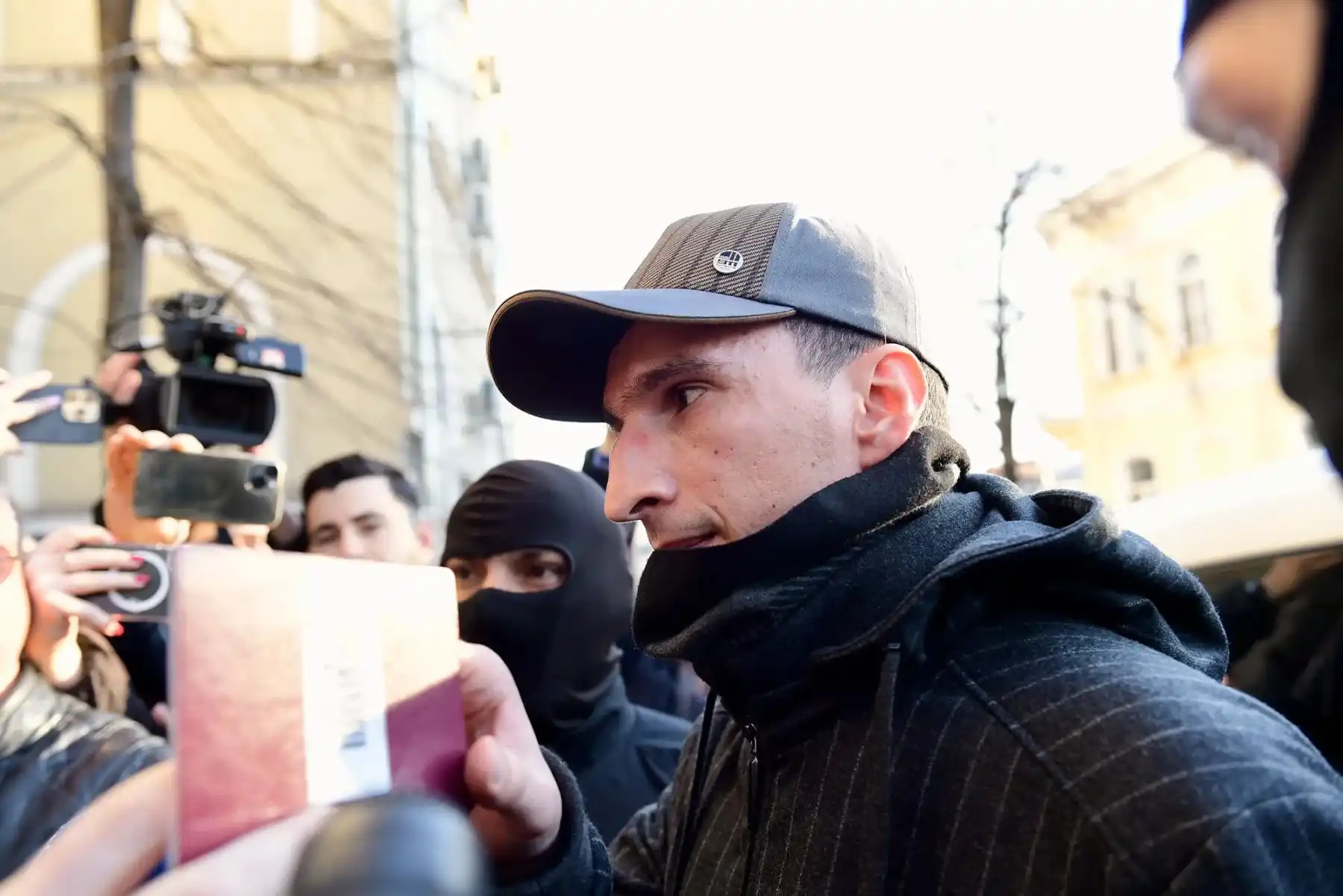
Bogdan Peșchir—referred to as Bogpr by his 200,000 followers on TikTok—being escorted to the headquarters of the Bucharest Prosecutor's Office.
Photographer: Cristian Nistor / Romanian National News Agency Photo
Costel Niculae, also known by the online alias Costelusclejeanioficial10, is a 14-year-old who received a 22-year prison sentence for murder. His TikTok account features content about prison stories, singing, and life reflections filled with profanity.
Six days before the election, Niculae messaged Peschir, saying he hadn't heard from him in days. "Aren't you going to involve me in the voting event?" he wrote. "I can gather many people in my area, with video evidence."
"I didn't 'involve' anyone to do anything," Peschir replied. "I just tell people what I think is good for the country. I don't pay people to do things."
Niculae was puzzled: "I don't understand. Why are you ignoring me? What did I do wrong?"
"I'm not ignoring you," Peschir responded, "Just do what you think is right." After a few exchanges, Peschir reiterated, "There is no plan to pay anyone." In total, he gifted Niculae items worth $4207.37.
If Peschir's messages sound like they've been vetted by an election law expert, it's because they have: police found search records on his computer, including "electoral bribery" and Romania's Electoral Finance Law 334/2006. In Romania, buying votes or candidates accepting undisclosed support is illegal. Prosecutors believe that even though not explicitly stated, this quid pro quo relationship was tacitly understood.
Peschir refused to discuss these messages, citing a pending court case as a reason for non-disclosure. However, he mentioned genuinely liking Georgescu and wanting him to win, with the search on election laws aimed at staying compliant. "These accusations are straight out of an Orwellian novel — being accused of 'thought crimes' by a surveillance state in the face of clear evidence to the contrary," Peschir wrote in an email. "Utterly ridiculous."
A cross-border financial investigation could take years, and Romanian prosecutors are known for their secrecy. This might explain why the prosecution and officials rarely make public statements, only occasionally hinting at Peschir's incredible explanation for his lavish spending on TikTok (Telecom Regulation Officer Popescu said, "Who would spend a million dollars to support some random person?") In the documents, prosecutors state that Peschir deliberately avoided showing a money-power exchange with Georgescu's supporters, precisely proving that's what he was doing. They argue that his TikTok tips over more than half a year leading up to the campaign season were all part of a plan: to draw people into his rapidly expanding network, creating a sense of dependency to exploit during the campaign season.
Peschir said that those non-political tips only showed his wide range of interests on TikTok. His lawyer, Cristian Sirbu, stated that the client not only tipped Georgescu's supporters but also sent gifts to his opponent's supporters. Sirbu pointed out that Peschir explicitly told others that his tipping was not for political purposes.
"But the judge didn't listen at all," Sirbu mentioned referring to a judge at a March hearing last year, "He said that even if [Peschir] told others not to follow suit, there was actually a subconscious suggestion for them to do so. This calls for a visit to a psychiatrist. I even started asking myself if I should go to a mental hospital for a check-up."
The government also stated that around $7 million was found in Peschir's cryptocurrency account after his arrest, which "does not correspond to the standard of living associated with his company's operations." This is the closest the government has come to alleging that Peschir had off-the-books income or that the TikTok tipping funds were not his own.
However, the current charges against Peschir do not involve the source of the funds. Until 2023, he worked for nearly a decade at a Bitcoin ATM company called BitXatm. Since then, he has claimed to be a full-time cryptocurrency trader. "Most of my investments have been made on publicly verifiable decentralized platforms, accessible to anyone with a basic understanding of blockchain," he said.
Peschir's case is part of a larger investigation into Georgescu's behind-the-scenes supporters. Following his initial victory and subsequent disqualification, Georgescu has been under intense scrutiny. He is charged with glorifying the Legionnaire Movement (which is illegal under Romanian law) and conspiring to overthrow the government after the election results were overturned. In October 2025, Romania's Chief Prosecutor confirmed that they had sought assistance from at least three foreign countries to investigate the source of Georgescu's campaign funds.
Romanian President Dan admitted last fall that convicting Peschir remains challenging for the government. "We know how (social media influence operations) were carried out," he said, "We know that some clues—whether from fake accounts or the intermediary companies of paid network advertising—point to Russia. What we don't know is who designed the whole strategy. Similarly, we know very little about the flow of funds... related to Bogdan Peschir."
Peschir has been in custody for nearly a year. A police source told the Business Weekly that the case is still under investigation. He has returned home, can move freely, and has a new laptop to replace those confiscated. He says he is working hard to recover through cryptocurrency trading. Describing himself as a workaholic and introverted person, he leads a very calm, quiet life, spending most of his time in the office. "My only bit of free time, I go to church, spend time with my pets, read, or take late-night drives to relax," he said, mentioning that tipping on TikTok is just another way to unwind.
In December 2024, the Romanian government submitted TikTok to the European Commission to investigate whether it had fulfilled its obligations to prevent the platform from being manipulated. The investigation results have not been disclosed to date.
TikTok has acknowledged the presence of election manipulation attempts but does not agree with the Romanian authorities' description of the manipulation operation. In an email to Business Week, a TikTok spokesperson stated that the company dismantled multiple manipulation networks targeting Romania between November and December 2024, and these networks did not solely support Georgescu. "Considering the wide range of candidate support, the assertion that Călin Georgescu is the sole beneficiary of TikTok's inauthentic activity is inaccurate and cannot measure the relative benefits different candidates derived from it," the spokesperson said.
However, Dan squarely pointed to the sole opponent. "We are facing Russian information attacks on European countries," he said in October, defining Russia's alleged subversion of the Romanian election as hybrid warfare.
This term refers to indirect hostile activities between states that do not involve violent aggression, aimed at subverting the target from within. Western governments most commonly attribute this strategy to Russia, accusing it of election interference, infrastructure sabotage, and supporting coups. Russia always denies involvement on each occasion.
To those supporting the government's position, the more difficult to prove, the better the indication that the conspirators have done a good job covering their tracks. However, to skeptics, this instead suggests that the so-called conspiracy is just a conspiracy theory.
The unprecedented decision to cancel the elections has left many Romanians dissatisfied. Elena Lasconi, the mainstream candidate who was in line to face Georgescu in the final round before he dropped out, said that canceling the elections "shattered the core of democracy—the ballot." In January 2025, tens of thousands of people marched in Bucharest, some carrying coffins with "democracy" written on them.
At one point, Romania's decision to kick out Georgescu from the race seemed to backfire. Another sovereignist candidate, George Simion, announced his candidacy. Like Georgescu, he is skeptical of the EU and its support for Ukraine and claims that Russia poses no threat to NATO. Georgescu publicly endorsed him.
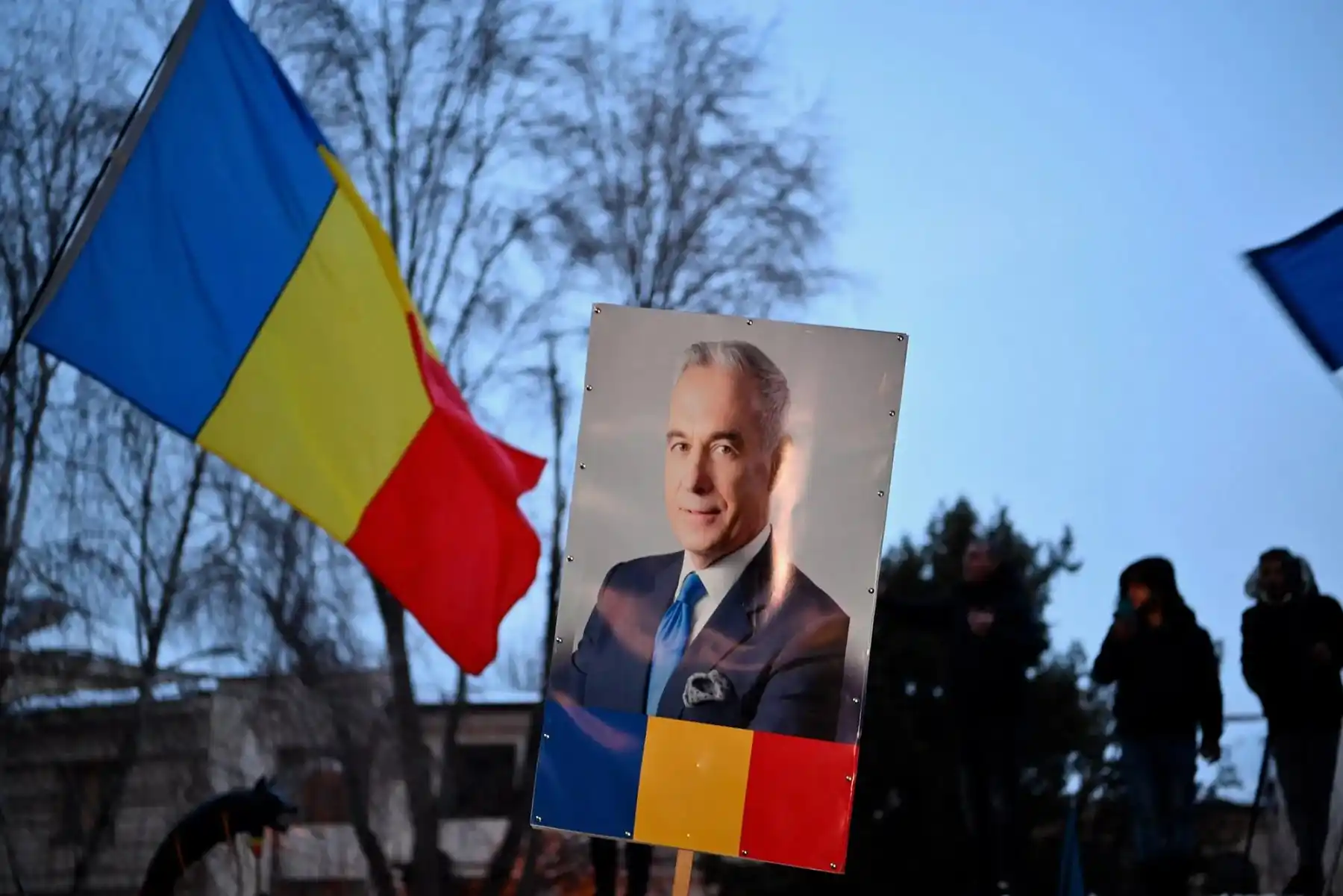
Two months after this candidate's brief electoral victory, he was taken in for questioning by the police, and his supporters gathered together that day.
Photographer: Alex Nicodim / Anadolul Communications Agency
In the May 2025 runoff election, Simion received 41% of the votes, far ahead of that year's Georgescu's 23%. His final opponent was mathematician and activist Dan, who had been the mayor of Bucharest since 2020. Global media outlets predicted Simion's victory. On May 7th, Reuters headlined: "Romania's Far-Right Leader Simion Leads in Pre-Election Polls." The Romanian leu hit a historic low against the euro, reflecting investors' concerns about Simion's economic policies.
On TikTok, Simion has 1.3 million followers, while Dan has only 350,000. Simion posts videos of himself with workers and in churches; Dan shares his urban life in Bucharest, dining out, and sharing household chores with his partner. Simion talks about restoring dignity and justice to the Romanian people; Dan solves math problems and explains budget balancing. Simion aims to involve Romanians in a great historical movement; Dan discusses the rule of law and liberalism.
TikTok, still under investigation by the EU, notably ramped up its response to suspicious activities on the platform during the election period. Mircea Toma, the State Secretary of the Romanian Audiovisual Council (TV regulator), stated that TikTok doubled its Romanian language moderation team and increased collaboration with regulatory bodies. "Once we flag content, it can be removed within minutes," Toma said. "Previously, we couldn't find anyone."
On May 18th, Election Day, Romanian voters delivered another surprise. Dan defeated Simion with 53.6% to 46.4% of the vote. Following the 9 p.m. announcement of the results, large crowds gathered outside Dan's campaign headquarters near Cișmigiu Park in Bucharest. The voter turnout reached a record-high of 65%, compared to the 53% in the annulled first round. The crowd chanted "Europe, Europe" and "Down with fascism," with many waving EU flags.
Although the Russian-favored candidate lost, the Georgescu-style political ideology evidently lingered. "Our society is more polarized than ever before," said Romanian journalist Victor Ilie. "Because of the canceled and rerun elections, all those who voted for Simion and Georgescu do not consider Nicușor Dan a legitimate president. On the other side, those who voted for Dan are ecstatic that the far-right did not win and idolize him in an extreme way. These two groups no longer communicate."
Of course, Bogdan Peschir is a firm believer that Georgescu was the true victim of election interference. "The reason why Romanian elections had to be annulled is that the 'wrong' person won—a wrong one for the political establishment," he said.
When asked why he thought Georgescu could go viral, Peschir said it was purely because he was charismatic. "I think it's just because people resonate with his ideas," he said, "Romanian society is deeply craving change, and people see him as an outsider. He's very good at touching on the key issues that really hurt Romania."
In a sense, this seems obvious. The viral campaign orchestrated by fake accounts gave Georgescu a huge head start, allowing him to get into the average person's phone first. And once reaching the audience, many people were genuinely persuaded. A fake campaign eventually turned into real sentiment.
You may also like

Gate founder Dr. Han: The crypto winter drives structural reshaping, and everything on-chain will become a new paradigm in finance

Is XRP a Good Investment in 2026? Why Is It Stuck at $1.45
XRP is up 6.7% this week, but exchange reserves remain high. Is a volatility spike imminent? We analyze price trend, ETF inflows, whale activity, and regulatory catalysts to answer: will XRP go up, why is XRP dropping, and is XRP a good investment right now?
TL; DR
What is XRP: XRP is a digital asset built for fast, low-cost international payments. It runs on the XRP Ledger and is used by Ripple for its On-Demand Liquidity (ODL) service. Unlike Bitcoin, XRP settles transactions in 3-5 seconds with near-zero fees.Why is XRP Dropping: XRP is not actively dropping, but it is struggling to rise. On the monthly chart, XRP has seen six consecutive months of decline. Currently, the price faces an additional supply wall at $1.45. About 1.24 billion XRP were bought in that range, and those holders sell when the price approaches, creating selling pressure that prevents a recovery.Will XRP Go Up: Potentially yes. XRP is trading near $1.43 and showing its best weekly performance since September 2025. If the price breaks above the $1.45 resistance, analysts expect a move toward $1.90, supported by strong institutional demand.Is XRP a Good Investment: The answer is not simple. Short-term traders may see opportunity in the coming volatility spike. Long-term investors face a bigger question that depends on one key regulatory event. However, the data reveals a surprising signal that most retail buyers are missing right now. To understand whether XRP is a smart buy or a trap at $1.43, you will need to read the full analysis below.What is XRP? A Digital Asset for Global SettlementBefore analyzing the charts, it is crucial to understand the asset in question. What is XRP? Unlike Bitcoin, which was designed as a decentralized digital gold, XRP operates on the XRP Ledger (XRPL). It was created to facilitate fast, low-cost international payments. Traditional bank transfers take days and incur high fees. XRP transactions settle in 3-5 seconds, costing fractions of a penny.
Ripple, the company associated with XRP, uses this asset for its "On-Demand Liquidity" (ODL) service. Banks and financial institutions use ODL to source liquidity during cross-border transactions without pre-funding accounts. This utility is the primary driver for institutional interest. Recently, the network hit a milestone of over 8 million active wallets, signaling growing usage despite recent price stagnation . Furthermore, Ripple is proactively preparing for the future, releasing a four-stage roadmap to make the XRPL "quantum-resistant," aiming to secure the ledger against future quantum computing threats by 2028 .
XRP Price Analysis: The Battle for $1.45The XRP price trend over the last month tells a story of exhaustion followed by cautious recovery. On the monthly chart, XRP experienced six consecutive months of decline. However, April shows signs of a bottoming process. Weekly charts reinforce this view: after four weeks of lower closes, the last two weeks have seen small rebounds.
According to data from April 22, 2026, XRP is trading at approximately $1.44. Over the last seven days, XRP has outperformed both Bitcoin and Ethereum, rising 6.7% while the broader market rose only 3.2%. Spot trading volume surged 23% to $3.79 billion, and derivative markets saw $40 billion in futures volume on a single day.
Despite this, the price remains 60% below its July 2025 high of $3.65. The current technical picture shows a "low volatility grind" higher. The 20-day EMA is at $1.3924, and the 50-day EMA is at $1.4119, both acting as support . However, the immediate hurdle is the $1.45 resistance level. This price point has rejected every rally attempt in 2026.
Why is XRP Dropping? And Will XRP Go Up?The primary reason for the recent "drop" (or lack of upward momentum) is not active selling, but rather the "supply wall." Data indicates that roughly 1.24 billion XRP tokens were purchased by investors in the $1.45 to $1.47 range. These investors have been waiting months to "break even." Every time the price approaches $1.45, these holders sell to exit their positions, creating a massive wall that retail buying cannot easily absorb.
However, the underlying momentum is shifting. Analysts suggest a xrp volatility spike imminent because the absorption capacity of buyers is increasing. Historically, when exchange reserves are high but the price refuses to drop significantly, it signals that buyers are absorbing the supply. The price has held above $1.39 despite the overhang, which is a sign of relative strength.
So, will XRP go up? Yes, potentially. But it needs a catalyst, if the price closes a daily candle above $1.45. If that happens, the next targets are $1.60 to $1.65, and eventually $1.90 .
XRP Exchange Netflow and XRP ETF Netflow: A Tale of Two MarketsThe current market dynamic is best understood by looking at two opposing data streams: XRP Exchange netflow and XRP ETF flows.
Exchange Dynamics (Retail / Whales):
Data shows a complex pattern of "large inflows and increasing reserves." Recently, a Ripple-associated wallet moved 75 million XRP (approx. $108 million) to Coinbase. This initially looks like a dump, but context matters. These transfers are likely to provide liquidity for Ripple’s ODL business, not necessarily spot market selling. However, the result is that exchange reserves have climbed to 2.76 billion XRP .
The Good News: While reserves are high, the rate of increase is slowing. Specifically, "whale" transfers to exchanges have dropped 98% from their April 11 peak. The Binance reserve has slightly decreased from 27.7 to 27.6 billion. The aggressive selling from large holders appears to have stopped.
Institutional Dynamics (ETF):
While whales were sending coins to exchanges, institutions were buying XRP ETF products. XRP ETF net flow is strongly positive.
US-listed XRP ETFs recorded four consecutive days of inflows totaling $38.86 million recently .The weekly inflow for mid-April hit $119.6 million, a multi-month high .Cumulative net inflows stand at $12.8 billion, with Assets Under Management (AUM) at roughly $10.8 billion.Analyzing the Divergence: Why Both Flows Are PositiveIt seems contradictory that exchange reserves are high (suggesting selling) while ETFs are buying (suggesting buying). However, this phenomenon reveals the current market structure.
Different Investor Profiles: The exchange inflows likely come from short-term traders, market makers, or Ripple itself providing ODL liquidity. These are "hot" coins ready to be sold. The ETF inflows represent "sticky" capital. Institutions buying ETFs are typically long-term holders (LTHs) or asset managers who do not day-trade. They are removing liquidity from the spot market by buying through custodians.The "De-risking" Trade: Sophisticated funds might be engaging in basis trading. They buy the ETF (taking a long position) while simultaneously shorting XRP futures or selling spot inventory to capture the funding rate. This keeps the price stable while volume increases.Absorption: The most likely scenario is that the market is simply absorbing the excess supply. The fact that the price is stable ($1.43) and not collapsing to $1.20 despite 2.76 billion coins sitting on exchanges is a massive win for the bulls. The ETF inflows are acting as a sponge, soaking up the selling pressure from the ODL wallets.The Regulatory Catalyst: The SEC and the CLARITY ActFundamentally, the recent price action cannot be separated from regulation. For years, the primary answer was the SEC lawsuit. That narrative is dying.
Ripple CEO Brad Garlinghouse recently praised SEC Chair Paul Atkins as "a breath of fresh air and sanity" . This regulatory thaw is critical. The SEC is reportedly considering dropping the long-standing lawsuit, and five XRP ETF applications are awaiting review.
The major catalyst on the horizon is the CLARITY Act. A Senate markup is expected before the end of April. Standard Chartered analysts project that if the bill advances, it could unlock $4 to $8 billion in institutional flows . Polymarket gives the bill a 60-66% chance of passing in 2026. If the CLARITY Act classifies XRP as a non-security (commodity), the institutional floodgates will open, likely overwhelming the $1.45 supply wall instantly.
Is XRP a Good Investment in 2026?Given all this data, is XRP a good investment? The answer depends entirely on your risk tolerance and time horizon.
The Bull Case (Why it is a good investment): The risk/reward ratio is asymmetrical to the upside. The price is near multi-year lows relative to its utility. Whale selling has stopped, ETF demand is rising, and the network is expanding (8 million wallets, quantum resistance roadmap). If the CLARITY Act passes, XRP could realistically trade between $1.60 and $1.80 in the short term, with a potential run to $3.00+ if the lawsuit is officially dropped.The Risk Case (Why it is NOT a good investment): There is a clear resistance wall at $1.45. If the CLARITY Act fails or is delayed past May (due to midterm election dynamics), the "buy the rumor, sell the news" dynamic could reverse. If the price fails to break $1.45 and loses support at $1.33, a drop back to $1.15 is technically possible .Verdict: XRP is a speculative buy for traders looking for a volatility spike. It is a hold for current investors. For new investors, it is only a good investment if you believe in regulatory clarity within the next 30 days. Technically, waiting for a confirmed break above $1.55 (to avoid the fakeout) is safer than buying at $1.43.
FAQQ: Will XRP go up if the CLARITY Act passes?
A: Yes, historically. Analysts predict that if the CLARITY Act passes, signaling that XRP is a commodity, it would remove the regulatory overhang. This could trigger a surge in institutional buying, pushing the price from the current $1.43 range to test the $1.80 - $2.00 resistance levels quickly.
Q: Why is XRP dropping when Bitcoin is going up?
A: XRP has specific supply dynamics. Unlike Bitcoin, which has a fixed supply issuance, XRP faces periodic sell-pressure from Ripple's treasury wallets used to fund ODL (liquidity) services. Additionally, the $1.45 "break-even" wall causes XRP to drop relative to BTC when short-term traders exit.
Q: Is a volatility spike imminent for XRP?
A: Yes. The Bollinger Bands on the daily chart are squeezing. The price is stuck between support at $1.33 and resistance at $1.45. Historically, when XRP volume surges 23% in a week (as it did on April 21), it precedes a violent move. The direction depends on whether the $1.45 resistance breaks.
Q: What is the XRP ETF netflow status?
A: As of late April 2026, XRP ETFs are seeing positive netflows. The US ETFs recorded a single week inflow of $119.6 million in mid-April. Cumulative inflows are strong at $12.8 billion, indicating that institutions are accumulating during this dip, which is a long-term bullish signal for price stabilization.
Q: Is XRP a good investment for beginners?
A: XRP is less volatile than "meme coins" but more volatile than Bitcoin. For beginners, it is a moderate-risk investment. Its value is tied to real utility (bank payments). However, beginners should wait to see if the price can close a weekly candle above $1.55 before entering, to avoid buying into the current resistance wall.
Disclaimer: None of the information in this article constitutes, or is intended to constitute, investment advice. Trading cryptocurrencies carries a high level of risk and may not be suitable for all investors. Always do your own research.
About WEEXFounded in 2018, WEEX has developed into a global crypto exchange with over 6.2 million users across more than 150 countries. The platform emphasizes security, liquidity, and usability, providing over 1,200 spot trading pairs and offering up to 400x leverage in crypto futures trading. In addition to the traditional spot and derivatives markets, WEEX is expanding rapidly in the AI era — delivering real-time AI news, empowering users with AI trading tools, and exploring innovative trade-to-earn models that make intelligent trading more accessible to everyone. Its 1,000 BTC Protection Fund further strengthens asset safety and transparency, while features such as copy trading and advanced trading tools allow users to follow professional traders and experience a more efficient, intelligent trading journey.
Follow WEEX on social mediaX: @WEEX_Official
Instagram: @WEEX Exchange
Tiktok: @weex_global
Youtube: @WEEX_Official
Discord: WEEX Community
Telegram: WeexGlobal Group

FC Barcelona vs Celta Vigo: Can Anyone Stop Barcelona at Home?
FC Barcelona vs Celta Vigo lineups, standings, and stats for April 22, 2026. FC Barcelona need a win to stay on track for the La Liga title. Full preview inside.

Carl Moon & WEEX Head to Mugello: The Crypto Trader's Ferrari Challenge
Forget the sidelines. WEEX is hitting the 300km/h mark at Mugello this weekend. Witness Carl Moon’s transformation from a supermarket cashier to a Ferrari racer, and discover why the world’s fastest trading floor belongs on the world’s most technical track at the official Ferrari Challenge.

How to Become a Pro Crypto Trader: WEEX Interview with Ferrari Racer Carl Moon
Ferrari racer Carl Moon on mastering crypto trading: 80/20 rule, AI tools, Bitcoin at $95K, and risk lessons from the track.

Morning Report | Amazon increases investment in Anthropic up to $25 billion; SEC plans to introduce an "innovation exemption" mechanism to support compliant on-chain trading of tokenized securities

Jeff Hoffman, founder of Booking.com: How Web3 and AI are reshaping the trillion-dollar social travel market

Top 12 Cryptocurrencies to Invest in April 2026
Key Takeaways: Bitcoin remains the dominant player with a $1.42 trillion market cap. Hyperliquid’s HYPE token gains traction,…
18 Best Crypto & Bitcoin Casinos in March 2026
Key Takeaways: Cryptocurrencies offer faster, cheaper, and more private payment options in online casinos. Top crypto casinos include…

Full Post-Mortem of the KelpDAO Incident: Why Did Aave, Which Was Not Compromised, End Up in Crisis Situation?
Key Takeaways: The KelpDAO incident exposed vulnerabilities in collateral pricing and cross-chain bridge operations, affecting Aave’s liquidity. rsETH…

Is MicroStrategy’s STRC Bitcoin’s Savior or Destroyer?
Key Takeaways: MicroStrategy’s STRC offers an annualized yield of 11.5%, driving significant Bitcoin buying pressure. Michael Saylor’s financial…

Ceasefire Expiration and Market Response: Bitcoin Defies Market Trends
Key Takeaways: The current ceasefire agreement is anticipated to expire on Wednesday in Washington, with low likelihood of…

Oil Price Dilemma: More Than a Price Hike
Key Takeaways: Global oil market has surpassed its breaking point, not solving with price hikes but facing significant…

On the Day Aave Launched rsETH, Spark Strategically Exited
Key Takeaways: Aave enabled rsETH lending at a 93% LTV, while Spark withdrew due to low utilization by…

Nasdaq Breaks Record and Crypto Transactions Surge
Key Takeaways: Nasdaq’s rise to a new intraday high indicates strong market momentum. A significant transfer of 35,000…

Powell: Fed Requires a Brand New Inflation Blueprint
Key Takeaways: Powell aims for transformative policy overhauls within the Fed if appointed. Past inflation response mistakes during…

Without Cook’s Apple, Can it Still Grow in the AI Era?
Key Takeaways: John Ternus acts more like a systematic integrator within Apple rather than a solo visionary. Apple’s…

Iran Stock Market and Crypto Developments in Focus
Key Takeaways: The Iranian stock market is set to reopen in 10 to 12 days, excluding companies impacted…
Gate founder Dr. Han: The crypto winter drives structural reshaping, and everything on-chain will become a new paradigm in finance
Is XRP a Good Investment in 2026? Why Is It Stuck at $1.45
XRP is up 6.7% this week, but exchange reserves remain high. Is a volatility spike imminent? We analyze price trend, ETF inflows, whale activity, and regulatory catalysts to answer: will XRP go up, why is XRP dropping, and is XRP a good investment right now?
TL; DR
What is XRP: XRP is a digital asset built for fast, low-cost international payments. It runs on the XRP Ledger and is used by Ripple for its On-Demand Liquidity (ODL) service. Unlike Bitcoin, XRP settles transactions in 3-5 seconds with near-zero fees.Why is XRP Dropping: XRP is not actively dropping, but it is struggling to rise. On the monthly chart, XRP has seen six consecutive months of decline. Currently, the price faces an additional supply wall at $1.45. About 1.24 billion XRP were bought in that range, and those holders sell when the price approaches, creating selling pressure that prevents a recovery.Will XRP Go Up: Potentially yes. XRP is trading near $1.43 and showing its best weekly performance since September 2025. If the price breaks above the $1.45 resistance, analysts expect a move toward $1.90, supported by strong institutional demand.Is XRP a Good Investment: The answer is not simple. Short-term traders may see opportunity in the coming volatility spike. Long-term investors face a bigger question that depends on one key regulatory event. However, the data reveals a surprising signal that most retail buyers are missing right now. To understand whether XRP is a smart buy or a trap at $1.43, you will need to read the full analysis below.What is XRP? A Digital Asset for Global SettlementBefore analyzing the charts, it is crucial to understand the asset in question. What is XRP? Unlike Bitcoin, which was designed as a decentralized digital gold, XRP operates on the XRP Ledger (XRPL). It was created to facilitate fast, low-cost international payments. Traditional bank transfers take days and incur high fees. XRP transactions settle in 3-5 seconds, costing fractions of a penny.
Ripple, the company associated with XRP, uses this asset for its "On-Demand Liquidity" (ODL) service. Banks and financial institutions use ODL to source liquidity during cross-border transactions without pre-funding accounts. This utility is the primary driver for institutional interest. Recently, the network hit a milestone of over 8 million active wallets, signaling growing usage despite recent price stagnation . Furthermore, Ripple is proactively preparing for the future, releasing a four-stage roadmap to make the XRPL "quantum-resistant," aiming to secure the ledger against future quantum computing threats by 2028 .
XRP Price Analysis: The Battle for $1.45The XRP price trend over the last month tells a story of exhaustion followed by cautious recovery. On the monthly chart, XRP experienced six consecutive months of decline. However, April shows signs of a bottoming process. Weekly charts reinforce this view: after four weeks of lower closes, the last two weeks have seen small rebounds.
According to data from April 22, 2026, XRP is trading at approximately $1.44. Over the last seven days, XRP has outperformed both Bitcoin and Ethereum, rising 6.7% while the broader market rose only 3.2%. Spot trading volume surged 23% to $3.79 billion, and derivative markets saw $40 billion in futures volume on a single day.
Despite this, the price remains 60% below its July 2025 high of $3.65. The current technical picture shows a "low volatility grind" higher. The 20-day EMA is at $1.3924, and the 50-day EMA is at $1.4119, both acting as support . However, the immediate hurdle is the $1.45 resistance level. This price point has rejected every rally attempt in 2026.
Why is XRP Dropping? And Will XRP Go Up?The primary reason for the recent "drop" (or lack of upward momentum) is not active selling, but rather the "supply wall." Data indicates that roughly 1.24 billion XRP tokens were purchased by investors in the $1.45 to $1.47 range. These investors have been waiting months to "break even." Every time the price approaches $1.45, these holders sell to exit their positions, creating a massive wall that retail buying cannot easily absorb.
However, the underlying momentum is shifting. Analysts suggest a xrp volatility spike imminent because the absorption capacity of buyers is increasing. Historically, when exchange reserves are high but the price refuses to drop significantly, it signals that buyers are absorbing the supply. The price has held above $1.39 despite the overhang, which is a sign of relative strength.
So, will XRP go up? Yes, potentially. But it needs a catalyst, if the price closes a daily candle above $1.45. If that happens, the next targets are $1.60 to $1.65, and eventually $1.90 .
XRP Exchange Netflow and XRP ETF Netflow: A Tale of Two MarketsThe current market dynamic is best understood by looking at two opposing data streams: XRP Exchange netflow and XRP ETF flows.
Exchange Dynamics (Retail / Whales):
Data shows a complex pattern of "large inflows and increasing reserves." Recently, a Ripple-associated wallet moved 75 million XRP (approx. $108 million) to Coinbase. This initially looks like a dump, but context matters. These transfers are likely to provide liquidity for Ripple’s ODL business, not necessarily spot market selling. However, the result is that exchange reserves have climbed to 2.76 billion XRP .
The Good News: While reserves are high, the rate of increase is slowing. Specifically, "whale" transfers to exchanges have dropped 98% from their April 11 peak. The Binance reserve has slightly decreased from 27.7 to 27.6 billion. The aggressive selling from large holders appears to have stopped.
Institutional Dynamics (ETF):
While whales were sending coins to exchanges, institutions were buying XRP ETF products. XRP ETF net flow is strongly positive.
US-listed XRP ETFs recorded four consecutive days of inflows totaling $38.86 million recently .The weekly inflow for mid-April hit $119.6 million, a multi-month high .Cumulative net inflows stand at $12.8 billion, with Assets Under Management (AUM) at roughly $10.8 billion.Analyzing the Divergence: Why Both Flows Are PositiveIt seems contradictory that exchange reserves are high (suggesting selling) while ETFs are buying (suggesting buying). However, this phenomenon reveals the current market structure.
Different Investor Profiles: The exchange inflows likely come from short-term traders, market makers, or Ripple itself providing ODL liquidity. These are "hot" coins ready to be sold. The ETF inflows represent "sticky" capital. Institutions buying ETFs are typically long-term holders (LTHs) or asset managers who do not day-trade. They are removing liquidity from the spot market by buying through custodians.The "De-risking" Trade: Sophisticated funds might be engaging in basis trading. They buy the ETF (taking a long position) while simultaneously shorting XRP futures or selling spot inventory to capture the funding rate. This keeps the price stable while volume increases.Absorption: The most likely scenario is that the market is simply absorbing the excess supply. The fact that the price is stable ($1.43) and not collapsing to $1.20 despite 2.76 billion coins sitting on exchanges is a massive win for the bulls. The ETF inflows are acting as a sponge, soaking up the selling pressure from the ODL wallets.The Regulatory Catalyst: The SEC and the CLARITY ActFundamentally, the recent price action cannot be separated from regulation. For years, the primary answer was the SEC lawsuit. That narrative is dying.
Ripple CEO Brad Garlinghouse recently praised SEC Chair Paul Atkins as "a breath of fresh air and sanity" . This regulatory thaw is critical. The SEC is reportedly considering dropping the long-standing lawsuit, and five XRP ETF applications are awaiting review.
The major catalyst on the horizon is the CLARITY Act. A Senate markup is expected before the end of April. Standard Chartered analysts project that if the bill advances, it could unlock $4 to $8 billion in institutional flows . Polymarket gives the bill a 60-66% chance of passing in 2026. If the CLARITY Act classifies XRP as a non-security (commodity), the institutional floodgates will open, likely overwhelming the $1.45 supply wall instantly.
Is XRP a Good Investment in 2026?Given all this data, is XRP a good investment? The answer depends entirely on your risk tolerance and time horizon.
The Bull Case (Why it is a good investment): The risk/reward ratio is asymmetrical to the upside. The price is near multi-year lows relative to its utility. Whale selling has stopped, ETF demand is rising, and the network is expanding (8 million wallets, quantum resistance roadmap). If the CLARITY Act passes, XRP could realistically trade between $1.60 and $1.80 in the short term, with a potential run to $3.00+ if the lawsuit is officially dropped.The Risk Case (Why it is NOT a good investment): There is a clear resistance wall at $1.45. If the CLARITY Act fails or is delayed past May (due to midterm election dynamics), the "buy the rumor, sell the news" dynamic could reverse. If the price fails to break $1.45 and loses support at $1.33, a drop back to $1.15 is technically possible .Verdict: XRP is a speculative buy for traders looking for a volatility spike. It is a hold for current investors. For new investors, it is only a good investment if you believe in regulatory clarity within the next 30 days. Technically, waiting for a confirmed break above $1.55 (to avoid the fakeout) is safer than buying at $1.43.
FAQQ: Will XRP go up if the CLARITY Act passes?
A: Yes, historically. Analysts predict that if the CLARITY Act passes, signaling that XRP is a commodity, it would remove the regulatory overhang. This could trigger a surge in institutional buying, pushing the price from the current $1.43 range to test the $1.80 - $2.00 resistance levels quickly.
Q: Why is XRP dropping when Bitcoin is going up?
A: XRP has specific supply dynamics. Unlike Bitcoin, which has a fixed supply issuance, XRP faces periodic sell-pressure from Ripple's treasury wallets used to fund ODL (liquidity) services. Additionally, the $1.45 "break-even" wall causes XRP to drop relative to BTC when short-term traders exit.
Q: Is a volatility spike imminent for XRP?
A: Yes. The Bollinger Bands on the daily chart are squeezing. The price is stuck between support at $1.33 and resistance at $1.45. Historically, when XRP volume surges 23% in a week (as it did on April 21), it precedes a violent move. The direction depends on whether the $1.45 resistance breaks.
Q: What is the XRP ETF netflow status?
A: As of late April 2026, XRP ETFs are seeing positive netflows. The US ETFs recorded a single week inflow of $119.6 million in mid-April. Cumulative inflows are strong at $12.8 billion, indicating that institutions are accumulating during this dip, which is a long-term bullish signal for price stabilization.
Q: Is XRP a good investment for beginners?
A: XRP is less volatile than "meme coins" but more volatile than Bitcoin. For beginners, it is a moderate-risk investment. Its value is tied to real utility (bank payments). However, beginners should wait to see if the price can close a weekly candle above $1.55 before entering, to avoid buying into the current resistance wall.
Disclaimer: None of the information in this article constitutes, or is intended to constitute, investment advice. Trading cryptocurrencies carries a high level of risk and may not be suitable for all investors. Always do your own research.
About WEEXFounded in 2018, WEEX has developed into a global crypto exchange with over 6.2 million users across more than 150 countries. The platform emphasizes security, liquidity, and usability, providing over 1,200 spot trading pairs and offering up to 400x leverage in crypto futures trading. In addition to the traditional spot and derivatives markets, WEEX is expanding rapidly in the AI era — delivering real-time AI news, empowering users with AI trading tools, and exploring innovative trade-to-earn models that make intelligent trading more accessible to everyone. Its 1,000 BTC Protection Fund further strengthens asset safety and transparency, while features such as copy trading and advanced trading tools allow users to follow professional traders and experience a more efficient, intelligent trading journey.
Follow WEEX on social mediaX: @WEEX_Official
Instagram: @WEEX Exchange
Tiktok: @weex_global
Youtube: @WEEX_Official
Discord: WEEX Community
Telegram: WeexGlobal Group
FC Barcelona vs Celta Vigo: Can Anyone Stop Barcelona at Home?
FC Barcelona vs Celta Vigo lineups, standings, and stats for April 22, 2026. FC Barcelona need a win to stay on track for the La Liga title. Full preview inside.
Carl Moon & WEEX Head to Mugello: The Crypto Trader's Ferrari Challenge
Forget the sidelines. WEEX is hitting the 300km/h mark at Mugello this weekend. Witness Carl Moon’s transformation from a supermarket cashier to a Ferrari racer, and discover why the world’s fastest trading floor belongs on the world’s most technical track at the official Ferrari Challenge.
How to Become a Pro Crypto Trader: WEEX Interview with Ferrari Racer Carl Moon
Ferrari racer Carl Moon on mastering crypto trading: 80/20 rule, AI tools, Bitcoin at $95K, and risk lessons from the track.


 App
App