
- Buy Crypto
- Markets
 Futures
- Spot
- Copy Trade
- Earn
- More
Bitcoin continues to plummet, will Strategy be forced to sell?

Original Title: "Bitcoin Continues Sharp Decline, MSTR Forced to Sell Becomes Focus"
Original Author: Ye Zhen, Wall Street See News
Bitcoin is undergoing a severe stress test against institutional holdings, as the price falls below a key psychological level, approaching the cost basis of major holders like MicroStrategy, the market's concern over high-leverage holders' liquidity is rapidly escalating.
Over the weekend, Bitcoin broke below the $80,000 integer mark, hitting its lowest level since April 7, 2025. This round of selling occurred against the backdrop of significant market illiquidity, further intensifying Bitcoin's recent cumulative decline of over 30%.
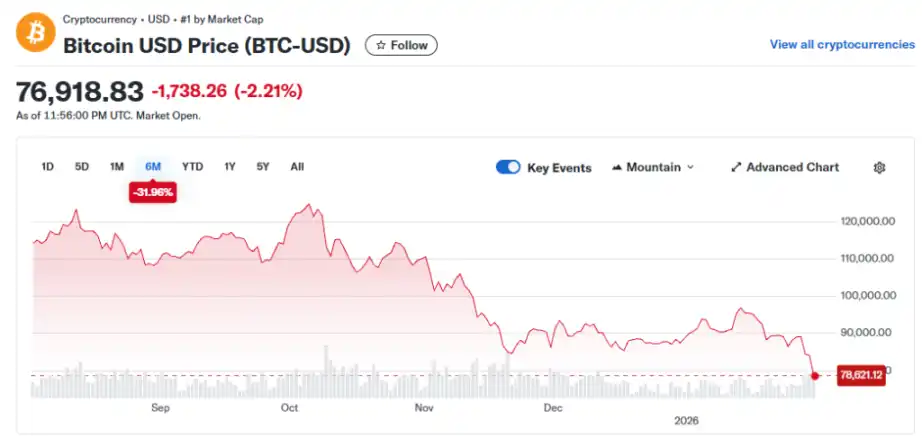
Despite the gloomy market sentiment, MicroStrategy CEO Michael Saylor posted an image with the caption "More Orange" on social media platform X on Sunday, implying continued buying. The company announced a 25 basis point increase in the dividend on its Series A Perpetual Preferred Stock (STRC) to 11.25%, aiming to attract capital at a high financing cost to maintain its Bitcoin purchase strategy. However, analysts point out that if the coin price remains stagnant or falls below its cost basis, the high dividend payout may trigger severe cash flow constraints.

Bianco Research's Macro Strategist Jim Bianco's analysis indicates that the Bitcoin market is facing a narrative exhaustion crisis. The current market structure exhibits a highly institutionalized feature, with ETF investors and MicroStrategy collectively controlling about 10% of the float, and currently overall underwater. This suggests that the once supportive "institutional entrance" narrative may flip into a significant source of selling pressure after being trapped at the peak.
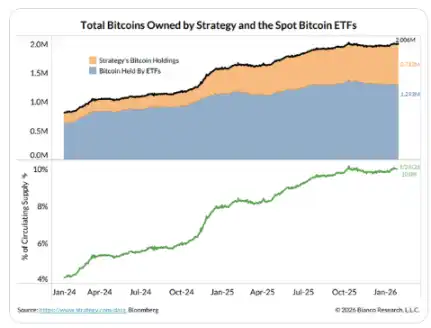
Institutional Holding Underwater Intensifies, ETFs Experience Net Outflows
Jim Bianco's analysis shows that Bitcoin is becoming highly "institutional accountized," meaning the market can now clearly observe large funds' holding costs and P/L status. Currently, MicroStrategy and 11 physical Bitcoin ETFs collectively hold about 10% of Bitcoin's float, with their combined average purchase cost at around $85,360. Based on the current price, these institutional holdings are collectively underwater by about $8,000 per coin, with a total unrealized loss of approximately $7 billion.
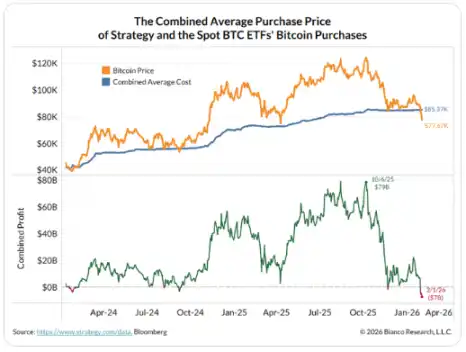
Among them, spot ETFs have become a core force influencing the supply-demand structure. Data shows that the 11 largest spot Bitcoin ETFs hold 1.29 million Bitcoins, accounting for 6.5% of the circulating supply, with a market value of approximately $115 billion. However, the average buy-in cost of these ETF investors is as high as $90,200, and the current coin price is about $13,000 lower than their cost.
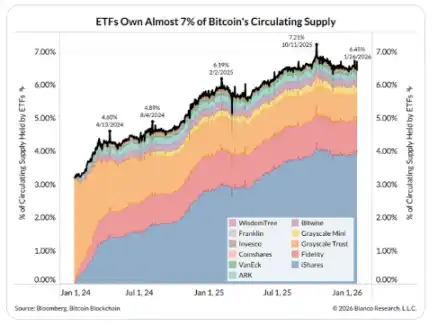
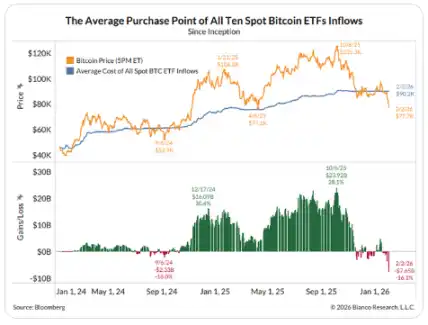
This high-level bottom fishing structure has led to a typical pro-cyclical effect. Bianco pointed out that these ETFs have seen net outflows for 10 consecutive trading days, with investors choosing to redeem during the retracement after buying in at a high level, amplifying the market's downward volatility.
MicroStrategy Safety Net Narrows, Aggressive Financing Raises Concerns
As the benchmark for corporate Bitcoin holdings, MicroStrategy's balance sheet is facing its most severe test in months. Currently, the company holds 712,647 Bitcoins with an average cost of around $76,037. With the Bitcoin trading price falling to around $78,000, the company's unrealized gains have narrowed significantly to less than 3%.
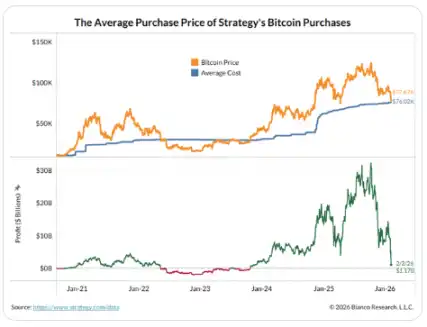
Despite the narrowing safety net, MicroStrategy has not shown signs of backing down. To fund the next phase of purchases, the company has adjusted the yield on its STRC product to 11.25%. This rate of return carries a significant premium compared to typical corporate bonds, reflecting the company's extreme capital thirst and the inherent volatility risk of its Bitcoin-centric model. Data shows that since the debut of the STRC product in November, sales of this product alone have funded the purchase of over 27,000 Bitcoins.
Analysis believes that MicroStrategy is still profitable, but its margin of error has significantly diminished. If the price continues to fall, the company will face an overall unrealized loss. Maintaining dividends at such a high cost could lead to cash flow constraints, especially when the Bitcoin price falls below its $76,000 cost "watermark," making this risk particularly acute.
Old Narrative Obsolete, Market in Urgent Need of New Catalysts
From a macro perspective, this recent plunge has intensified the market's disappointment of recent weeks. Jim Bianco believes that the real issue facing Bitcoin is the lack of a new narrative. The previously highly anticipated "Boomer Adoption" story, which the market had pinned its hopes on, has now been fully priced in and is even being debunked.
The current market structure shows that ETFs and MicroStrategy not only bought heavily and in a concentrated manner, but are currently overall underwater. Bianco points out that as long as a new, sustainable buying narrative does not emerge, the trend of outflows is likely to continue. In this scenario, what was once seen as a bullish high-level institutional holding may instead become the market's biggest source of pressure. The current issue with Bitcoin is not whether people bought in the past, but rather, at the current price level, where the next batch of buyers will come from.
You may also like

US & Canada Crypto Tax Season 2026: Official Tax Reporting Support from WEEX × KoinX
Prepare for US & Canada crypto tax season 2026. Learn how to export your WEEX transaction history and access official reporting support through our partnership with KoinX.

Conversation between Tom Lee and "The Big Short" Author: AI has detected bubble signal, crypto correction due to gold liquidity being "siphoned off"

The true reason for Claude's ban, Kraken accessing the Federal Reserve payment system, What is the English community paying attention to?

「Buying the Dip」 of 400,000 BTC: Is $74,000 a Rebound or a Reversal?

OpenClaw, Another Batch of Middle Class Jobless

Morning News | Backpack will launch on-chain IPO subscription service; Predict.fun strategically acquires on-chain prediction platform Probable; SoFi partners with Mastercard for strategic cooperation

Inventorying the Washington power in the crypto space, who is speaking out for U.S. crypto legislation?

650 million dollars, 1.5 billion dollars, 2 billion dollars, the crypto VC landscape has changed!

Why prediction markets are the largest untapped collateral pool in DeFi

500% XAUT Staking, Zero-Fee Gold Futures and $100K Rewards: Why Traders Are Turning to WEEX for Tokenized Gold
Explore WEEX's $100,000+ gold campaign featuring 500% XAUT staking, zero-fee gold contracts, and $30,000 PAXG rewards. Trade tokenized gold today.

AI within artillery range
“The cloud” is a metaphor, but the data center isn’t.

March 4th Market Key Intelligence, How Much Did You Miss?

Taking Stock of Crypto's Washington Power Players: Who is Advocating for US Crypto Regulation?

DDC Enterprise Limited Announces 2025 Unaudited Preliminary Financial Performance: Record Revenue Achieved, Bitcoin Treasury Grows to 2183 Coins
On March 4, 2026, DDC Enterprise Limited (NYSE American: DDC) today announced preliminary, unaudited full-year financial performance for the year ended December 31, 2025. The company expects to achieve record revenue and record positive adjusted EBITDA, primarily driven by continued growth in its core consumer food business and overall margin improvement. The final audited financial report is expected to be released in mid-April 2026.
Revenue: Expected to be between $39 million and $41 million, reaching a new company high.
Organic Growth: Excluding the impact of the company's strategic contraction of its U.S. operations, core revenue is expected to grow 11% to 17% year over year.
Gross Profit Margin: Expected to be between 28% and 30%, reflecting continued operational efficiency improvements.
Adjusted EBITDA: The company expects to achieve a positive full-year result in 2025, a significant improvement from a $3.5 million loss in 2024, mainly due to rigorous cost controls and a higher-margin sales mix.
In 2025, DDC's core consumer food business maintained strong operational performance.
The company also disclosed Core Consumer Food Business Adjusted EBITDA, a metric that further excludes costs related to its Bitcoin reserve strategy and non-cash fair value adjustments related to its Bitcoin holdings from adjusted EBITDA to more accurately reflect the core business performance.
In 2025, Core Consumer Food Business Adjusted EBITDA is expected to be between $5.5 million and $6 million.
In the first half of 2025, DDC initiated a long-term Bitcoin accumulation strategy, holding Bitcoin as its primary reserve asset.
As of December 31, 2025: The company holds 1,183 BTC.
As of February 28, 2026: Holdings increased to 2,118 BTC
Today's additional purchase of 65 BTC brings the company's total holdings to 2,183 BTC
DDC Founder, Chairman, and CEO Norma Chu stated, "We are proud to have closed 2025 with record revenue and positive adjusted EBITDA, demonstrating the steady growth of the company's consumer food business and the ongoing improvement in profitability. We are building a disciplined, growth-oriented food platform and strategically allocating capital to Bitcoin assets with a long-term view, aligning with our core beliefs. We believe that this dual-track model of 'Steady Consumer Business + Strategic Bitcoin Reserve' will help DDC create lasting long-term value for shareholders."
For the full year 2025, the company defines "Adjusted EBITDA" (a non-GAAP financial measure) as: Net income / (loss) excluding the following items:· Interest expense· Taxes· Foreign exchange gains/losses· Long-lived asset impairment· Depreciation and amortization· Non-cash fair value changes related to financial instruments (including Bitcoin holdings)· Stock-based compensation
DDC Enterprise Limited (NYSE: DDC) is actively implementing its corporate Bitcoin Treasury strategy while continuing to strengthen its position as a leading global Asian food platform.
The company has established Bitcoin as a core reserve asset and is executing a prudent, long-oriented accumulation strategy. While expanding its portfolio of food brands, DDC is gradually becoming one of the public company pioneers in integrating Bitcoin into its corporate financial architecture.

Uncovering YZi Labs 229 Investment: Over 18% of the portfolio is already inactive, with an average project transparency score of 78

The business of crypto VC is becoming promising

China's AI Compute Power Counterstrike

Global Assets Plunge: Hormuz, Chips, and a South Korean Holiday
US & Canada Crypto Tax Season 2026: Official Tax Reporting Support from WEEX × KoinX
Prepare for US & Canada crypto tax season 2026. Learn how to export your WEEX transaction history and access official reporting support through our partnership with KoinX.


 App
App