
Berachain DeFi Lead's Latest Interview: How to Earn Super High Yields through POL?

Original Article Title: Berachain Ecosystem Insights: POL and Yield Opportunities
Original Article Author: Castle Labs, Web3 Ecosystem Partner
Original Article Translation: ChatGPT
Editor's Note: The author conducted an interview with the Berachain DeFi lead and summarized it into an article, exploring how to participate and earn generous returns on Berachain. The article focuses on explaining Berachain's innovative DeFi mechanisms, Boyco cross-chain deployment, and how to earn rewards through liquidity bidding and token staking. It will also delve into the interaction of three tokens and the POL mechanism, demonstrating how it brings new earning opportunities to users.
The following is the original content (slightly reorganized for better readability):
Twitter is a gold mine of information, as long as you know where to look.
Today, we will delve into the interview between @phtevenstrong and @capnjackbearow (Berachain DeFi lead), focusing on how to participate in Berachain and take advantage of some surprising earning opportunities.
The Role of DeFi in Berachain
Many have misunderstood the launch of Berachain and what users can do on the network. Since its launch, the lack of POL has indeed dampened the enthusiasm of many, but the Berachain ecosystem has introduced several innovative protocols and primitives that users can already start taking advantage of.
Here are some insights about Jack's role:
· Building a narrative in DeFi
· Focusing on Boyco
· Identifying asset focuses (e.g., Boyco chose Bitcoin LSTs early on)
The mechanisms developed internally in Berachain reflect a larger trend of the changing roles in DeFi: DeFi is not just about gaining APY through asset lending as we previously envisioned. With the industry's maturation, DeFi is poised to underpin all financial applications.
The Significance of BOYCO
The deployment of Boyco is a crucial decision for a new system, where users can ensure over $30 billion in liquidity is bootstrapped for Berachain through liquidity bidding prior to launch.
The inspiration for Boyco comes from the Agglayer (Jack previously worked on development tools at Polygon) bridging and calling feature, which allows users to cross-chain transfer funds from A to B and call smart contracts on chain B.
Therefore, Boyco can be seen as a cross-chain deposit module with a bridging-calling execution model, depositing funds into Berachain, thus significantly improving the depositor's user experience.
Experiences Learned from Boyco
· Some assets had a late listing time (e.g., Ethena)
· No expectations for a third-party escrow deposit vault
· TVL growth was too fast, prompting changes in some outcomes and KPIs (e.g., how to get liquidity for key assets, how to ensure asset ratio balance, and how to ensure fund yield)
· Next time, perhaps more focus can be placed on the selection of asset pairs
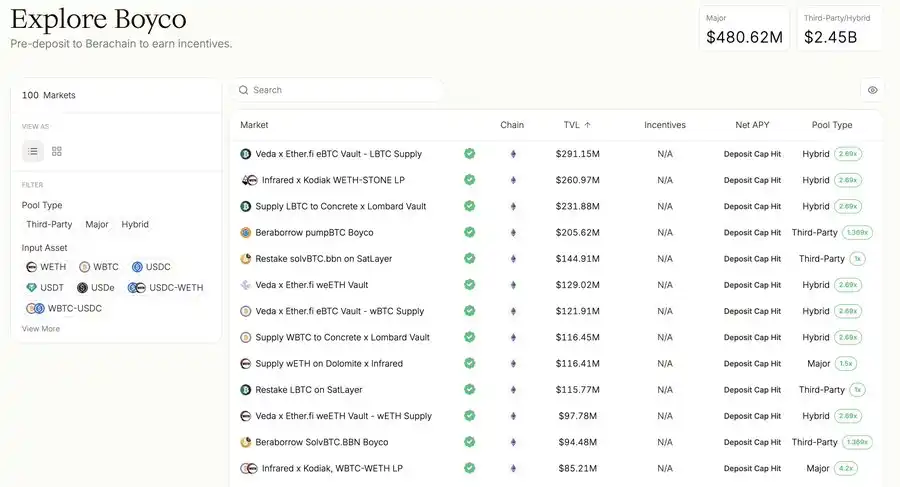
How to Translate into a Yield Benchmark?
Using the Pendle market performance on Bera as an example, the Boyco experiment seems to be highly successful in providing the offered APY yield benchmark.
The stablecoin APY ranges from 8% to 10%, and the Bitcoin APY (SolvBTC) exceeds 12%.
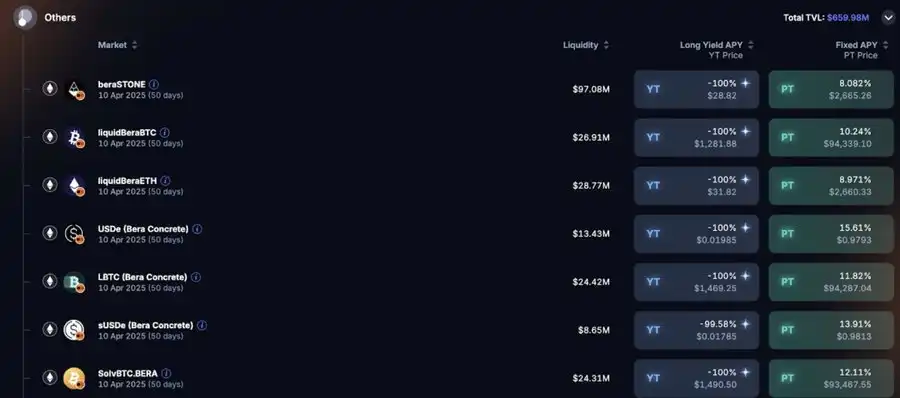
However, Jack emphasizes that these forecasts do not take into account the interest of native apps, which will stack on top of these yields.
How do users interact with the ecosystem and the three tokens of Bera? What are their functionalities, and how do they interact with each other?
$Honey: The native ecosystem stablecoin with minimal correlation to POL. Honey is minted by depositing collateral from a whitelist into the vault. Initially, Honey was an algorithmic seigniorage stablecoin (inspired by Frax) but eventually transitioned into a fully collateralized stablecoin backed by a basket of different stablecoins. This was done to minimize risks for Honey by avoiding the addition of any risky assets to the basket.
$BERA: The gas token of Berachain, which must be staked by participants to become validators. BERA is transferable and can be obtained by burning BGT tokens.
$BGT (Bera Governance Token): BGT is the core of POL, Berachain's fee-generating component that grants rights to POL rewards. It is a non-transferable token that only validators can earn through block rewards. Users can acquire BGT by performing certain actions in authorized dApps (such as adding liquidity to a pool or borrowing assets). Once obtained, BGT can be burned to receive BERA or delegated to validators.
This token model enables Berachain to identify and differentiate between various use cases and utilize different tokens to handle POL specialization.
How Does POL Work?
“We borrowed the design of a POS network and redirected the block rewards elsewhere.”
Instead of placing incentive assets in the protocol token (critical for protocol functionality), Berachain uses BGT as the fee allocation and governance token. Block rewards are distributed to more ecosystem participants, who can bid for these rewards (e.g., they can utilize these rewards to scale more frequently).
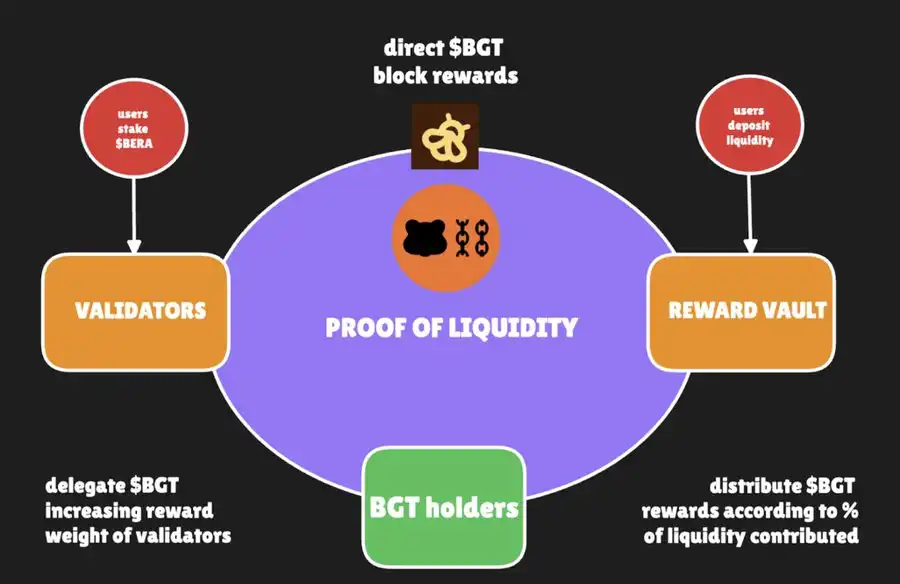
Explaining POL to a five-year-old could be likened to multiple food courts scattered throughout a city:
· Berachain is the city itself, with multiple food courts.
· Validators are the owners or managers of each food court, ensuring smooth operations and customer attraction.
· Apps are the stalls within each food court, providing customers with specific dishes (services).
· Users are the customers at these stalls—they purchase food (transactors, performing transactions) or hang around the stalls, eating and drinking (liquidity providers, staking assets or providing liquidity for others to transact).
How the dynamics work:
· The food court owners (validators) aim to attract more customers to their court rather than others. Customers bring footfall, vitality, and ultimately profit to the court, but more importantly, if they are satisfied, they will stay longer, providing stability to the court.
· The stall owner (application) wants to secure the best location in the food court to attract these customers. Competition between stalls is fierce, so stall owners negotiate with the square owner to secure a prime spot or privileges that will attract customers.
The POL Mechanism is like a new form of bargaining chip:
· To obtain a better location or lower rent (i.e., better incentives or validator support), stall owners offer a portion of their revenue (protocol fees) or some products (tokens) to the food court owner.
· The food court owner is incentivized to accept these proposals as it ties their success closely to the stall's success. By supporting profitable stalls, both parties benefit. In return, the stall receives the best location, attracting more customers (users and liquidity).
· This dynamic creates a self-reinforcing cycle through the POL Mechanism: Validators align with well-performing applications, and applications are incentivized to continue growing, thus keeping the square and entire city (network) bustling. Everyone benefits, from users to applications to validators.
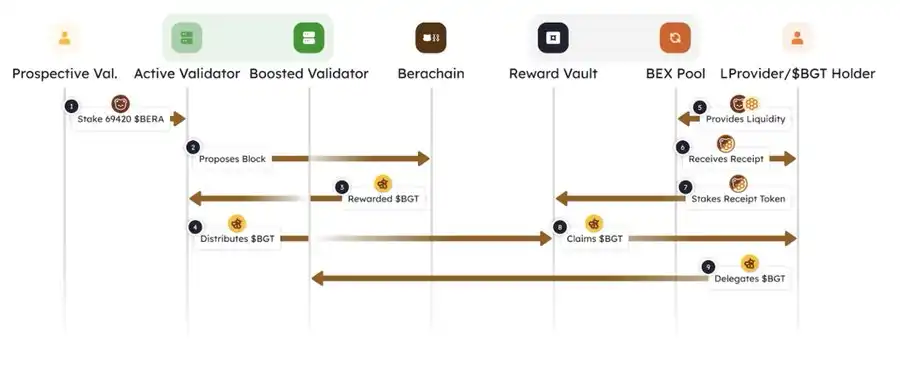
Berachain's Rewards
POL introduces an additional layer of rewards to the ecosystem:
For example, users on @Dolomite_io who stake assets not only earn yields on those assets but also receive additional rewards through POL.
Initially, these rewards are expected to be quite generous.
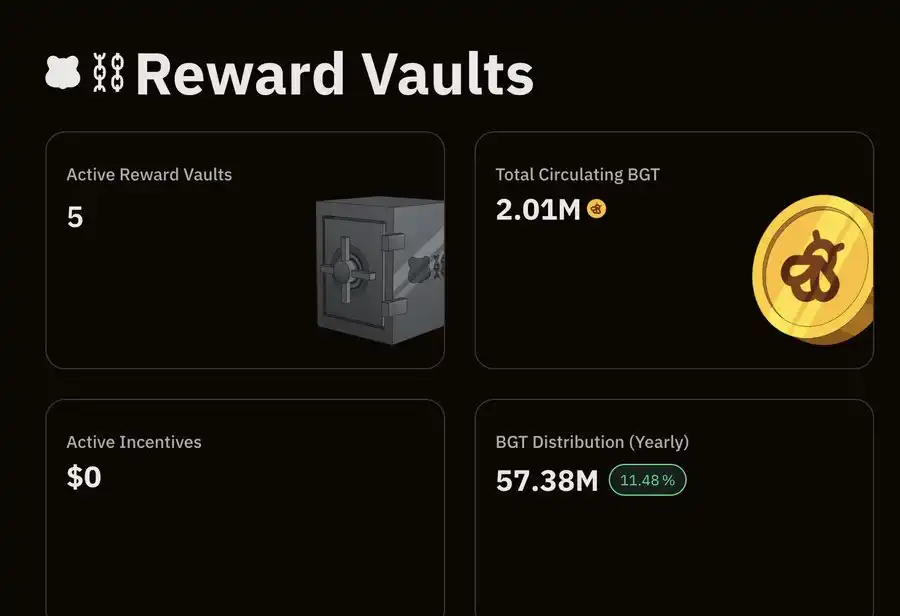
Comparing it to ve tokens (e.g., Curve or the original Solidly fork), the yield provided per BGT will be much higher than the yearly-distributed yield.
Currently, the trading price for BGT is expected to be 1.3 to 1.5 times that of Bera, primarily due to the anticipated incentive value.
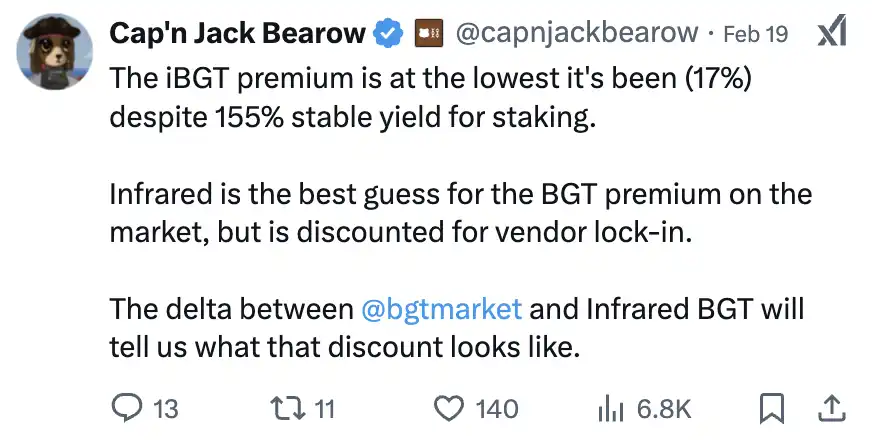
The only way to receive these rewards is by holding BGT, which can be acquired in two ways:
· Providing liquidity to POL
· Using liquidity-wrapped tokens such as iBGT (although, in case of increased demand, the premium may rise)
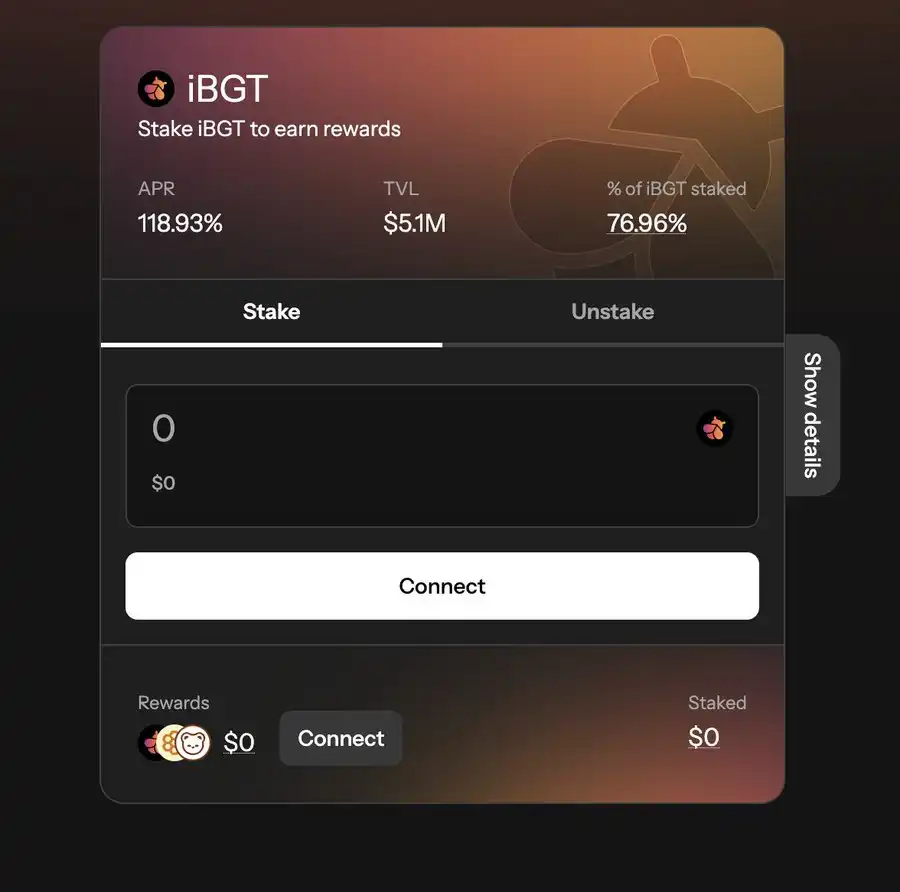
It is expected that as the staking token ratio increases, and more BGT circulates compared to incentives, the premium will gradually decrease.
· Bull Market Scenario: Incentives flowing to BGT will increase at a higher rate than the issuance speed of BGT, thereby increasing returns, further increasing the demand for BGT > more liquidity flows into the chain for yield farming.
· Bear Market Scenario: Incentives decrease, BGT issuance will increase, but at a fixed rate, thereby reducing returns and BGT demand > users will start burning BGT to BERA, reducing their yield claim, as the amount of yield claimed decreases, the rewards increase relative to BGT issuance, restarting the flywheel.
As a holder of iBGT (the transferable version of BGT), you can now stake iBGT and receive over a 100% Annual Percentage Rate (APR). This is currently not possible on $Bera, although $Bera still allows users to access some of the validator rewards.
· Real-World Example: An application incentivizes with $1 worth of BGT.
Validators take a 10% commission, which can be shared with Bera stakers. The remaining 90% of the $1 flows to BGT stakers delegated to that validator.
Two Ways to Stake to Validators
· Staking via Bera
· Delegating via BGT
Breakdown of LP Fees, using @Kodiakfi as an example
Currently, these are the only liquidity pools that have received governance approval, for BGT to set the validator issuance rate. This is crucial to ensure the initial BGT distribution before POL launch, to mitigate governance attacks.
When looking at the Kodiak pool, BEX is used on the backend.
Furthermore, the pool's APR does not take into account the premium on iBGT. If users wish to take advantage of this, make sure to deposit your LP tokens from BEX to @Infraredfinance through the "Vault" section.
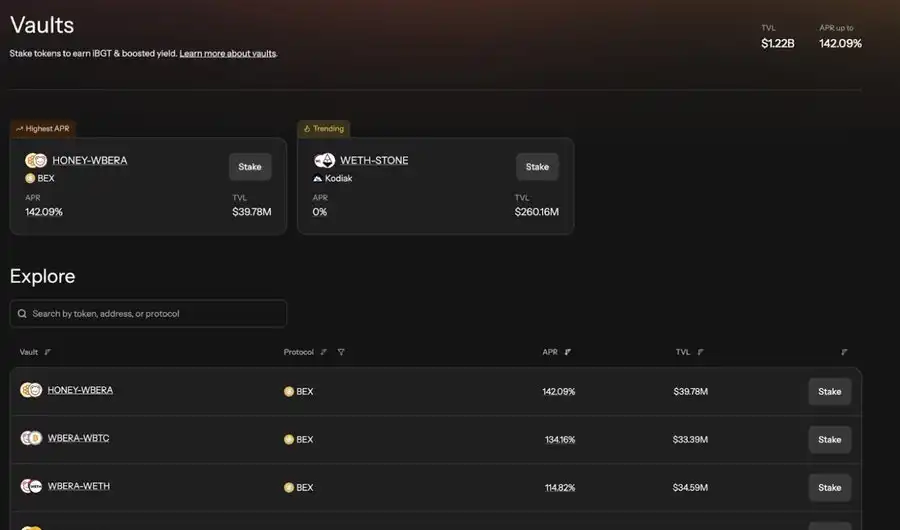
Another example, @Dolomite_io allows users to deposit their LP tokens and choose which POL-eligible assets they want to expose.
· Deposit collateral > Choose iBGT as issuance > Stake to earn additional rewards
This is similar to Convex: deposit LP tokens and receive a liquid-wrapped token with additional functionality, with the main difference being that users cannot redeem CVX like the underlying asset of veCVX (except through OTC trading).
If iBGT's trading price falls below BGT, a burn mechanism will be activated to ensure less volatility.
How does the system scale as more pools are added? How can users participate in this process?
Through proposals, the growth of pools will start slowly (adding about 5-10 initially in the first few weeks) and increase over time to allow governance to determine liquidity and flow.
Participants and validators are incentivized to whitelist as many honest pools (non-rug) as possible. In each block, validators will decide which pool's liquidity issuance to allocate to. With a deeper order book, validators can access higher ROI for their block rewards. Validators are incentivized to allow as much throughput as possible to receive rewards.
Therefore, any legitimate reward pool proposal should expect to be approved.
What is Boyco's mode of participation?
In the future, we can expect products related to Boyco to receive BGT instead of BEX pools.
For example, multiple treasury vaults on Infrared, including Kodiak and Dolomite, will receive BGT rewards once they are whitelisted.
To foster the game theory of POL, Jack shared some plans to address the negotiation around reward distribution between validators and applications through an effective ZK OTC framework.
Additionally, there are plans to reduce the current 10% inflation rate to a smaller and stable figure.
POL can also help address the value demand on L2: Since Berachain is EVM compatible, L2 chains like Arbitrum and other Orbit chains can seamlessly connect to Berachain and benefit from these yields, introducing these mechanisms into the protocol architecture (from the 56-minute timestamp: we recommend listening to understand this exciting overview of how it works).
Berachain's main focus will continue to be on DeFi and consumer applications.
Given these developments, we hope this overview will give you a clearer understanding, enabling you to better grasp Berachain's current game theory and incentive mechanisms for users.
In particular, we haven't seen such a high APY in a long time.
Many have been scarred by the 2021 era of liquidity provision—will Berachain bring back the glory of returns?
Some resources to explore Berachain's returns
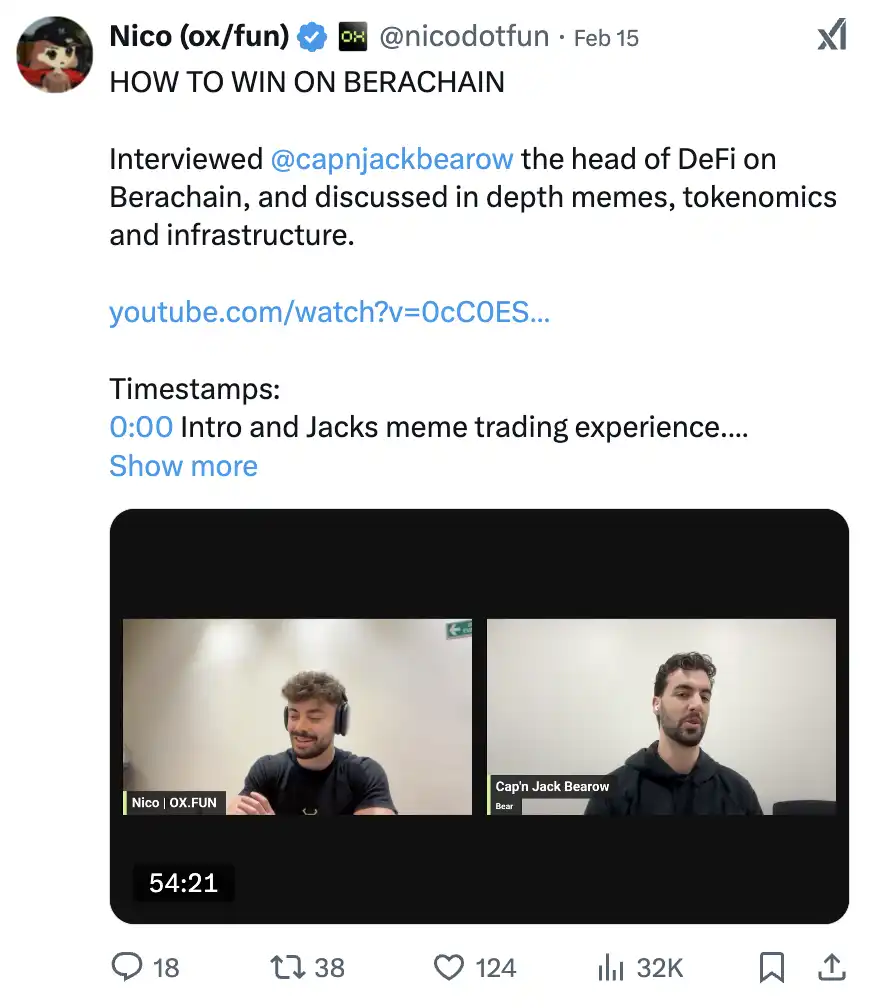
Another fascinating interview by @nicodotfun and @capnjackbearow
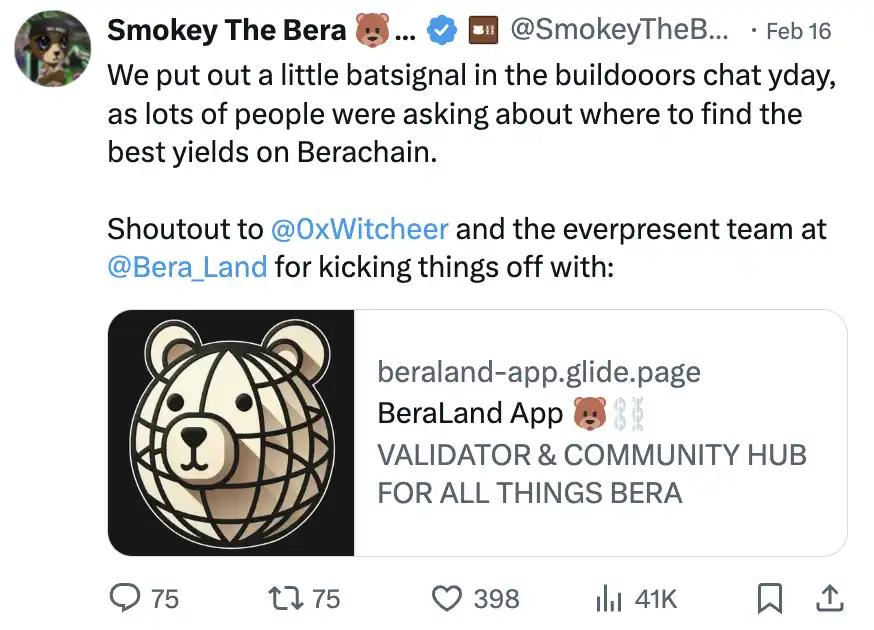
Beraland Community Hub
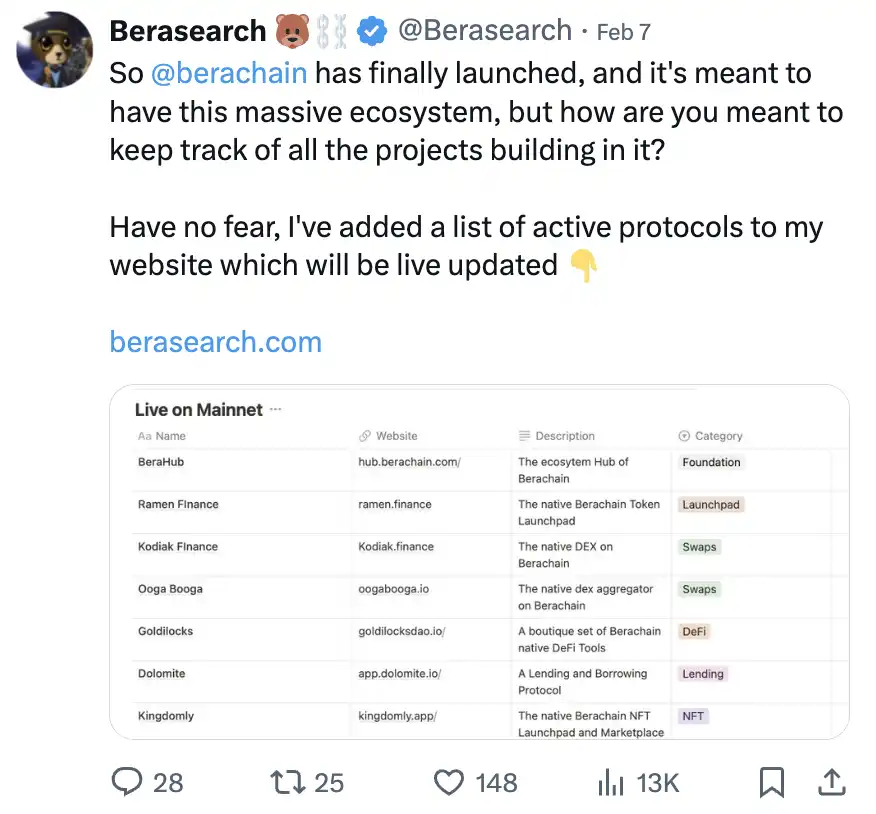
Real-time protocol list on Berasearch
You may also like

New York Proposes Stricter Stablecoin Issuer Rules Aligned With Federal GENIUS Act
NYDFS proposed stricter stablecoin issuer rules aligned with the GENIUS Act, covering reserves, custody, redemption timelines, audits, and capital buffers.

Every exchange is a "Universal Exchange."

The counterattack of traditional finance: Alliance chains are quietly reviving

CryptoQuant Says Bitcoin Profitable Supply Is Near 45% Pressure Zone as On-Chain Data Points to Market Repricing
CryptoQuant said Bitcoin’s profitable supply is nearing the 45% pressure zone, signaling rising market stress, unrealized losses, and a possible on-chain repricing phase.

Bitcoin Falls Below 200-Week Moving Average as On-Chain Data Shows Over Half of Supply in Loss
Bitcoin dropped below its 200-week moving average as on-chain data showed over 50% of circulating supply is now in loss, signaling rising market stress.

CFTC Reportedly Plans New Prediction Market Rules Focused on Manipulation Risk and Public Interest Review
The CFTC is reportedly preparing new prediction market rules focused on manipulation risk, public interest review, and retail trader protections.

Meet the new WEEX trial fund—your gateway to greater profits

WEEX Labs Lands at Dutch Blockchain Week: A Disruptive Crypto × AI Conversation Sets Sail in Amsterdam

SK Hynix Reportedly Plans U.S. ADR Listing as Early as August, With SEC Approval Possible in Late June
SK Hynix may pursue a U.S. ADR listing as early as August, with SEC approval reportedly possible in late June amid strong AI chip supply chain demand.

SpaceX vs Tesla vs xAI: Which Elon Musk Trade Has the Biggest Upside in 2026?
OpenAI Reveals It Has Confidentially Submitted an S-1 to the SEC, Keeping the Door Open for a Future IPO
On June 9, according to an OpenAI announcement, the company recently confidentially submitted a draft S-1 registration statement to the U.S. Securities and Exchange Commission (SEC), beginning the preliminary compliance process for a potential initial public offering. OpenAI said it chose to disclose this proactively because it expected the news might leak; however, the company has not yet set a specific listing timeline, and related arrangements may still take some time.

Latest research from 13 top universities including Cornell University: The current state, challenges, and misconceptions of the fusion of Crypto and AI
Deconstructing Anthropic: The Best AI Company, Possibly Also a Type of Organizational Invention
Apollo and Blackstone Reportedly Back $35 Billion Anthropic Chip Financing as Deal Details Remain Unclear
On June 9, according to currently available news alerts, Apollo and Blackstone Group participated in a $35 billion financing for an Anthropic “chip project.” Based on the original wording of the report, the funding has already been raised, but public information remains limited. The financing structure, use of proceeds, project entity, and whether Apollo and Blackstone participated through equity, debt, or project financing have not yet been disclosed.

Humanity Protocol Security Incident Escalates: More Than $31 Million Stolen From Related Addresses as Attacker Continues Selling H for ETH
On June 9, according to monitoring by Onchain Lens, more than $31 million has been stolen from addresses linked to Humanity Protocol, and the attack is still ongoing, with the hacker continuously swapping H tokens for ETH. Project founder Terence Kwok later confirmed the security incident on X, saying the issue involved a private key leak.

Bloomberg: As Bitcoin Weakens, Stablecoins and RWA Continue to Drive Expansion in Crypto Businesses
In June, Bloomberg reported that despite Bitcoin falling below $60,000 last week, wiping out about $235 billion in market value within seven days, and dropping close to 50% from last year’s peak, some core businesses in the crypto industry are still expanding, mainly in stablecoins, real-world asset tokenization (RWA), payments, and infrastructure. The report also noted that overall altcoin activity has contracted significantly: altcoin market capitalization has fallen from a peak of about $431 billion in November 2021 to around $170 billion, and among the tens of millions of tokens issued in recent years, fewer than 1,700 still maintain meaningful trading activity.

Galaxy Deep Research Report: How Hyperliquid's HIP-4 Upgrade Changes the Landscape of Prediction Markets?
Binance Research: RWA Market Expected to Expand Nearly 6x from Early 2025, with Public Equities and Onchain Payments Heating Up Together
In June, Binance Research said in its monthly market report that the real-world asset (RWA) market is expected to grow by about 589% from the beginning of 2025. Bond- and money market fund-related RWA expanded by about $6.5 billion, up 83% year over year, while publicly traded equity RWAs grew by about 422%. The report also noted that monthly crypto debit card transaction volume exceeded $747 million in May, up 48.6% year to date.
New York Proposes Stricter Stablecoin Issuer Rules Aligned With Federal GENIUS Act
NYDFS proposed stricter stablecoin issuer rules aligned with the GENIUS Act, covering reserves, custody, redemption timelines, audits, and capital buffers.
Every exchange is a "Universal Exchange."
The counterattack of traditional finance: Alliance chains are quietly reviving
CryptoQuant Says Bitcoin Profitable Supply Is Near 45% Pressure Zone as On-Chain Data Points to Market Repricing
CryptoQuant said Bitcoin’s profitable supply is nearing the 45% pressure zone, signaling rising market stress, unrealized losses, and a possible on-chain repricing phase.
Bitcoin Falls Below 200-Week Moving Average as On-Chain Data Shows Over Half of Supply in Loss
Bitcoin dropped below its 200-week moving average as on-chain data showed over 50% of circulating supply is now in loss, signaling rising market stress.
CFTC Reportedly Plans New Prediction Market Rules Focused on Manipulation Risk and Public Interest Review
The CFTC is reportedly preparing new prediction market rules focused on manipulation risk, public interest review, and retail trader protections.


