
- Buy Crypto
- Markets
 Futures
- Spot
- Copy Trade
- Earn
- More
Behind the x402 Craze: How ERC-8004 is Building the Cornerstone of AI Agents' Trust

Original Article Title: "Bitget Wallet Research Institute: Behind the x402 Craze, How Does ERC-8004 Build the Cornerstone of an AI Agent"
1. Introduction: From the x402 Craze to the Emergence of ERC-8004
Recently, as the x402 protocol designed for automatic micro-payments between AI agents has become a market hot topic, discussions about its early potential have been ongoing. However, under the halo of x402, a more fundamental standard—ERC-8004—is quietly entering the field of keen observers.
A new question arises: since x402 has already focused on solving the payment issue, what is the role of ERC-8004? Are they in a competitive relationship?
The answer seems to be negative. They are more like elegantly designed, complementary components in the business landscape of AI agents.
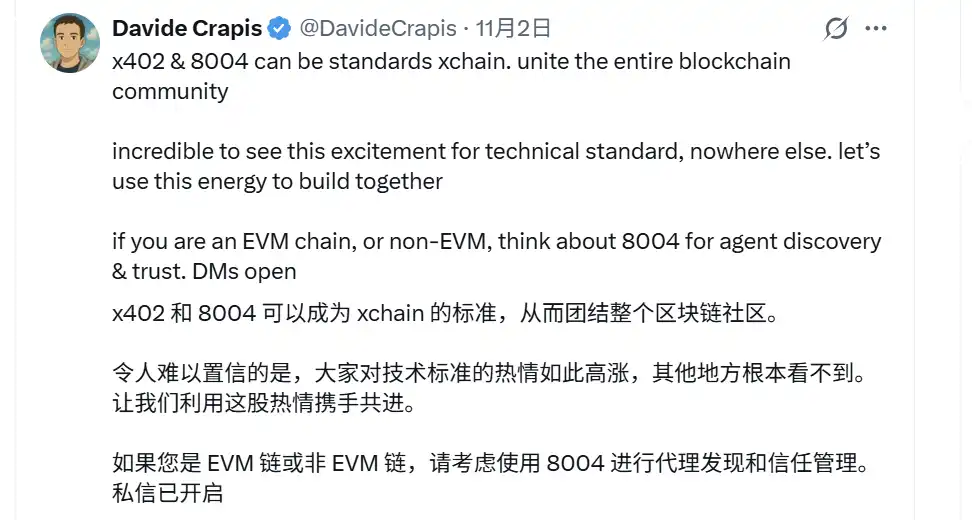
Source: X Post by Davide Crapis, AI Lead at the Ethereum Foundation
An aspect worth noting is that the creator of x402, Erik Reppel from Coinbase, is also one of the final signatories of the ERC-8004 protocol. Along with him, core representatives from MetaMask, Google, and the Ethereum Foundation have also signed this standard. This heavyweight lineup with significant personnel overlap strongly suggests that they are not in a competitive relationship, but are jointly building a grander blueprint.
The logic of this blueprint is very clear: if the emergence of x402 confirms the significant demand for AI agent payments, then ERC-8004 represents another more foundational core element necessary to build this vast machine economy. It targets precisely the core challenge that x402 alone cannot solve—where does trust come from in an economy where AI agents autonomously collaborate? The Bitget Wallet Research Institute may help you find the answer in this article.
2. The "Trust" Issue of Agent Collaboration: The Dilemma x402 Alone Cannot Solve
In the commercial collaboration of AI agents, payment (the issue addressed by x402) is only the final step of the closed loop. A more fundamental issue lies ahead: how can an AI agent be sure that the other AI agent it has hired is trustworthy? In other words, how can an agent prove its ability to accomplish the task at hand?
To answer this question, we must delve into the foundational framework of agent commerce. According to the theory supported by Davide Crapis of the Ethereum Foundation, a decentralized AI agent business system must rely on three main pillars to operate securely: Discovery, Communication, and Computation.
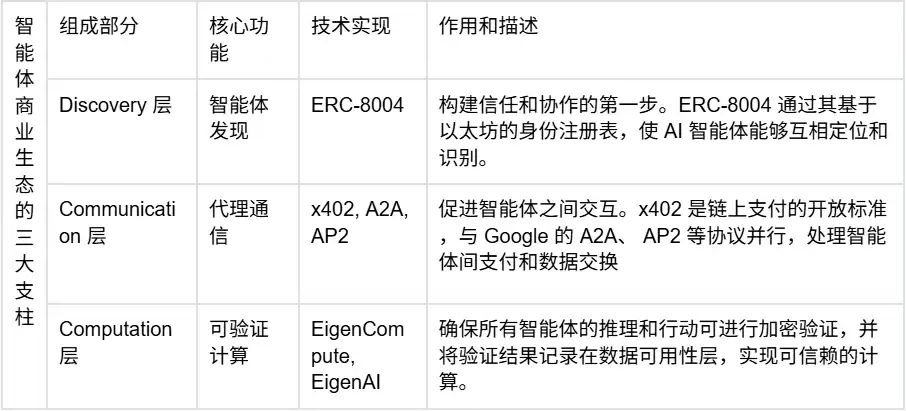
Source: X Tweet forwarded by Davide Crapis
As shown in the table above, the x402 protocol itself mainly addresses the payment standard issue in the communication layer, but it does not answer the critical questions of identity verification and reputation assessment. Before making a payment, an AI agent first needs to be securely "discovered," thereby establishing trust and cooperation. ERC-8004 precisely tackles this problem by building a decentralized trust layer.
The ERC-8004, led by the Ethereum Foundation's dAI team and Consensys, in collaboration with institutions such as MetaMask, Google, and Coinbase, aims to be the on-chain "trust layer" for AI agents. It is a decentralized business registration and registry system that provides each AI agent with a verifiable identity, a complete history of performance, and proof of capability. All information is immutably recorded on the blockchain and openly accessible to all participants.
Source: ERC-8004 Official Website
III. ERC-8004: Decentralized Trust Layer for Agents
ERC-8004 is positioned as the foundational infrastructure of agent economics, with its core value lying in using blockchain technology to address the fundamental issue of AI agents lacking a trusted identity, enabling them to break free from the constraints of traditional centralized platforms and establish verifiable, cross-platform collaborative relationships.
This mechanism operates based on ecosystem contributors' input of trust data: AI developers are responsible for registering the unique identity of the agent; application developers continuously provide behavioral feedback of the agent to accumulate reputation data; and validation services act as independent auditors, providing trustworthy on-chain validation of the agent's operations.
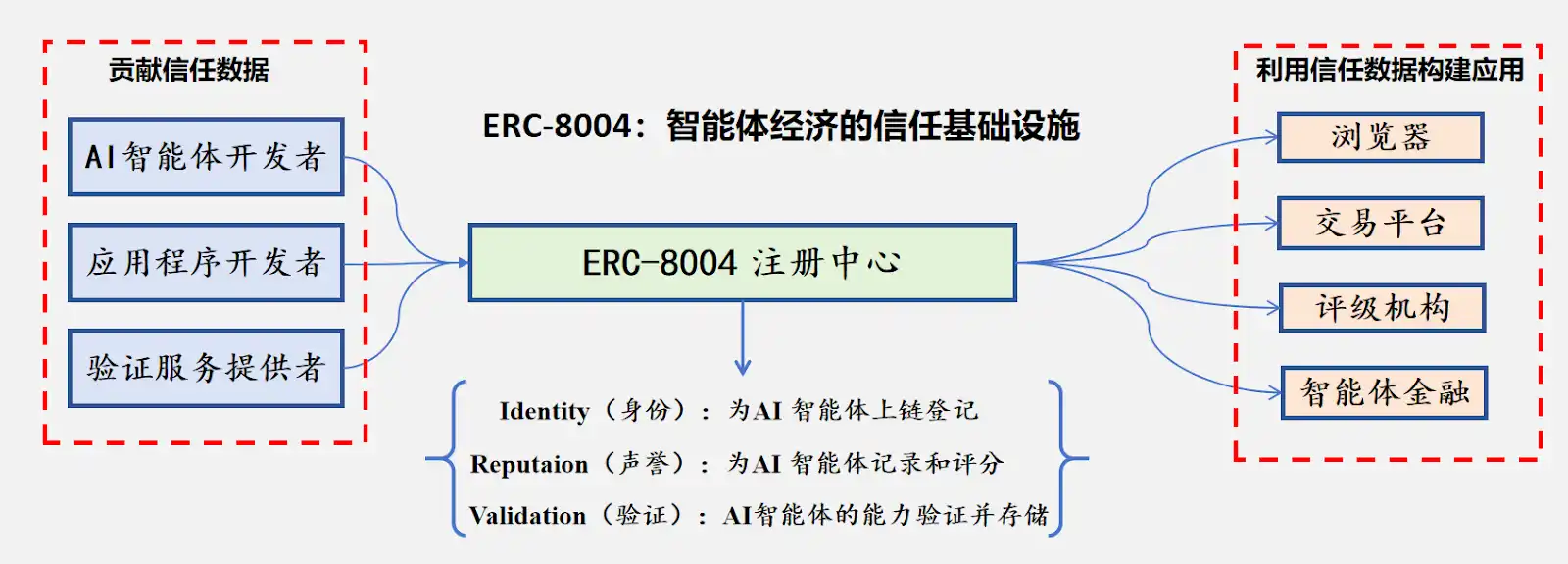
Source: Compiled by Bitget Wallet
This information converges into the ERC-8004 Registry, which consolidates the three core functions of the protocol:
· Identity Registry: Through the ERC-721 NFT protocol, it grants each AI agent a unique digital identity. This design not only makes identities transferable but also allows them to be linked to standardized "agent cards" to detailed record the agent's name, capabilities, and metadata, ultimately achieving cross-platform permissionless discovery.
· Reputation Registry: This mechanism, built upon the identity registration, serves as a decentralized review system. Clients or other agents can submit structured feedback. The key design is that these evaluations can be linked to x402 payment proofs, ensuring that only genuine transaction participants can conduct assessments, thereby effectively reducing fraudulent behavior and ensuring the public transparency of all reputation data.
· Validation Registry: It provides the final safeguard for high-risk or high-value transactions. Agents can request trusted third-party validation, such as TEE oracles, staked inference, or ZK-ML proofs. These validation methods can provide cryptographic proof for specific model execution and outputs, thereby establishing a verifiable accountability mechanism similar to traditional market professional certifications.
Relying on the trusted data foundation provided by ERC-8004, a new downstream application ecosystem has flourished, including browsers for agent discovery and queries, marketplaces that allow agents to trade freely based on reputation, professional rating agencies, and even innovative services such as InfoFi and AgentFi. These advanced applications are all built on the trusted identity of agents and their validation records, marking the formal establishment of a permissionless, efficient collaboration intelligent agent service ecosystem.
Four, Collaboration: The Complete Process of an Intelligent Agent Transaction
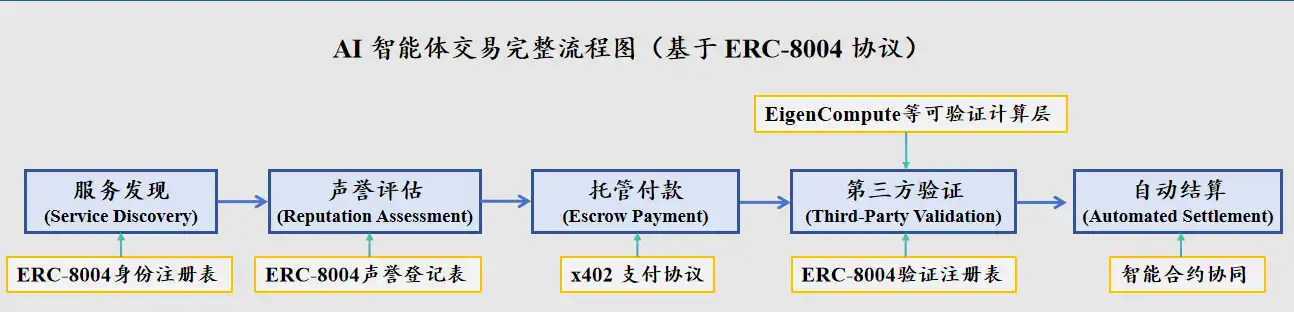
So, how do these components collaborate in practice? The full lifecycle of a decentralized AI intelligent agent transaction can clearly illustrate this process.
Source: Compiled by Bitget Wallet
1. First, the Requesting Party Agent initiates service discovery and evaluation through the ERC-8004 Identity and Reputation Registry, querying and filtering out service provider agents with specific capabilities and good credit.
2. Once both parties reach an agreement, the Requesting Party then uses the x402 Payment Protocol to lock the required fee in a smart contract (i.e., financial guarantee).
3. Subsequently, the Service Provider Agent begins executing the task and undergoes third-party validation. Their work output runs on a verifiable computation layer like EigenCompute, generating cryptographic proof. An independent third-party validation agent then records the audit result in the ERC-8004 Verification Registry.
4. Finally, in the automatic settlement phase, the x402 smart contract automatically detects the trusted signature in the ERC-8004 Verification Registry. Once the task eligibility is confirmed, the funds are automatically released to the Service Provider Agent.
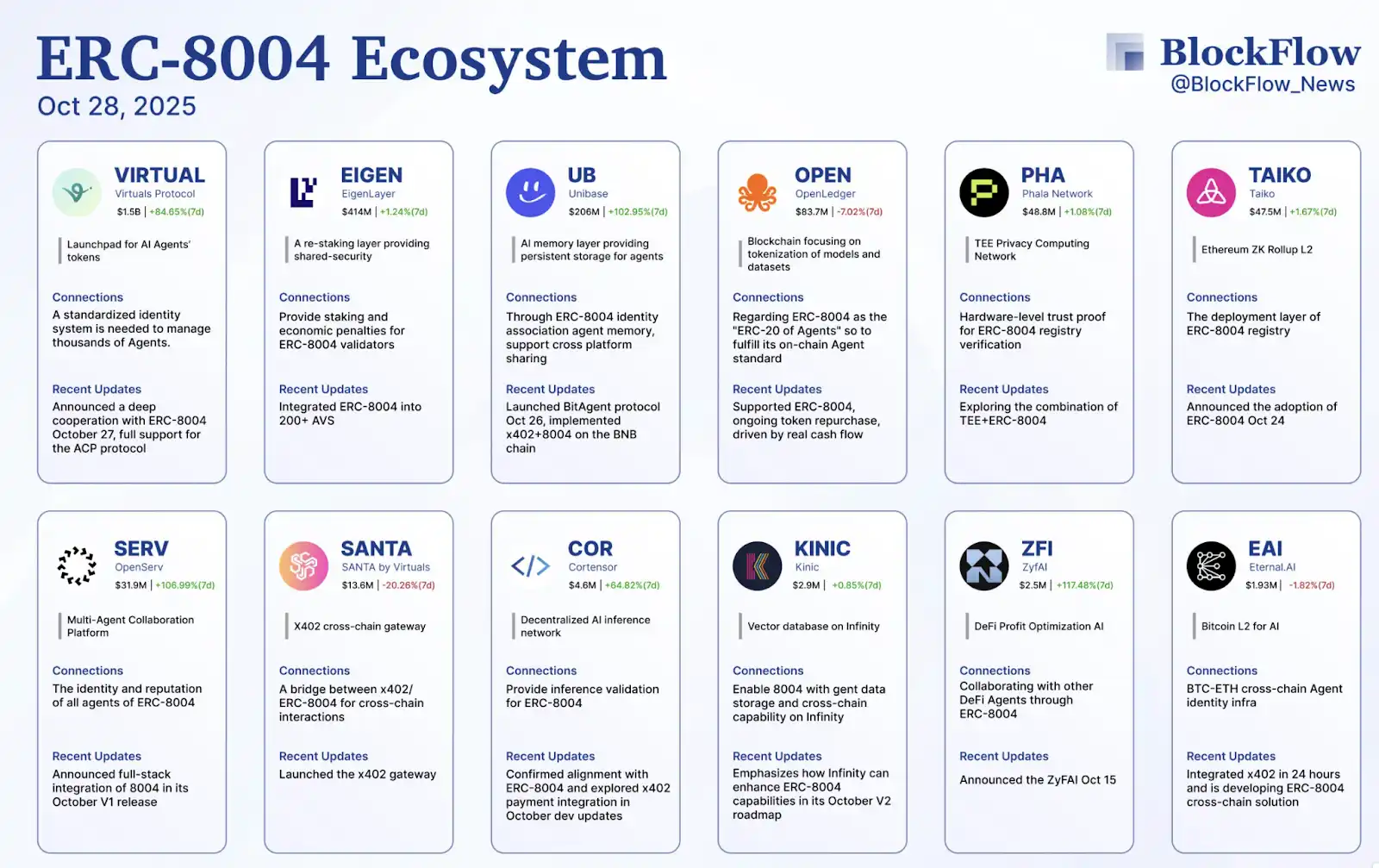
In this closed-loop process, ERC-8004 is responsible for admission and acceptance, x402 is responsible for payment, and verifiable computation secures the process. Each of the three is indispensable. This also indicates that, unlike early rewards concentrated in the payment token of x402, the ecosystem of ERC-8004 (as shown in the figure below) will be distributed across multiple layers such as infrastructure, middleware, and applications.
Source: BlockFlow
Five, Conclusion: The Order and Future of the Machine Economy
One point to acknowledge is that ERC-8004 is currently in the early stage of promotion and implementation—the cold start of related products and whether the grand vision of "machine economy identity validation" can be achieved are still subject to market observation. In addition, the costs and specific implementation paths of third-party validation, as well as its interoperability with protocols like x402, are significant variables that need to be addressed in the future.
But what can be certain is that the emergence of protocols like ERC-8004 signals that the machine economy is moving from “wild growth” to “establishing order.” It provides a cross-platform identity and credit system for autonomous AI agents for the first time.
If x402 is the “currency” of the machine economy, then what ERC-8004 offers is the “passport” and “credit report,” marking the beginning of a permissionless, efficient, collaborative, and trustworthy intelligent agent service ecosystem.
This article is a guest contribution and does not represent the views of BlockBeats.
You may also like

21Shares Enhances Crypto ETP Pricing with FTSE Partnership
Key Takeaways: 21Shares AG updates the pricing methodology for its Bitcoin and Ethereum-linked ETPs on the London Stock…

Alibaba AI Projects Crypto Value Surge for XRP, Bitcoin, and Ethereum by 2026
Key Takeaways: Alibaba’s AI predicts significant price increases for XRP, Bitcoin, and Ethereum by 2026’s end, driven by…

Ethereum USD Reclaims $2,200 Amidst Crypto Market Surge
Key Takeaways: Ethereum USD rebounds from $1,840 lows, reclaiming the $2,200 mark with a +19% recovery as of…

TRUMP Memecoin Investors Granted Exclusive Mar-a-Lago Invite
Key Takeaways: $TRUMP memecoin holders gain exclusive access to a Mar-a-Lago event featuring Donald Trump and other key…

Why Is Crypto Up: BTC USD Decoupling From Gold Amid Heated Israel-Iran Conflict
Key Takeaways: Bitcoin’s price recently hit $74,000, marking its highest close since February 2026 before slightly retracting to…

Trump Meme Coin Skyrockets 60% Post Mar-a-Lago Gala Promotion
Key Takeaways: TRUMP meme coin surged by 60% following the announcement of a gala event at Mar-a-Lago. Trading…
Large Bitcoin Wallets Resume Accumulation as BTC Holds $71K Level
Key Takeaways: Wallets holding 10 to 10,000 Bitcoin now control 68.17% of Bitcoin’s circulating supply, signaling renewed confidence…

Solana Hits Key $100 Resistance amid Institutional ETF Interest
Key Takeaways: Solana is witnessing a surge towards the psychological $100 mark, currently trading at $93 as of…

CLARITY Act Faces Diminishing Odds in 2026 Without April Committee Approval
Key Takeaways: Alex Thorn from Galaxy Digital highlights the narrowing timeframe for the CLARITY Act to progress in…

Billionaire Predicts Stablecoins’ Dominance in Global Payments Over Next 10-15 Years
Key Takeaways: Billionaire Stanley Druckenmiller foresees stablecoins as a central player in global payments within 10-15 years. Blockchain…

Hyperliquid Price Surge: A Potential 23.29% Drop Expected
Key Takeaways: Hyperliquid is anticipating a price drop to $28.81, reflecting a potential 23.29% decrease in the next…

AAVE Crypto Swap Leads to $50 Million Loss: A Costly Lesson in DeFi
Key Takeaways: A single crypto whale lost $50 million attempting to swap USDT for AAVE due to severe…

Aptos Price Trends and Predictions for March 2026
Key Takeaways: Aptos is priced at $1.01, trading 34.62% above the predicted price for March 21, 2026. Market…

DOJ and Europol Take Down SocksEscort: A Major Blow to Crypto Crime
Key Takeaways: U.S. DOJ and Europol successfully dismantled the SocksEscort proxy network, an essential tool for crypto-related cybercrime.…
Mantle Market Analysis: Current Trends and Predictions for March 2026
Key Takeaways: Mantle’s current price is 35.18% above the predicted value for March 21, 2026. The Fear &…

Bittensor Trading Above Price Prediction: Market Analysis and Forecast for March 2026
Key Takeaways: Bittensor (TAO) is trading at $279.82, significantly above the predicted $211.41 for March 20, 2026. The…
Pepe Coin Price Surges 20%: Will March Push It Higher?
Key Takeaways: Pepe coin saw a massive 20% surge, reaching near $0.00000406, reflecting renewed market interest in memecoins.…
Sui Crypto Price Prediction – SUI Estimated to Decline to $ 0.783986 by March 21, 2026
Key Takeaways: Sui Crypto, currently priced at $1.06, is predicted to fall to $0.783986 by March 21, 2026.…
21Shares Enhances Crypto ETP Pricing with FTSE Partnership
Key Takeaways: 21Shares AG updates the pricing methodology for its Bitcoin and Ethereum-linked ETPs on the London Stock…
Alibaba AI Projects Crypto Value Surge for XRP, Bitcoin, and Ethereum by 2026
Key Takeaways: Alibaba’s AI predicts significant price increases for XRP, Bitcoin, and Ethereum by 2026’s end, driven by…
Ethereum USD Reclaims $2,200 Amidst Crypto Market Surge
Key Takeaways: Ethereum USD rebounds from $1,840 lows, reclaiming the $2,200 mark with a +19% recovery as of…
TRUMP Memecoin Investors Granted Exclusive Mar-a-Lago Invite
Key Takeaways: $TRUMP memecoin holders gain exclusive access to a Mar-a-Lago event featuring Donald Trump and other key…
Why Is Crypto Up: BTC USD Decoupling From Gold Amid Heated Israel-Iran Conflict
Key Takeaways: Bitcoin’s price recently hit $74,000, marking its highest close since February 2026 before slightly retracting to…
Trump Meme Coin Skyrockets 60% Post Mar-a-Lago Gala Promotion
Key Takeaways: TRUMP meme coin surged by 60% following the announcement of a gala event at Mar-a-Lago. Trading…


 App
App