
After 767 days, what does SBF's comeback tweet signify?


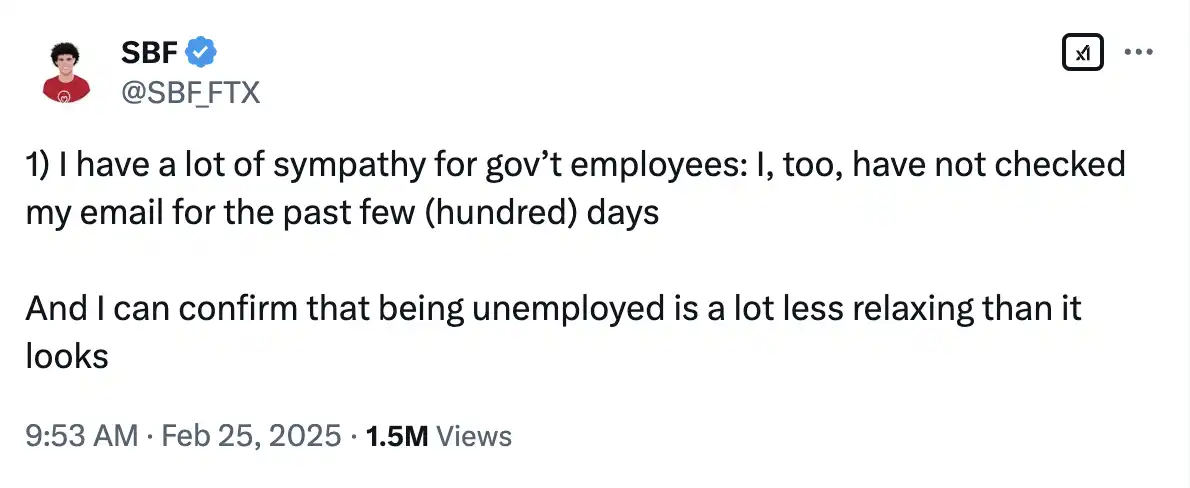
Two years later, SBF tweeted again, discussing the experience of firing employees. He wrote that firing employees is a very difficult and unpleasant thing, but often it is a problem in company management that leads to employees having to be let go, keeping employees in the company who have no value is instead a waste. SBF's lengthy discussion of firing also inevitably evokes recent crazy "layoffs" by the U.S. government.
The market has reignited the expectation that SBF will be pardoned, with FTT briefly breaking through $2.2, now priced at $2.05, a 24-hour increase of 11.8%.
SBF Changes Political Alignment, Clearly "Sides" with Trump to Seek Pardon
It all started when Trump took office.
On January 22, Trump posted on his social media platform Truth Social stating that he had pardoned the Silk Road founder, "Just got off the phone with Ross William Ulbricht's mother, told her, I am honored to have just signed a full and unconditional pardon for her son Ross."
By the end of the month, insiders leaked that SBF's parents, Stanford Law School professor Joseph Bankman and Barbara Fried, had recently met with lawyers and other Trump insiders in an attempt to seek a pardon for SBF, but it is unclear whether they have contacted the White House.
On February 18, like many in the crypto industry hoping to gain political points in Trump's second term, SBF, in an interview with the New York Sun, openly "sided" with Trump: "I have spent a lot of time studying crypto policy, and I am very frustrated and disappointed by what I have seen and heard from the Biden administration and the Democratic Party. The Biden administration is very destructive and difficult to work with, frankly, the Republicans are much more reasonable."
SBF hinted that his right-leaning tendency began in 2022 because he and Trump share a common enemy, namely Judge Lewis Kaplan, who is responsible for the FTX fraud case and the Trump federal defamation case trial.

In 2020, SBF was the second-largest donor to the Biden campaign, but SBF now says, "I used to think of myself as center-left, but now I don't see myself that way anymore. The tech industry has undergone an atmospheric shift, with former outspoken Democrats like Mark Zuckerberg and Marc Andreessen now all supporting Trump."
Bringing DOGE Close, What Does SBF Mean?
In SBF's return tweet, he core-expressed one thing, and that is "Firing employees is one of the hardest things in the world," which inevitably reminds people of Trump's Department of Government Efficiency (DOGE), whose most accomplished act after taking office was to fire government officials. Even SBF's prosecutor resigned due to the "new leader takes office with a bang," as the Justice Department asked her to halt her corruption investigation into New York City Mayor Eric Adams.
According to The Washington Post, in the three weeks since Trump's second term began, a series of actions with advisor Musk has sparked widespread controversy. Musk-led Department of Government Efficiency in the United States has intervened in 18 federal agencies, terminated 199 federal contracts, and attempted to dismiss tens of thousands of federal employees.
On February 16, the local time on the 15th, the Department of Government Efficiency led by Elon Musk (DOGE) sent dismissal notices to over a dozen staff members of the United States Digital Service. The office is an information technology (IT) department of the White House's Executive Office of the President, now under the management of the Department of Government Efficiency (DOGE).
Even the SEC had to make changes. On February 25, according to two sources familiar with the matter, the U.S. Securities and Exchange Commission (SEC) plans to replace top leadership in its regional offices nationwide as part of its cost-cutting proposal to the Trump administration.
Sources said the SEC told directors of its 10 regional offices on Friday that their positions will be eliminated according to the plan to be submitted next month. The SEC oversees over $100 trillion in U.S. capital markets and is currently under pressure from Trump to downsize and cut costs.
SBF's heartfelt and lengthy tweet can be said to hit the nail on the head.
Attached SBF Tweet Full Translation
I sympathize greatly with government employees: I myself have not checked my email in several hundred days. And I can confirm that being unemployed is harder than it looks.
Firing employees is one of the most challenging things in the world and is a terrible thing for all involved parties.
My experience is:
a) Firing employees is usually not their fault.
b) But often, firing them is still the right decision.
A more common issue is that the company simply did not have a position that was the right fit for them.
I tell every person who has been laid off: This is also our fault because we did not find the right position for them, or we did not find the right person to manage them, or we did not provide the right work environment for them.
Perhaps at that time, we did not have the right people to manage them. Maybe they performed best when working remotely, but our company is primarily based on face-to-face communication. Maybe they wanted to be involved in a specific project, but that project happened to not be what the company needed.
Or perhaps the department they were in had issues of its own. This situation happens. We have seen it at our competitors' where they hired an excess of 30,000 employees and had no idea how to allocate them—resulting in the whole team sitting there every day doing nothing.
We have also seen this internally, where when a manager becomes too busy or distracted, half of the department loses direction at the same time. In such situations, the employees are not at fault. If the employer does not know how to allocate them or does not have the right people to manage them effectively, it is not their fault. If internal politics cause the department to lose its way, that is not their fault either. But keeping them in the company, doing nothing, is futile.
You may also like

Mastercard Launches Agent Pay for AI, Plans to Record AI Agent Payment Authorizations on Polygon
Mastercard launched Agent Pay for AI, a new payment protocol designed to help AI agents make small payments such as pay-per-use access to data and APIs. The system plans to record human-granted AI agent permissions on Polygon, focusing on verifiable authorization, identity, and payment controls.

Curve Deploys Llamalend v2 on Optimism With 250,000 OP Incentives
Curve launched Llamalend v2 on Optimism with 250,000 OP incentives from the Optimism Foundation. The upgrade expands Llamalend beyond its earlier crvUSD-focused model, adding broader collateral support, LlamaRisk market reviews, and the ability to use Curve LP tokens as collateral.

Raydium Old Liquidity Pool Reportedly Exploited, With $1.34 Million Moved to Ethereum and Tornado Cash
An old Raydium liquidity pool was reportedly exploited for around $1.34 million in USDC, RAY, and wSOL, with the stolen funds bridged to Ethereum and deposited into Tornado Cash. The incident highlights the tail risks of legacy DeFi pools, old contracts, and cross-chain fund laundering paths.

Kalshi Executive Challenges “SBF Backed AI Unicorns” Narrative, Says Leopold Aschenbrenner Was Key Figure
Kalshi executive John Wang questioned the “SBF backed AI unicorns” narrative, saying Leopold Aschenbrenner was the key figure behind major AI investment decisions.

Pantera Capital Partner: How Tokenization is Restructuring the Private Equity and Early Investment Ecosystem?

New York Proposes Stricter Stablecoin Issuer Rules Aligned With Federal GENIUS Act
NYDFS proposed stricter stablecoin issuer rules aligned with the GENIUS Act, covering reserves, custody, redemption timelines, audits, and capital buffers.
Every exchange is a "Universal Exchange."

The counterattack of traditional finance: Alliance chains are quietly reviving

CryptoQuant Says Bitcoin Profitable Supply Is Near 45% Pressure Zone as On-Chain Data Points to Market Repricing
CryptoQuant said Bitcoin’s profitable supply is nearing the 45% pressure zone, signaling rising market stress, unrealized losses, and a possible on-chain repricing phase.

Bitcoin Falls Below 200-Week Moving Average as On-Chain Data Shows Over Half of Supply in Loss
Bitcoin dropped below its 200-week moving average as on-chain data showed over 50% of circulating supply is now in loss, signaling rising market stress.

CFTC Reportedly Plans New Prediction Market Rules Focused on Manipulation Risk and Public Interest Review
The CFTC is reportedly preparing new prediction market rules focused on manipulation risk, public interest review, and retail trader protections.

Meet the new WEEX trial fund—your gateway to greater profits

WEEX Labs Lands at Dutch Blockchain Week: A Disruptive Crypto × AI Conversation Sets Sail in Amsterdam
SK Hynix Reportedly Plans U.S. ADR Listing as Early as August, With SEC Approval Possible in Late June
SK Hynix may pursue a U.S. ADR listing as early as August, with SEC approval reportedly possible in late June amid strong AI chip supply chain demand.

SpaceX vs Tesla vs xAI: Which Elon Musk Trade Has the Biggest Upside in 2026?
OpenAI Reveals It Has Confidentially Submitted an S-1 to the SEC, Keeping the Door Open for a Future IPO
On June 9, according to an OpenAI announcement, the company recently confidentially submitted a draft S-1 registration statement to the U.S. Securities and Exchange Commission (SEC), beginning the preliminary compliance process for a potential initial public offering. OpenAI said it chose to disclose this proactively because it expected the news might leak; however, the company has not yet set a specific listing timeline, and related arrangements may still take some time.
Latest research from 13 top universities including Cornell University: The current state, challenges, and misconceptions of the fusion of Crypto and AI
Deconstructing Anthropic: The Best AI Company, Possibly Also a Type of Organizational Invention
Mastercard Launches Agent Pay for AI, Plans to Record AI Agent Payment Authorizations on Polygon
Mastercard launched Agent Pay for AI, a new payment protocol designed to help AI agents make small payments such as pay-per-use access to data and APIs. The system plans to record human-granted AI agent permissions on Polygon, focusing on verifiable authorization, identity, and payment controls.
Curve Deploys Llamalend v2 on Optimism With 250,000 OP Incentives
Curve launched Llamalend v2 on Optimism with 250,000 OP incentives from the Optimism Foundation. The upgrade expands Llamalend beyond its earlier crvUSD-focused model, adding broader collateral support, LlamaRisk market reviews, and the ability to use Curve LP tokens as collateral.
Raydium Old Liquidity Pool Reportedly Exploited, With $1.34 Million Moved to Ethereum and Tornado Cash
An old Raydium liquidity pool was reportedly exploited for around $1.34 million in USDC, RAY, and wSOL, with the stolen funds bridged to Ethereum and deposited into Tornado Cash. The incident highlights the tail risks of legacy DeFi pools, old contracts, and cross-chain fund laundering paths.
Kalshi Executive Challenges “SBF Backed AI Unicorns” Narrative, Says Leopold Aschenbrenner Was Key Figure
Kalshi executive John Wang questioned the “SBF backed AI unicorns” narrative, saying Leopold Aschenbrenner was the key figure behind major AI investment decisions.
Pantera Capital Partner: How Tokenization is Restructuring the Private Equity and Early Investment Ecosystem?
New York Proposes Stricter Stablecoin Issuer Rules Aligned With Federal GENIUS Act
NYDFS proposed stricter stablecoin issuer rules aligned with the GENIUS Act, covering reserves, custody, redemption timelines, audits, and capital buffers.


