
- Buy Crypto
- Markets
 Futures
- Spot
- Copy Trade
- Earn
- More
A 500% Surge in One Week: Understanding Sonic's "DeFi Engine" Shadow Exchange

Currently in the Sonic ecosystem, one of the hottest sectors is Shadow Exchange, with its native token $SHADOW seeing its market cap surge from around $5 million to the current $31.84 million in a week, marking a growth of over 500%. Shadow Exchange currently has a total of 457 liquidity pools, with a 7-day trading volume of $557 million and a daily peak trading volume of $171 million.
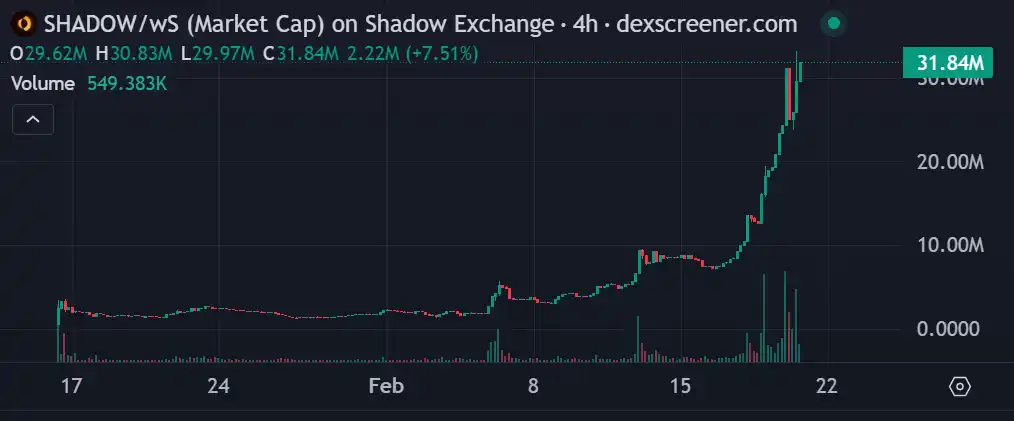
While other chains have been continuously distracted by various unexpected events in the meme market, Sonic Labs has been focusing on DeFi development. Sonic has announced several new measures to incentivize DeFi projects in its ecosystem, causing Sonic's TVL to surge by 500% in the past month. In just two months, Sonic has grown from 0 to over $500 million in TVL, with a net inflow of external funds of $110 million on-chain. Solana accounts for the majority, followed closely by Base and ETH. The DEX trading volume on Sonic has also surpassed the $1 billion mark.
Shadow Exchange is a native centralized liquidity layer and exchange on Sonic. In Sonic's high-speed, low-cost EVM-compatible Layer 1 ecosystem, Shadow Exchange, as one of its core trading protocols, has transformed the traditional ve(3,3) model into an x(3,3) incentive model, attracting the attention of many investors.
Related Sonic Reading: "TVL grows fivefold in one month, will AC Brother turn Sonic into the new DeFi profit center?"
Familiar (3,3), but with an added x
The history of decentralized finance has always been marked by repeated attempts to solve the "DEX trilemma," that is, how to coordinate incentive mechanisms among traders, liquidity providers, and token holders. Although Andre Cronje's ve(3,3) model theoretically addressed this issue by balancing incentives among all participants, the long lock-up period created a high-friction system, forcing users to lock up tokens to fairly participate in the incentive model.
Uniswap focuses on a simple two-sided system: traders and liquidity providers (LPs). ve(3,3) improves on this by adjusting the incentive mechanism to align with token holders' interests, but the distribution of these incentives is unfair and heavily favors the protocol.
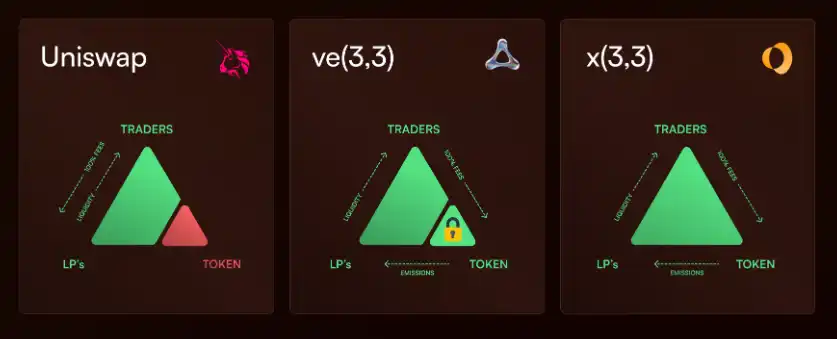
On the other hand, the x(3,3) model addresses these issues, allowing for instant withdrawals and unlocking restrictions through incentives. Users can participate in governance by staking platform tokens and vote on the emission weight of the liquidity pool. Voters can receive fee revenue share and additional "bribe rewards," incentivizing long-term token holders to actively participate in ecosystem development. The following diagram clearly illustrates the entire DeFi model flow:
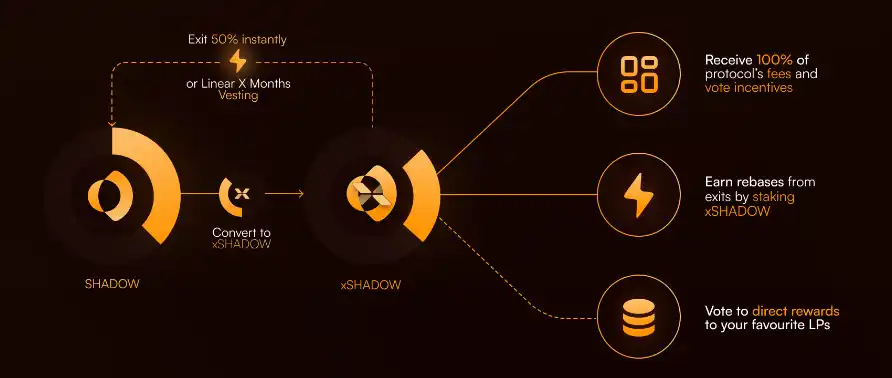
The $SHADOW token is the most fundamental token, freely exchangeable with other currencies. $SHADOW can be exchanged 1:1 with xSHADOW tokens, which are core to the entire model. xSHADOW stakers can vote to direct rewards straight to LPs, and through staking, they can also receive 100% of protocol fees, voting rewards, and exit penalties.
Regarding user exits, Shadow has implemented a unique Player vs. Player (PvP) rebasing mechanism where exit penalties flow to xSHADOW stakers. When a user prematurely exits their xSHADOW position, 100% of the seized tokens will flow pro-rata to existing xSHADOW stakers. In terms of token selection, users can claim more liquid SHADOW for default APY or illiquid xSHADOW for double APY.
Users can convert xSHADOW to SHADOW at any time: an immediate conversion (50% penalty) or a conversion within a user-selected vesting period (based on a ratio, e.g., 3 months = 1:0.73). The longer the vesting period, the more favorable the conversion rate, with a full 6-month vesting period allowing for penalty-free 1:1 conversion.
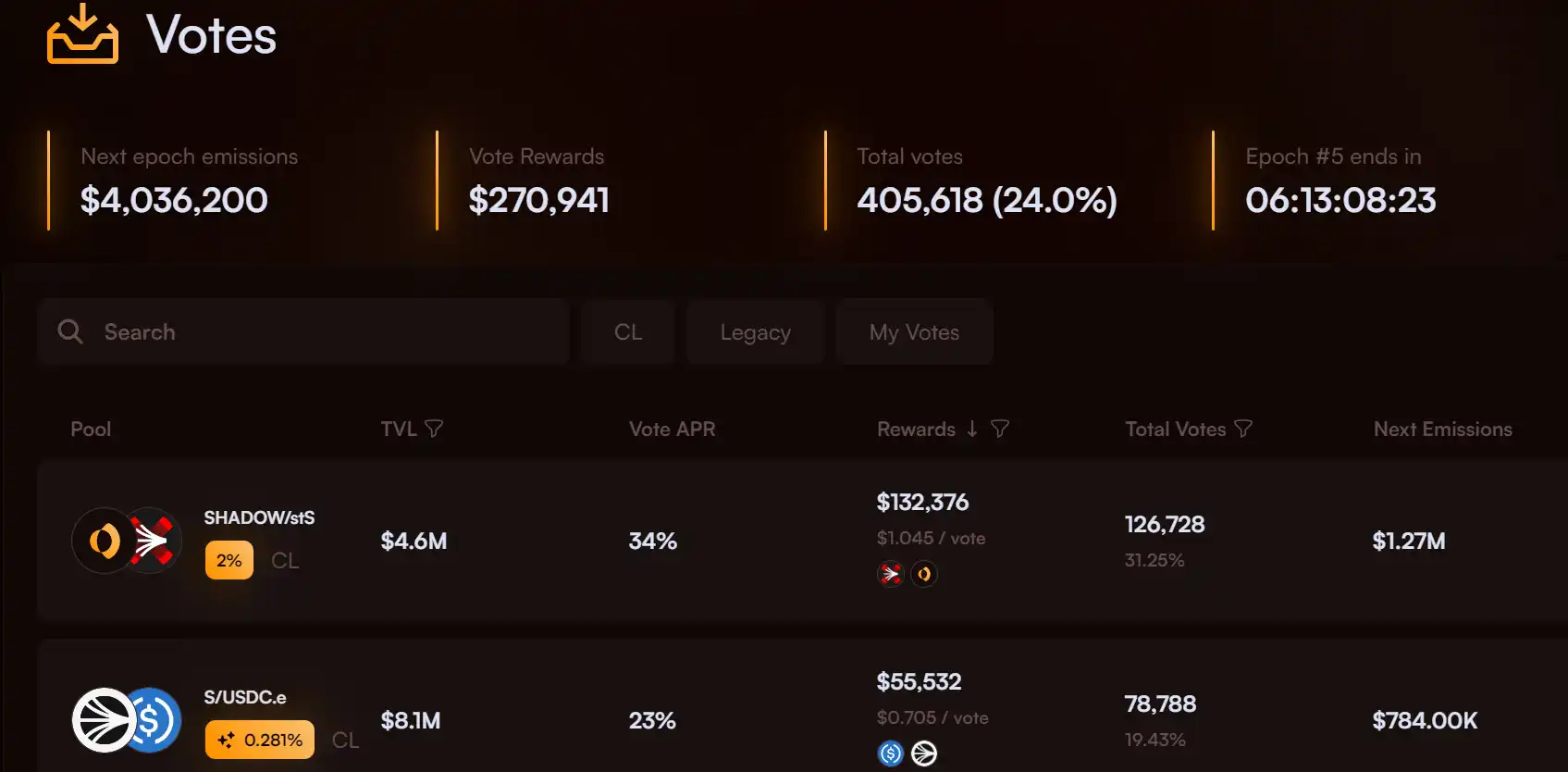
Voting Incentives
xSHADOW holders earn rewards through active participation and voting. When holders vote to support liquidity through a gauge, they proportionally share in all fees generated by that liquidity pair and additional voting incentives provided by the protocol to encourage participation. The primary purpose of xSHADOW tokens is to direct distributed token rewards through voting toward increasing liquidity, with this portion of the token rewards distributed in proportion to the total percentage of votes in that period. For example, if 100,000 xSHADOW are distributed in a single period and 10% of all votes are allocated to the SHADOW/USDC pair, then that pair will receive 10,000 xSHADOW tokens, which will be linearly distributed to the liquidity providers of the relevant LP pair throughout the period.
Liquidity Staking
The design goal of Shadow is to eliminate friction in the ve(3,3) model, with governance staking being one of the biggest sources of friction. After staking liquidity in xSHADOW, you can mint $x33, simplifying this process through automated voting and reward claiming without disrupting the core mechanism of xSHADOW. The $x33:xSHADOW ratio starts at 1.00:1.00 and gradually skews towards $x33 as rewards accumulate from fees, voting incentives, and resets. At the end of each period, rewards from fees and voting incentives are automatically sold to increase the $x33:xSHADOW ratio. While $x33 provides instant liquidity, it still does not avoid the exit penalty of xSHADOW. As a liquidity staking version of xSHADOW, the market price of $x33 will naturally reflect the instant exit fee structure and cannot be traded below the redemption value of xSHADOW.
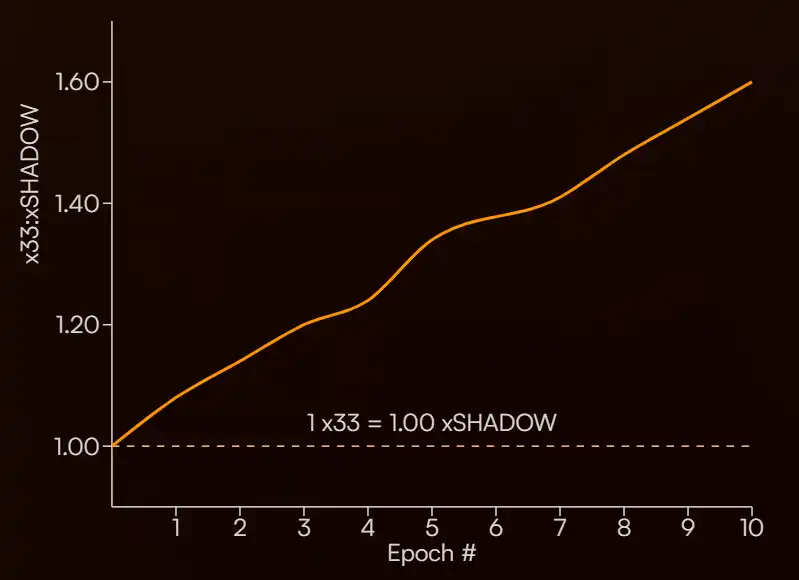
Shadow employs a unique Player vs. Player (PvP) mechanism, enhancing the traditional ve(3,3) anti-dilution model to both protect xSHADOW holders from dilution and incentivize them to maintain their positions and participate in the ongoing success of SHADOW. Stakers who stay longer in xSHADOW will earn more fees, voting incentives, user, and emission exit rewards. Users can exit their positions at any time, ensuring rewards flow to those who value and continue to participate in it the most. This mechanism not only encourages avoiding early exits but also ensures that remaining participants are rewarded for loyalty and active participation.
With the rapid growth of Sonic Chain TVL (increasing 13x from early 2025 to $357 million), and endorsements from core developers like Andre Cronje, Shadow Exchange is poised to leverage ecosystem momentum and become a benchmark for the next generation of DeFi trading protocols. Shadow Exchange is not only a technological playground for the Sonic Chain but also a frontier for DeFi governance and liquidity innovation, offering a new paradigm for traders, liquidity providers, and projects.
You may also like

Mining Companies' Great Migration: Some Have Already Secured $12.8 Billion in AI Orders
What Is Vibe Coding? How AI Is Changing Web3 & Crypto Development
What is vibe coding? Learn how AI coding tools are lowering the barrier to Web3 development and enabling anyone to build crypto applications.

The parent company of the New York Stock Exchange strategically invests in OKX: The intentions behind the $25 billion valuation

WEEX P2P update: Country/region restrictions for ad posting
To improve ad security and matching accuracy, WEEX P2P now allows advertisers to restrict who can trade with their ads based on country or region. Advertisers can select preferred counterparty locations for a safer, smoother trading experience.
I. Overview
When publishing P2P ads, advertisers can now set the following:
Allow only counterparties from selected countries or regions to trade with your ads.
With this feature, you can:
Target specific user groups more precisely.Reduce cross-region trading risks.Improve order matching quality.
II. Applicable scenarios
The following are some common scenarios:
Restrict payment methods: Limit orders to users in your country using supported local banks or wallets.Risk control: Avoid trading with users from high-risk regions.Operational strategy: Tailor ads to specific markets.
III. How to get started
On the ad posting page, find "Trading requirements":
Select "Trade with users from selected countries or regions only".Then select the countries or regions to add to the allowlist.Use the search box to quickly find a country or region.Once your settings are complete, submit the ad to apply the restrictions.
When an advertiser enables the "Country/Region Restriction" feature, users who do not meet the criteria will be blocked when placing an order and will see the following prompt:
If you encounter this issue when placing an order as a regular user, try the following solutions.
Choose another ad: Select ads that do not restrict your country/region, or ads that allow users from your location.Show local ads only: Prioritize ads available in the same country as your identity verification.
IV. Benefits
Compared with ads without country/region restrictions, this feature provides the following improvements.
Aspect
Improvement
Trading security
Reduces abnormal orders and fraud risk
Conversion efficiency
Matches ads with more relevant users
Order completion rate
Reduces failures caused by incompatible payment methods
V. FAQ
Q1: Why are some users not able to place orders on my ad?
A1: Their country or region may not be included in your allowlist.
Q2: Can I select multiple countries or regions when setting the restriction?
A2: Yes, multiple selections are supported.
Q3: Can I edit my published ads?
A3: Yes. You can edit your ad in the "My Ads" list. Changes will take effect immediately after saving.

What are the key highlights of this year's Ethereum's most important upgrade, the Glamsterdam upgrade?

March 6 Key Market Update You Can't Miss! | Alpha Morning Report

Sell Nvidia, Buy Power Plant: 27-Year-Old AI Investor Earns $5 Billion in One Year
The $24 Million Heist Behind It: The Most Dangerous Vulnerability in the Crypto World is Actually Human

Justin Sun Lawsuit Dismissed, BlackRock Bullish on Tokenization, What Is the English-Speaking Community Paying Attention To?

Morning News | NYSE parent company invests in OKX; Morgan Stanley provides $500 million loan to Core Scientific; Western Union partners with Crossmint to launch stablecoin USDPT

These former crypto builders have transitioned to the hottest AI projects globally

Ethereum Overhaul 2026 Blueprint, this time to abandon "gradualism"
What Is OpenClaw? How AI Agents Could Change Crypto Exchange Trading
OpenClaw is a rapidly growing open-source AI agent that can autonomously execute tasks and interact with software, including connecting to crypto exchanges through APIs to analyze markets and automate trading strategies. While this creates new opportunities for smarter trading, it also introduces security and operational risks. Through this article, WEEX aims to help users better understand the potential and risks of AI trading agents so they can explore new technologies while trading more safely and responsibly.
Ethereum 2029 Strawmap Guide: Ultra-Fast Consensus, Native Privacy, and the "Acceleration Variables" Brought by AI

Altcoin ETF Surge: SOL and XRP Inflows Total $23 Million as Institutions Diversify
Key Takeaways Institutional interest in altcoin ETFs is expanding, with SOL and XRP showing significant inflows on March…
Vitalik Drops Ethereum Endgame Bombshell: ETH USD to $3,000?
Key Takeaways Vitalik Buterin introduces the “Sanctuary Tech” manifesto to address Ethereum’s non-financial limitations. A current lack of…
Exclusive: Yuliya Barabash Predicts the Most Regulated Could Be the Biggest Crypto Winners
Key Takeaways The aftermath of FTX and Celsius collapses has ushered a new regulatory era, reshaping the crypto…

iPhone Crypto Wallets Under Threat from State-Grade Malware
Key Takeaways: The Coruna exploit kit exploits 23 iOS vulnerabilities, threatening iPhone users’ crypto wallets. Initially state-level surveillance,…
Mining Companies' Great Migration: Some Have Already Secured $12.8 Billion in AI Orders
What Is Vibe Coding? How AI Is Changing Web3 & Crypto Development
What is vibe coding? Learn how AI coding tools are lowering the barrier to Web3 development and enabling anyone to build crypto applications.
The parent company of the New York Stock Exchange strategically invests in OKX: The intentions behind the $25 billion valuation
WEEX P2P update: Country/region restrictions for ad posting
To improve ad security and matching accuracy, WEEX P2P now allows advertisers to restrict who can trade with their ads based on country or region. Advertisers can select preferred counterparty locations for a safer, smoother trading experience.
I. Overview
When publishing P2P ads, advertisers can now set the following:
Allow only counterparties from selected countries or regions to trade with your ads.
With this feature, you can:
Target specific user groups more precisely.Reduce cross-region trading risks.Improve order matching quality.
II. Applicable scenarios
The following are some common scenarios:
Restrict payment methods: Limit orders to users in your country using supported local banks or wallets.Risk control: Avoid trading with users from high-risk regions.Operational strategy: Tailor ads to specific markets.
III. How to get started
On the ad posting page, find "Trading requirements":
Select "Trade with users from selected countries or regions only".Then select the countries or regions to add to the allowlist.Use the search box to quickly find a country or region.Once your settings are complete, submit the ad to apply the restrictions.
When an advertiser enables the "Country/Region Restriction" feature, users who do not meet the criteria will be blocked when placing an order and will see the following prompt:
If you encounter this issue when placing an order as a regular user, try the following solutions.
Choose another ad: Select ads that do not restrict your country/region, or ads that allow users from your location.Show local ads only: Prioritize ads available in the same country as your identity verification.
IV. Benefits
Compared with ads without country/region restrictions, this feature provides the following improvements.
Aspect
Improvement
Trading security
Reduces abnormal orders and fraud risk
Conversion efficiency
Matches ads with more relevant users
Order completion rate
Reduces failures caused by incompatible payment methods
V. FAQ
Q1: Why are some users not able to place orders on my ad?
A1: Their country or region may not be included in your allowlist.
Q2: Can I select multiple countries or regions when setting the restriction?
A2: Yes, multiple selections are supported.
Q3: Can I edit my published ads?
A3: Yes. You can edit your ad in the "My Ads" list. Changes will take effect immediately after saving.


 App
App