
Tether's 20% Fee for Frozen USDT: What Hack Victims Must Know

 Prefer us on Google

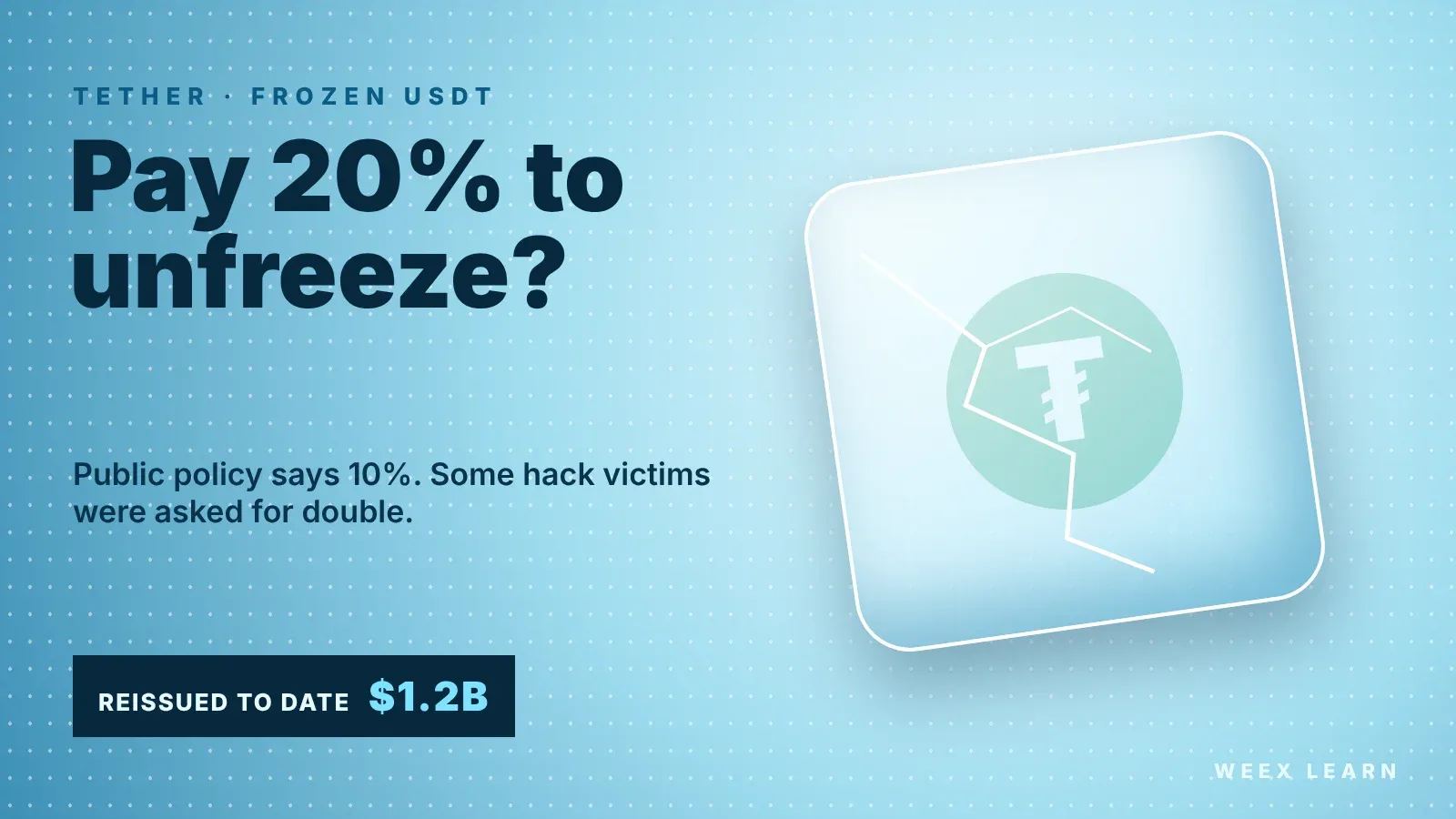
Tether has asked some hack victims to pay fees of up to 20% before it returns USDT it froze on their behalf, according to a Bloomberg investigation reported on November 25, 2026. That is double the 10% cap in Tether's published recovery policy, which covers tokens sent to the wrong address rather than stolen funds. Tether says the fees cover legal and recovery costs and that it has reissued about $1.2 billion of USDT so far. For anyone holding stablecoins, the story is a reminder that a frozen USDT balance is not the same thing as a recovered one. This article explains how Tether's freeze-and-reissue process works, why the fee gap exists, and what you can realistically do to protect your funds.
What Bloomberg Found About Tether's Recovery Fees
The investigation centers on victims who spent years trying to get back USDT that Tether had already frozen. In some of those cases, Tether sought fees of 20% to reissue the tokens. The most striking example is Bittok, a Singapore exchange that lost about $50 million in a 2020 hack and, more than five years later, has still not recovered its frozen USDT. For a business, five years of locked capital can matter as much as the theft itself.
Tether's response, through a spokesperson quoted by Bloomberg, is that it has reissued $1.2 billion of USDT to date and that the fees reflect real recovery costs, including legal work. The company's published policy, however, only covers tokens sent to the wrong address, with fees of up to 10% or $1,000, whichever is higher. Theft, fraud and hack cases are handled by a separate team with no published fee schedule, and that gap is the core of the controversy: the 10% figure most users know applies to user error, not to crime.
How Tether Freezes and Reissues USDT
USDT is a centrally issued token. Tether's smart contracts on Ethereum, TRON and other chains include a blacklist function that lets the company block a specific address from sending tokens. Recovering funds takes two further steps: Tether destroys the frozen balance, then mints an equal amount to the rightful owner. Every part of that process depends on Tether's decision, which is why it can be both fast and slow at the same time.
That power has become one of crypto's most effective anti-theft tools. Within 30 minutes of the October 29, 2026 Binance hack, Tether froze more than $1.5 billion in stolen USDT, and the company says it has frozen more than $7 billion across secondary-market addresses in total. Even so, investigators found that attackers converted about $729 million into other assets before the freeze landed, and six of 11 attacker wallets were already empty when restrictions took effect. For the full picture of that incident, see our Binance hack update on the $2.85B of $6.3B frozen.
The takeaway is that freezing and returning are two very different speeds. Freezing can happen in minutes because it protects everyone at once. Reissuing is slow, discretionary and, according to Bloomberg, sometimes expensive, because it requires Tether to decide who the rightful owner is and on what terms.
Why a 20% Fee Is Controversial
Supporters of Tether's approach argue that hack recoveries are genuinely complex. They can involve court orders, cross-border law enforcement, competing claims from several parties and long legal reviews, and someone has to pay for that work. From that perspective, a recovery fee is simply the price of a service that would not exist at all with a decentralized stablecoin.
Critics see three problems. First, without a published schedule for hack cases, victims cannot know the cost in advance, which weakens their negotiating position at the worst possible moment. Second, while USDT sits frozen, the dollars backing it stay in Tether's reserves, largely Treasury bills earning interest at rates above 4%, so the issuer benefits from delay. Third, centralization cuts both ways: the same control that lets Tether stop a thief also lets it set the terms for the victim. For users, this is a trade-off worth understanding before deciding where and how to hold stablecoins.
-- Price
What to Do if Your USDT Is Stolen or Frozen
Speed matters more than anything else. Tether's fastest freezes happen when an exchange or investigator flags addresses within minutes, before the attacker has time to swap USDT into other assets. If funds are stolen, report the theft immediately to any exchange that received them and to Tether, and file a police report the same day; Tether typically acts on law-enforcement requests, and a case number speeds every later step.
Documentation is the second priority. Save transaction hashes, wallet addresses and timestamps, because recovery decisions depend on a clean chain of evidence. If Tether offers to reissue funds, ask for the fee and conditions in writing before agreeing to anything. Finally, be alert to recovery scams: fake "fund recovery" agents actively target hack victims, and Tether does not cold-call users offering to retrieve funds.
How to Reduce Stablecoin Risk Going Forward
The most effective protection is structural rather than reactive. Splitting custody so that no single hot wallet or platform holds all your USDT limits the damage from any one breach. Platforms with active risk teams can also flag stolen funds far faster than an individual can, which improves the odds that a freeze happens before the money moves.
It also helps to avoid parking large idle stablecoin balances on-chain when you are not using them. On WEEX, you can move between USDT and major assets such as bitcoin in seconds on BTC/USDT spot, and USDT-margined products such as the BTCUSDT perpetual let you manage market exposure while your collateral stays in one account rather than being shuffled between wallets.
FAQ
1. Does Tether charge a fee to return frozen USDT?
Yes. Its public policy for tokens sent to the wrong address charges up to 10% or $1,000, whichever is higher. Bloomberg reported that Tether asked some hack victims for 20%.
2. How much USDT has Tether frozen?
Tether says it has frozen more than $7 billion in USDT in total, including more than $1.5 billion tied to the October 29, 2026 Binance hack.
3. How much frozen USDT has Tether returned?
A Tether spokesperson told Bloomberg the company has reissued about $1.2 billion of USDT to date.
4. Can Tether freeze any USDT wallet?
Tether can blacklist addresses on the chains where it issues USDT. It generally acts on law-enforcement requests or clear links to hacks, fraud or sanctions.
This content is provided for general informational purposes only and doesn't constitute financial, investment, legal, or tax advice. Any events, rewards, online promotions, or related information mentioned herein should not be considered a recommendation, solicitation, or invitation to purchase, sell, trade, or otherwise deal in any crypto assets. Crypto assets are highly volatile and may result in loss. The availability of WEEX services, products, and related events may vary by region. You are responsible for ensuring that your participation is in accordance with applicable local laws and regulations.
You may also like
View moreBinance Hack Update: $2.85B of $6.3B Frozen, Dec. 1 Court Test
Beginner3 minSecurityIs WEEX Safe? Proof of Reserves, 1,000 BTC Fund and Licences Checked (2026)
Beginner7 minSecurityBinance Hack Explained: What the $6.3B Theft Means for Users
Beginner4 minSecurityBNB Down 2%: Binance Verifies Reserves for 10 Assets
Intermediate9 minSecurityBinance Proof of Reserves: What the Nov. 3 ZK Report Can Prove
Beginner4 minSecurityHot Wallet Security Explained: Lessons From the Binance Incident
Beginner3 minSecurity


