
OKXICE Launches 24/7 Tokenized Stocks: Are All 113 Assets Available?

 Prefer us on Google


Key Takeaways
- OKXICE launched its Tokenized Securities Venue on November 23, 2026, opening round-the-clock trading in available securities for eligible U.S. customers.
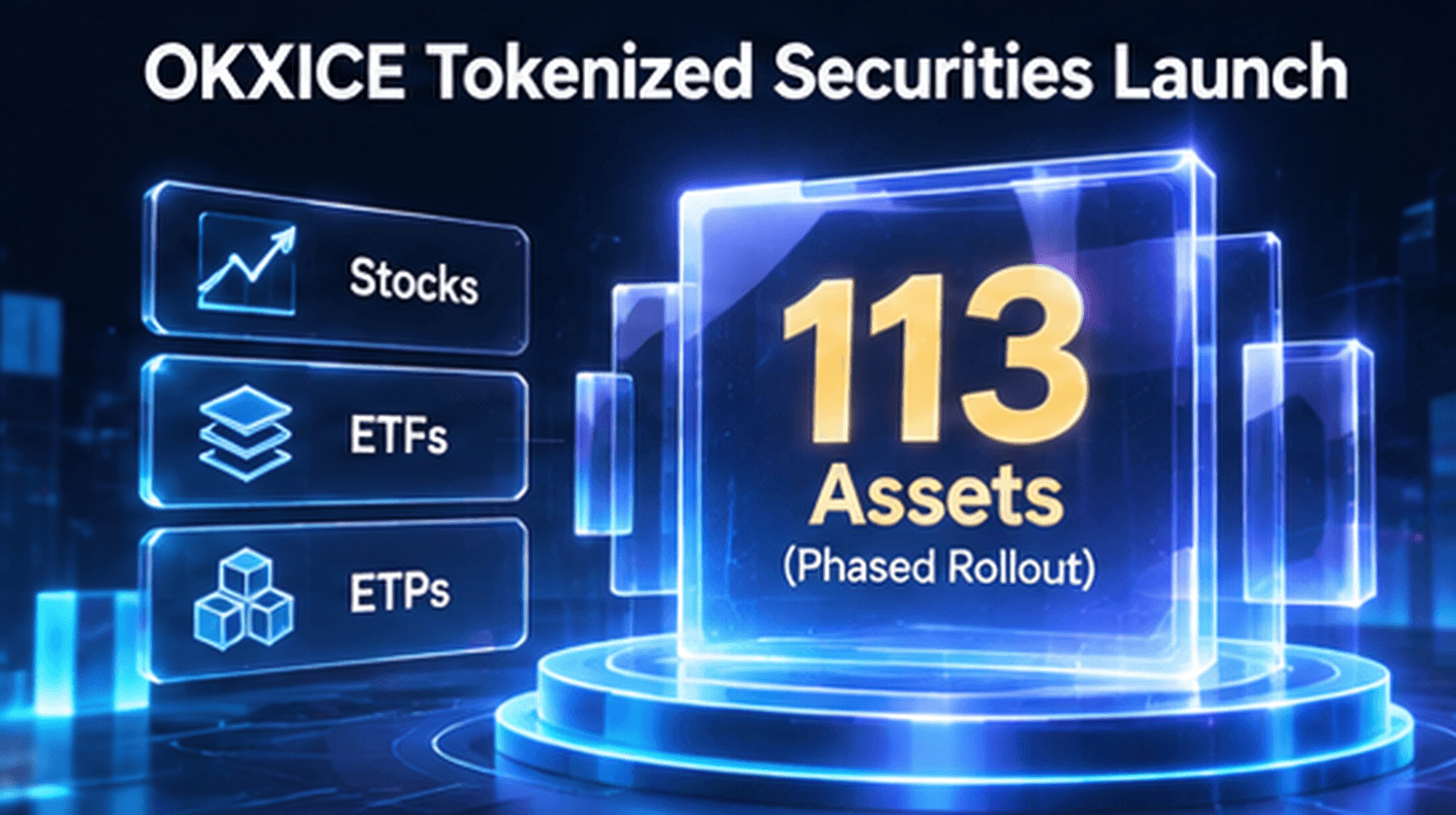
- The platform confirmed 113 planned assets, including stocks, ETFs and exchange-traded products, but the assets are being introduced in phases.
- OKXICE operates as a venture involving OKX and Intercontinental Exchange, the parent company of the New York Stock Exchange.
- Investors should distinguish tokenized securities with defined legal rights from synthetic stock-price products and derivative contracts that do not confer ordinary shareholder ownership.
The market for tokenized stocks reached a new milestone on November 23, 2026, when OKXICE launched a round-the-clock securities trading venue. The platform confirmed plans to introduce 113 assets, but not all tokenized stocks were available immediately. As tokenized stocks attract greater attention, the launch raises questions about investor eligibility, self-custody, shareholder rights and whether trading outside traditional market hours can deliver sufficient liquidity.
What Is OKXICE's New Tokenized Securities Venue?
OKXICE announced that its Tokenized Securities Venue, or TSV, would begin supporting trading in available assets from noon Eastern Time on November 23.
The platform is designed to provide eligible U.S. customers with access to digital representations of securities through the OKX application.
The initiative involves OKX and Intercontinental Exchange, the parent company of the New York Stock Exchange.
Its launch represents an attempt to combine blockchain-based asset infrastructure with regulated securities-market processes.
However, the relationship with ICE should not be interpreted as meaning that every security listed on the New York Stock Exchange has automatically become tradeable through OKXICE.
OKXICE Launch: Core Facts
| Feature | Announced Details |
|---|---|
| Platform | OKXICE Tokenized Securities Venue |
| Launch Date | November 23, 2026 |
| Launch Time | Noon ET |
| Eligible Audience | Qualified U.S. customers |
| Trading Schedule | 24/7 for available assets |
| Confirmed Asset Pipeline | 113 assets |
| Asset Categories | Stocks, ETFs and ETPs |
| Rollout Method | Phased availability |
| Access | TSV section of the OKX app |
| Custody Model | Customer self-custodial wallets |
| Venue Relationship | OKX and Intercontinental Exchange |
Source: OKX Official Launch Announcement, November 23, 2026.
The platform's introduction reflects wider experimentation with digital securities, settlement mechanisms and blockchain-based ownership records.
Whether such venues achieve widespread adoption will depend on liquidity, compliance, user protections and the reliability of their underlying infrastructure.
Are All 113 Tokenized Assets Available for Trading?
No. OKXICE confirmed a pipeline of 113 securities-related assets but explicitly stated that they would become available on a rolling basis.
The distinction is important for investors reading headlines about the platform's launch.
A confirmed asset pipeline represents planned coverage. It should not be reported as a complete list of immediately tradeable instruments.
Confirmed Versus Planned Availability
| Claim | Correct Interpretation |
|---|---|
| The venue launched on November 23 | Confirmed |
| Eligible users can trade supported assets around the clock | Confirmed, subject to venue rules |
| 113 assets were confirmed for the platform | Confirmed pipeline |
| All 113 were live at launch | Not established |
| All U.S. securities are available | Not established |
| Every global investor can access the platform | No; eligibility restrictions apply |
Source: OKXICE November 23 launch announcement.
The launch involves stocks, ETFs and exchange-traded products.
These instruments may have different investment objectives, payout structures, fees and legal characteristics.
As a result, readers should assess the specific tokenized asset rather than treating every product available on the venue as equivalent to an ordinary share of common stock.
-- Price
How Does 24/7 Tokenized Stock Trading Work?
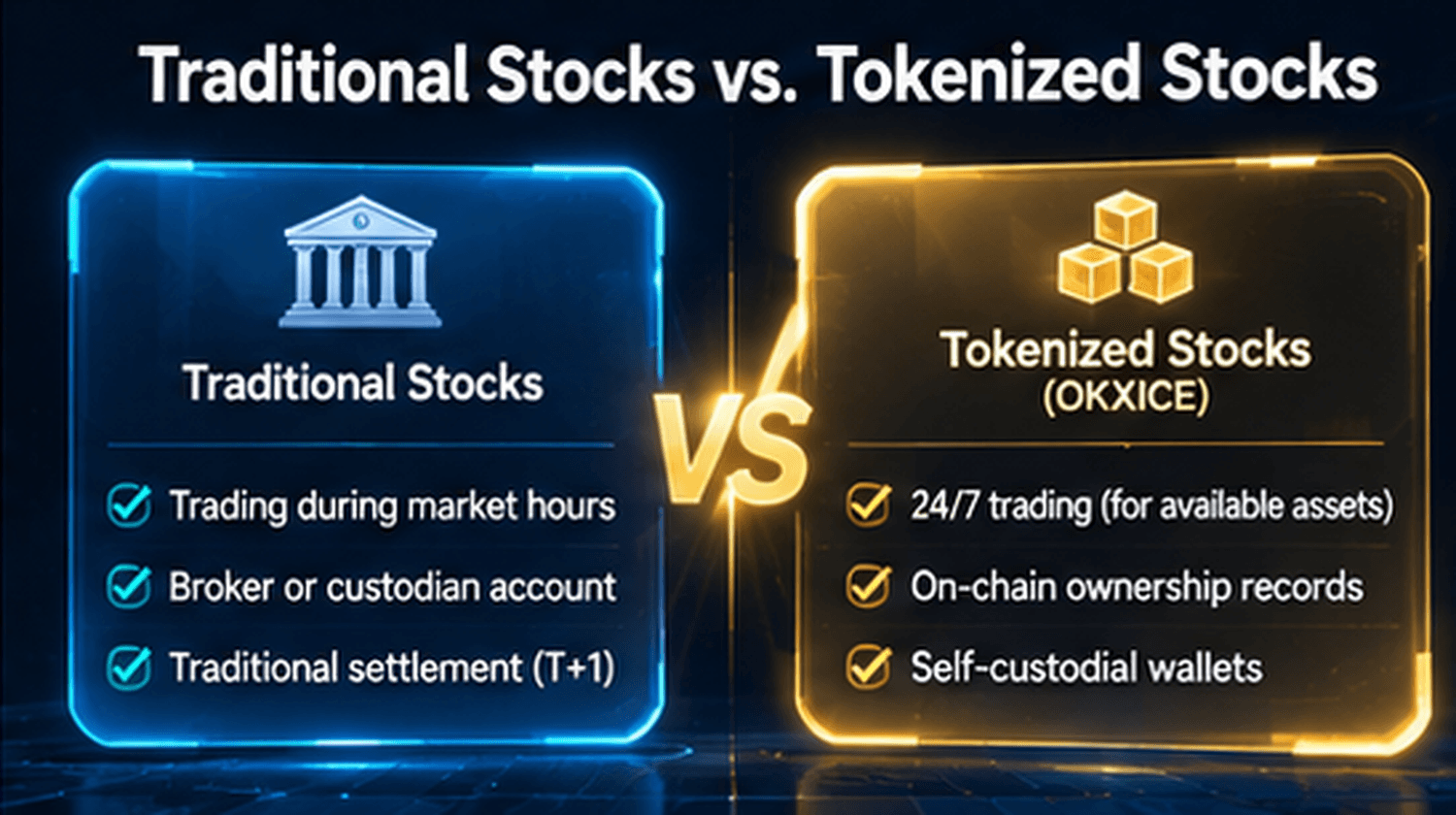
Traditional U.S. stock exchanges operate according to scheduled trading sessions, including regular market hours and certain extended-hours periods.
Blockchain-based trading systems can support transactions outside that traditional schedule.
OKXICE's model is designed to make eligible assets available for trading around the clock.
This may appeal to investors who live in different time zones or want to respond to developments occurring outside regular U.S. market hours.
However, continuous market access does not guarantee continuous liquidity.
The available bid and ask quotations may be less competitive when trading activity is limited.
What Changes With Around-the-Clock Trading?
| Feature | Traditional U.S. Stock Trading | OKXICE TSV |
|---|---|---|
| Trading Schedule | Defined exchange and extended sessions | 24/7 for available assets |
| Asset Representation | Conventional securities records | Tokenized securities |
| Investor Eligibility | Brokerage and jurisdiction rules | OKXICE-specific eligibility |
| Wallet Structure | Typically broker or custodian account | Self-custodial wallets |
| Liquidity | Concentrated in established sessions | Depends on venue activity |
| Product Rights | Determined by security and custody structure | Determined by specific tokenized instrument |
Sources: OKXICE announcement and general U.S. securities-market structure.
For users trading outside standard market hours, price discovery becomes especially important.
A security's tokenized quotation may respond to overnight news even when its primary U.S. exchange is closed.
Price differences can emerge because the products trade on different venues, at different times and under different liquidity conditions.
Do Tokenized Stocks Give Investors Real Shareholder Rights?
Not every product marketed using stock-related terminology provides the same legal rights.
An actual tokenized security may represent a defined legal interest in an underlying financial instrument. The investor's rights depend on the issuer, custody arrangement and applicable law.
A synthetic stock token or price-linked perpetual contract may instead provide economic exposure without ownership of an underlying share.
The distinction is especially important for investors expecting voting rights, dividends or direct claims on company assets.
Tokenized Securities vs. Stock Perpetual Futures
| Feature | Tokenized Security | Stock-Linked Perpetual Future |
|---|---|---|
| Main Exposure | Rights specified by the security structure | Contract referencing price movements |
| Underlying Share Ownership | Depends on issuer and legal terms | Generally no direct ownership |
| Dividends and Voting | Depend on instrument terms | No ordinary shareholder voting rights |
| Leverage | Depends on platform and product | May be available |
| Funding Payments | Product-dependent | Common in perpetual futures |
| Liquidation Risk | Depends on financing structure | Significant when leveraged |
Source: Product-structure comparison; actual rights must be established from each instrument's governing documentation.
Before trading, investors should review the issuer's disclosures and determine whether the product is legally a security, a derivative or another type of digital asset.
Why Does OKXICE Matter for Real-World Asset Tokenization?
Real-world asset tokenization, commonly called RWA tokenization, refers to the use of blockchain-based systems to represent claims linked to assets outside the blockchain.
Potential applications include securities, funds, bonds and other financial instruments.
The OKXICE launch is notable because it connects a major cryptocurrency trading platform with infrastructure associated with traditional financial markets.
The venue also emphasizes self-custody, meaning users are responsible for managing the relevant wallets and private keys.
That approach can provide users with direct control over blockchain-based holdings, but it also introduces wallet-management responsibilities.
What Challenges Could Limit Adoption?
Regulatory requirements: Securities tokenization must operate within applicable investor protection and market rules.
Liquidity: Round-the-clock access needs sufficient market participants and competitive quotations to function efficiently.
Custody and security: Self-custody reduces certain intermediary dependencies but increases the importance of safeguarding private keys.
Corporate actions: Dividends, splits, voting arrangements and other events require reliable processes for handling investors' rights.
Interoperability: Different platforms may use different token standards, legal structures and settlement arrangements.
Solving these challenges will determine whether tokenized securities can develop from a specialized product category into a widely used market structure.
How to Trade Stock-Related Products on WEEX
WEEX provides stock-related trading products, including selected USDT-margined stock perpetual contracts.
These products should not be confused with the tokenized securities available on OKXICE.
Step 1: Explore the Available Stock-Related Markets
Open the WEEX trading interface and review the available stock-linked products.
For example, the NVDA-related stock page provides information associated with NVIDIA market exposure.
Step 2: Review Perpetual Futures Specifications
WEEX also lists an NVDAUSDT perpetual futures contract.
Perpetual futures do not provide the same legal ownership rights as ordinary listed shares.
Check leverage limits, funding rates, trading restrictions and market status before proceeding.
Step 3: Confirm Product Risk
Review order size, margin requirements, fees and liquidation conditions.
Stock-linked derivatives may trade at prices that differ from official exchange quotations, particularly outside regular U.S. market hours.
Conclusion
The launch of OKXICE represents a significant development for tokenized stocks, combining a 24/7 trading model with a planned lineup of 113 securities-related assets.
However, investors should recognize that the initial rollout is phased and that tokenized stocks can differ substantially in their legal rights, custody arrangements and market liquidity.
The longer-term success of tokenized stocks will depend on regulatory clarity, transparent asset structures and the ability of platforms to support reliable trading beyond conventional market hours.
FAQ
1. When did OKXICE launch its tokenized securities venue?
The venue began operating for eligible users on November 23, 2026, with trading in supported assets scheduled to begin at noon Eastern Time.
2. Are all 113 tokenized assets available immediately?
No. OKXICE confirmed 113 planned assets and stated they would become available through a phased rollout.
3. Can international users trade through OKXICE?
The November 23 announcement specifically concerns eligible U.S. customers. Availability for other jurisdictions should not be assumed.
4. Are tokenized securities the same as stock perpetual futures?
No. Tokenized securities and perpetual derivatives have different legal and economic structures. Shareholder rights depend on the specific instrument, while perpetual futures generally provide price exposure without direct share ownership.
5. Does 24/7 trading guarantee better prices?
No. Continuous access does not guarantee sufficient liquidity, low spreads or prices identical to those on traditional exchanges.
This content is provided for general informational purposes only and doesn't constitute financial, investment, legal, or tax advice. Any events, rewards, online promotions, or related information mentioned herein should not be considered a recommendation, solicitation, or invitation to purchase, sell, trade, or otherwise deal in any crypto assets. Crypto assets are highly volatile and may result in loss. The availability of WEEX services, products, and related events may vary by region. You are responsible for ensuring that your participation is in accordance with applicable local laws and regulations.
You may also like
View moreNVDA Falls 5.9% After Huang's Return: Why Is Congress Investigating?
Beginner6 minBinance Hack: Can the DOJ Recover $1.1B in Frozen USDC?
Beginner9 minWEEX Product GuideWhat Is Proof of Stake? Why Some Coins Pay Staking Rewards
Beginner3 minJensen Huang Is Back as Nvidia CEO: Timeline of the Resignation and Reinstatement
Beginner4 minBitcoin Lightning Network for Beginners: 5 Things to Know Before Your First Payment
Beginner5 minAnthropic IPO vs SpaceX IPO: Price, Raise Size and First-Day Performance Compared
Beginner5 min




