
Bitcoin Fell to $57K on Hot PCE: Why a 97% Fed Hike Bet Matters

 Prefer us on Google

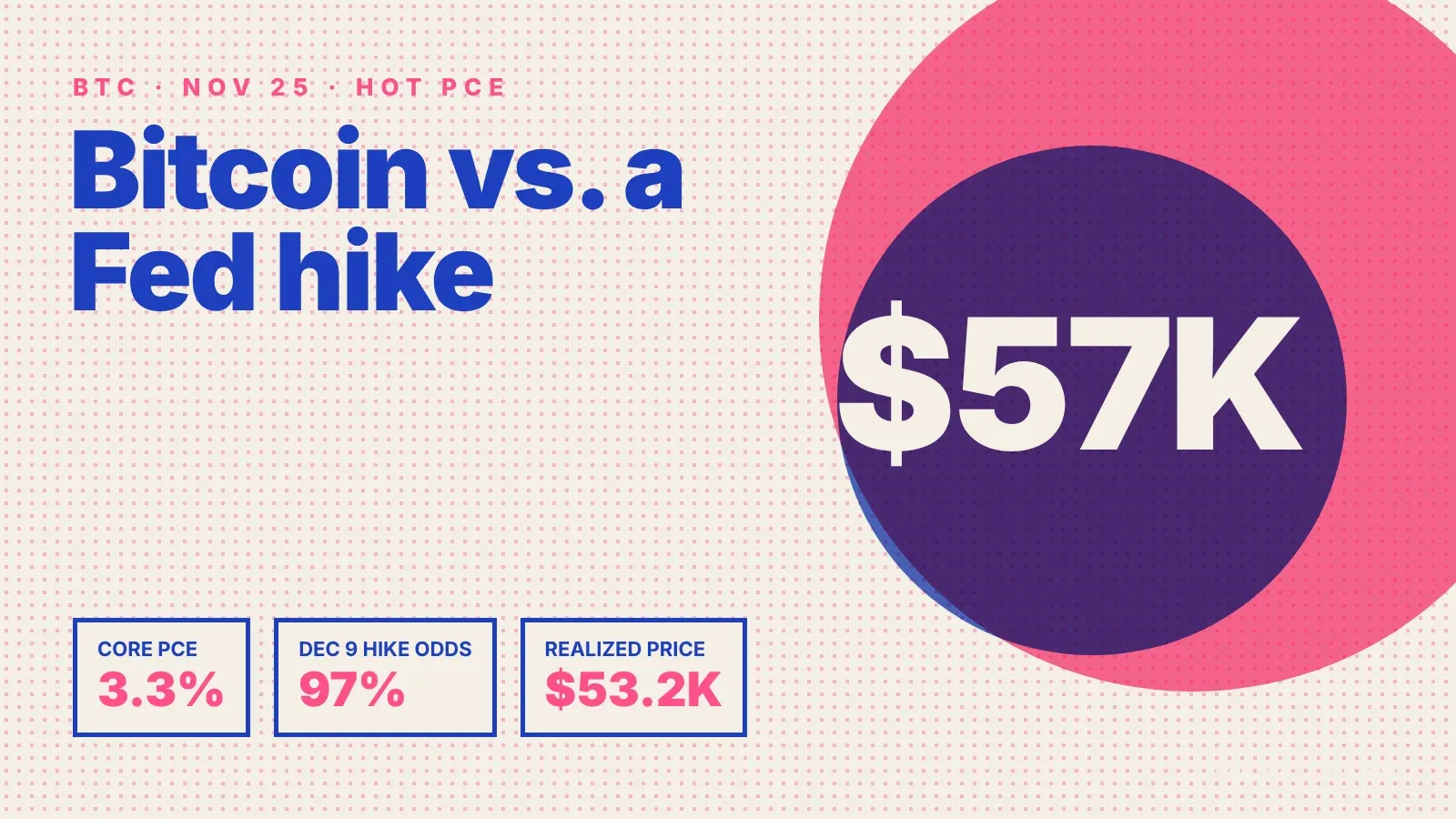
Bitcoin fell to about $57,300 on November 25, 2026, because a hotter-than-expected inflation print and a fresh round of proposed Trump tariffs pushed traders to price in a Federal Reserve rate hike, not a cut, at the December 9 meeting. Core PCE, the Fed's preferred inflation gauge, came in at 3.3%, its highest reading in three years, and CME futures moved to roughly 97–98% odds of a quarter-point increase. By early Asian hours on November 26, BTC had bounced back to $60,671 on WEEX, but the question traders are asking has flipped. It is no longer "when do cuts come?" It is "how high do rates go, and does the $53,200 realized price hold?" This article walks through what moved the market, why a near-certain hike still matters, and the levels that decide the next leg.
What Happened to Bitcoin on November 25
The sell-off arrived in two waves, and the first one started in Asia rather than in crypto. South Korea's chip-heavy Kospi dropped 6.2% as semiconductor stocks unwound, Nasdaq futures slid about 2% before the U.S. open, and bitcoin broke below Sunday's $58,769 low during the European session. That sequence matters because it shows BTC reacting as a high-beta tech proxy, not as a safe haven. When the Philadelphia Semiconductor Index fell nearly 8% the previous day, crypto had nowhere to hide.
The second wave hit once U.S. data landed. October's PCE price index rose 3.8% year over year, and core PCE printed 3.3% against a 3.2% forecast. On the same day, the administration proposed new tariffs on 14 major trading partners, including an additional 20% on China and up to 35% on Vietnam. Those tariffs are not in effect, and public hearings do not begin until January 25, 2027, but markets trade the headline long before the hearing. The combination pushed BTC to an intraday low near $57,300; the WEEX BTCUSDT perpetual recorded a 24-hour low of $57,261.7.
Leverage made the move sharper than the macro news alone would justify. Roughly $515 million in crypto positions were liquidated over 24 hours, and U.S. spot bitcoin ETFs logged a sixth straight day of outflows, including $231.6 million on Tuesday. Month-to-date, ETF outflows reached about $4.9 billion, making November the worst month since the funds launched in January 2024. With the Fear & Greed Index at 13, sentiment sits deep in "Extreme Fear."
Why a 97% Rate Hike Bet Changes the Math for BTC
For most of 2026, the bitcoin bull case leaned on the idea that rates would eventually fall. That story has now reversed. The Fed's benchmark range sits at 4.00%–4.25%, futures traders are pricing another increase as early as January 2027, and Q3 GDP was revised up to a 4.3% annualized pace, which gives the Fed room to tighten without fearing an immediate recession. In other words, the macro backdrop that justified a "buy the dip" reflex for most of the year is gone.
Higher rates weigh on bitcoin through a few connected channels. Cash and Treasury bills pay more, which raises the opportunity cost of holding an asset with no yield. Hikes also tend to lift the dollar, and BTC has traded inversely to the dollar for most of this cycle. Most importantly right now, bitcoin's correlation with the Nasdaq 100 is at its highest level since September 2022, so every tech sell-off spills directly into crypto prices.
The nuance traders often miss is that a 97% probability means the hike itself is almost fully priced. The real surprise risk on December 9 is the guidance, not the decision. A "one and done" message could trigger a relief rally as hedges unwind, while a signal that more hikes are coming in 2027 would likely extend the drawdown. If you want the backstory on how the market reached this point, our earlier breakdown of Bitcoin below $62K ahead of the Dec. 9 Fed call covers the run-up.
The On-Chain Levels Traders Are Watching
On-chain data from Glassnode and CryptoQuant describes a market under more stress than a routine pullback. The most important number is the realized price of about $53,200, the average cost basis of every coin on the network. It sits roughly 7.4% below the November 25 low. Historically, stretches where bitcoin trades below realized price have marked capitulation zones, because the average holder is underwater and forced sellers run out.
The derivatives market is already positioned for that kind of stress. The seven-day average put-to-call volume ratio has climbed to 1.7, the highest since June 2022, which means traders are paying up for downside protection. Realized losses relative to fresh capital inflows are at their highest since the FTX collapse in November 2022. Meanwhile, the November 20 low of $57,778 was briefly undercut on November 25, so short-term support has already been tested once and held only on a wick.
WEEX market data shows where the price stands after the bounce. As of November 26, around 03:00 UTC, the BTCUSDT perpetual traded at $60,671.2, with a 24-hour range of $57,261.7 to $61,600.0, about $5.76 billion in 24-hour volume, and a funding rate of +0.008255%. Funding staying slightly positive after half a billion dollars in liquidations is telling: longs have been shaken out, but they have not fully capitulated, which keeps downside risk alive.
-- Price
Three Scenarios for Bitcoin Into December 9
The base case is a range between roughly $57,000 and $64,000. In that scenario, the hike is already priced, ETF outflows slow, and BTC chops until the Fed speaks. Resistance sits near $61,200, the top of the recent rebound, and then around $64,300. This is the outcome the options market is effectively paying for, and it tends to punish anyone using high leverage in either direction.
The bear case is a test of the realized price at $53,200. That would most likely come from another hot data point, since November CPI lands on December 10, one day after the Fed decision, or from tariff escalation. Some analysts have flagged $48,500 as the next target if $53,000 gives way. The bull case is a relief rally above $64,000, which would require the Fed to hike while signaling a pause, letting the heavy put positioning unwind into a short squeeze toward the mid-$60,000s. None of these is a forecast; they are the levels the market itself has drawn, and the guidance on December 9 decides which one plays out.
How to Trade Bitcoin Volatility on WEEX
Event-driven weeks reward a plan made before the candle rather than during it. Spot buyers who want to accumulate near the realized price can stage limit orders on BTC/USDT spot instead of chasing intraday bounces, which avoids buying the top of a relief wick. Traders who want to hedge an existing spot position, or trade the range itself, can use the BTCUSDT perpetual, where liquidity is deep enough for tight stops.
The practical lesson from November 25 is to size for the wick, not the close. BTC covered more than $4,000 within hours, so leverage that cannot survive a 7% intraday swing is leverage that will be liquidated before the thesis plays out. It also pays to watch funding closely: if funding flips negative while price holds above $57,000, shorts are becoming crowded, which historically precedes the sharpest squeezes.
FAQ
1. Why did Bitcoin drop to $57,000?
Hot October PCE data, with core inflation at 3.3%, newly proposed U.S. tariffs, and a semiconductor sell-off pushed traders to price a 97% chance of a December 9 Fed rate hike. The move triggered about $515 million in liquidations.
2. What is Bitcoin's realized price right now?
Glassnode puts it near $53,200, roughly 7.4% below the November 25 low. It represents the average on-chain cost basis of all bitcoin in circulation.
3. Will the Fed raise rates on December 9, 2026?
CME FedWatch showed about 97–98% odds of a quarter-point hike as of November 25. The statement and guidance on 2027 matter more for bitcoin than the decision itself.
4. Is bitcoin still correlated with the Nasdaq?
Yes. Its correlation with the Nasdaq 100 is at the highest level since September 2022, so tech-stock sell-offs are spilling directly into crypto.
This content is provided for general informational purposes only and doesn't constitute financial, investment, legal, or tax advice. Any events, rewards, online promotions, or related information mentioned herein should not be considered a recommendation, solicitation, or invitation to purchase, sell, trade, or otherwise deal in any crypto assets. Crypto assets are highly volatile and may result in loss. The availability of WEEX services, products, and related events may vary by region. You are responsible for ensuring that your participation is in accordance with applicable local laws and regulations.
You may also like
View moreBitcoin Miners Sell 4x What They Mine: Riot, MARA, CleanSpark
Beginner4 minBitcoinHow Does CPI Affect Crypto? The Dec. 10 Print Lands After the Fed
Beginner3 minBitcoinBitcoin Hit $55K, Then Reclaimed $60K: Is $53,000 the Real Floor?
Beginner3 minBitcoinBitcoin Below $62K: Is $60,000 Next Before the Dec. 9 Fed Call?
Beginner4 minBitcoinWhy Is Bitcoin Down Today? BTC's Slide to $76K Explained
Beginner4 minBitcoinBitcoin and the US Midterms: A Trader's Checklist for Nov. 3-11
Beginner3 minWEEX Product Guide


