


WEEX Reduce-Only Order: What It Does and When It Gets Cancelled
A WEEX reduce-only order is a futures order that is only allowed to make an existing position smaller. If it would increase the position or flip it to the other side, the exchange trims or rejects the part that does that. WEEX lists reduceOnly as an order parameter in its futures API documentation as of October 2026. This guide covers what the flag blocks, which WEEX order types can carry it, and what happens to a resting reduce-only order when your position shrinks or closes before it fills.
The flag matters more than it sounds. The usual way traders end up with a short they never meant to open: they place take-profit sell limits above a long, close part of the long by hand, and forget the limits are still on the book. A rally fills them and the extra sells open a fresh short. Reduce-only exists to stop that.
One caveat before the mechanics. WEEX's Help Center describes closing through the Close button (market or limit close) and through take-profit/stop-loss orders, but it doesn't publish a page on a "Reduce-Only" checkbox in the app's order panel. The confirmed support is at the API level. App users should look for the option in the futures order panel, whose labels may vary by app version.
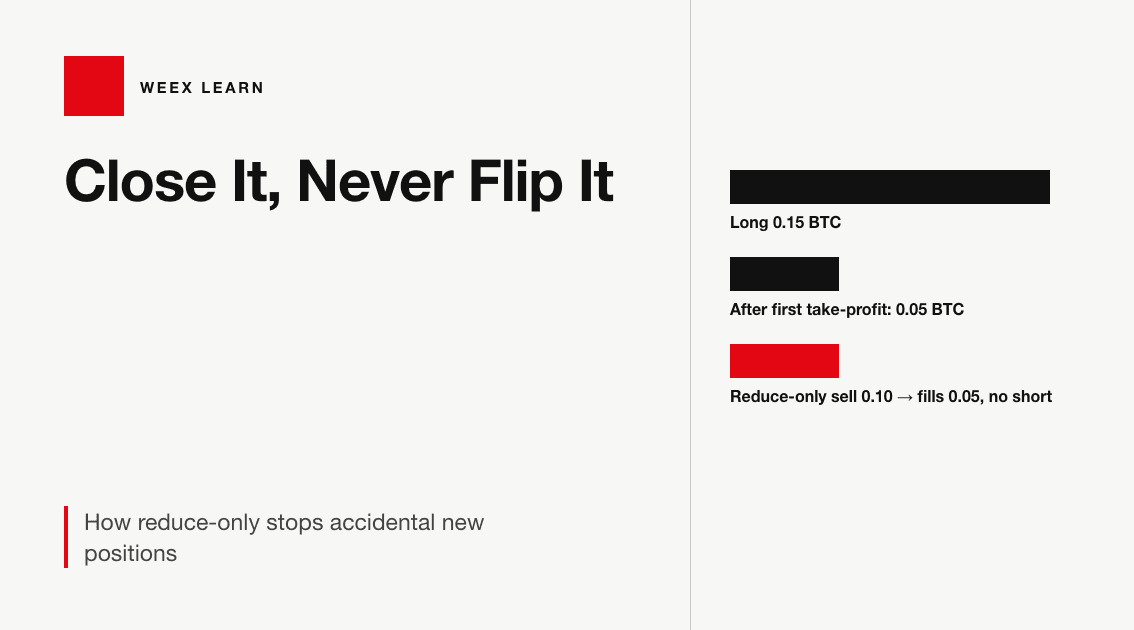
What a Reduce-Only Order Actually Blocks
A normal sell order does whatever the quantity says. Long 0.10 BTC and sell 0.25 BTC, and you close the long and open a 0.15 BTC short. A reduce-only sell of 0.25 BTC fills 0.10 BTC at most. Once you're flat, the rest has nothing to reduce and doesn't execute.
That gives you three guarantees:
- No accidental reversal. The order cannot carry you through zero into the opposite side.
- No added exposure. A reduce-only buy against a long, or a reduce-only sell against a short, has nothing to reduce and won't open or add to a position.
- No extra margin. The order only releases exposure, so it doesn't lock up new margin the way an opening order does.
What reduce-only does not do: it doesn't promise a fill, it doesn't make the order a maker order (that is what POST_ONLY is for), and it doesn't protect you from slippage on a market close.
Where WEEX Confirms Reduce-Only Support
As of October 2026, the confirmation sits in the WEEX futures API documentation, on these endpoints:
- Place Order (
POST /capi/v3/order) has an optionalreduceOnlyfield described as "Whether the order is reduce-only." The same endpoint acceptsLIMITandMARKETtypes, withGTC,IOC,FOKandPOST_ONLYtime-in-force options for limits. - Place Orders Batch reuses the Place Order fields, so each order in a batch can set
reduceOnlyon its own. - Place Conditional Order (
POST /capi/v3/algoOrder) also takesreduceOnly, for the typesSTOP,TAKE_PROFIT,STOP_MARKET,TAKE_PROFIT_MARKETandTRAILING_MARKET. - Place TP/SL Conditional Orders (
POST /capi/v3/placeTpSlOrder) treats reduce-only as always on. The docs say the server "always uses true, even if false is supplied," because the endpoint only closes positions. AclosePosition=trueflag there sets TP/SL for the whole position, with quantity left empty. - Get Order Info returns
reduceOnlyon each order, so you can check after the fact whether an order went in with the flag.
For app traders, the closest documented equivalents are the Close button and position TP/SL. The WEEX futures trading guide says to close with "Close" using a market (flash) close or a limit close. Both are close-only by design, even though the guide doesn't use the word "reduce-only."
Which WEEX Order Types Can Carry the Flag
Based on the API parameters above, as of October 2026:
- Limit orders: yes, via
reduceOnlyon Place Order. This is the typical use, for scaled take-profit ladders. - Market orders: yes, same endpoint. A quick exit capped at your position size.
- Stop and take-profit conditional orders (limit and market versions): yes, via Place Conditional Order.
- Trailing stops (
TRAILING_MARKET): yes, same conditional endpoint. - Position TP/SL: always reduce-only. You can't turn it off.
The flag does the most work in one-way mode, where one sell can either close a long or open a short depending on its size. In dual-side (hedge) mode, which WEEX exposes as dualSidePosition, closing orders already target a named leg, so reduce-only is a second safety check.
Worked Example: A Take-Profit Ladder on a Shrinking Long
These numbers are for illustration only, not live WEEX prices. You open a 0.30 BTC long on BTC-USDT futures at 96,000 USDT and place three sell limits to scale out:
- 0.10 BTC at 98,000
- 0.10 BTC at 100,000
- 0.10 BTC at 102,000
Price dips to 97,000 and you get nervous, so you market-close 0.15 BTC. Your position is now 0.15 BTC long, but 0.30 BTC of sell limits are still resting on the book.
Without reduce-only, follow the rally:
- At 98,000, the first limit fills: 0.10 BTC sold, position now 0.05 BTC long.
- At 100,000, the second limit sells 0.10 BTC. That closes the remaining 0.05 BTC and opens a 0.05 BTC short at 100,000.
- At 102,000, the third limit sells another 0.10 BTC, so the short grows to 0.15 BTC with an average entry of about 101,333.
- If price keeps going to 105,000, that short you never wanted is down about 0.15 × (105,000 − 101,333) ≈ 550 USDT, before fees.
With reduce-only on all three limits, the same path ends differently:
- At 98,000, 0.10 BTC fills and the position drops to 0.05 BTC.
- At 100,000, only 0.05 BTC can fill. The position is now flat.
- The 102,000 order has nothing left to reduce, so it is cancelled or never executes.
Exposure stays capped at what you held, and the 550 USDT loss never happens.
When the Position Shrinks or Closes Before the Order Fills
On most derivatives venues, a resting reduce-only order whose quantity now exceeds the open position gets handled in one of two ways:
- Resized. The exchange trims the order down to the remaining position size. With several orders, it usually trims the ones furthest from the market first.
- Cancelled. The excess order is cancelled outright, either straight away or when it is about to fill, so its quantity can never exceed the position.
WEEX's API docs, as of October 2026, define the flag but don't say which of these WEEX applies to a resting reduce-only limit after a partial manual close. Check your own account: after you shrink a position, open the Open orders and Order history tabs on the BTC-USDT futures page and see whether the order quantity changed or the order shows as cancelled.
WEEX does document the full-close case for TP/SL. Its take-profit and stop-loss help article says TP/SL orders are cancelled automatically when you close the position by hand, and also on liquidation or auto-deleveraging. The cancellation appears in order history under "Position Change Cancellation." WEEX's liquidation guide adds that open orders may be cancelled before a position is force-closed. The same article doesn't say whether a partial close resizes a TP/SL.
Practical rule: after every partial close, re-check your exit orders. Reduce-only prevents a reversal, not a stale ladder.
FAQ
1. Does WEEX support reduce-only orders?
Yes, at the API level. WEEX's futures API documentation lists reduceOnly on Place Order, batch orders and conditional orders as of October 2026, and position TP/SL is always reduce-only. WEEX's Help Center doesn't document a reduce-only toggle in the app's order panel, so check the panel itself in your app version.
2. Is a reduce-only order the same as a close order?
Both can only lower exposure. A Close or flash close exits right away, while the reduce-only flag can sit on a limit, stop or trailing order that waits for a price.
3. Will a reduce-only order be rejected if I have no position?
It can't reduce anything, so it won't open a position. Depending on the venue, it is either rejected at submission or cancelled before it executes. Check Order history on WEEX to see how your order was handled.
4. Does reduce-only lower my trading fees?
No. Fees depend on whether the order adds liquidity (maker) or takes it (taker). To make a reduce-only limit rest as a maker order, combine it with the POST_ONLY time-in-force, then confirm rates on WEEX's fee page.

Gainers


